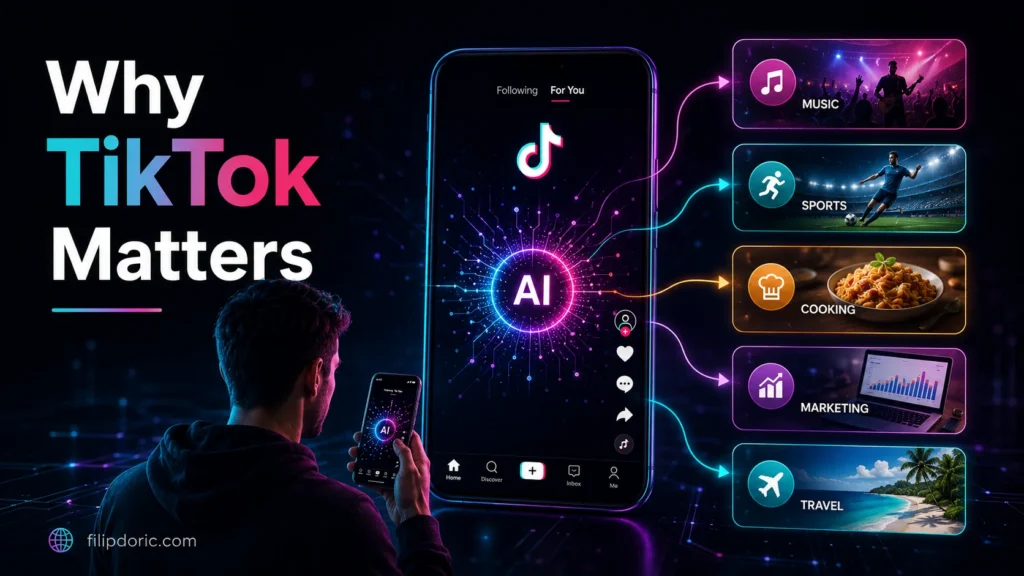
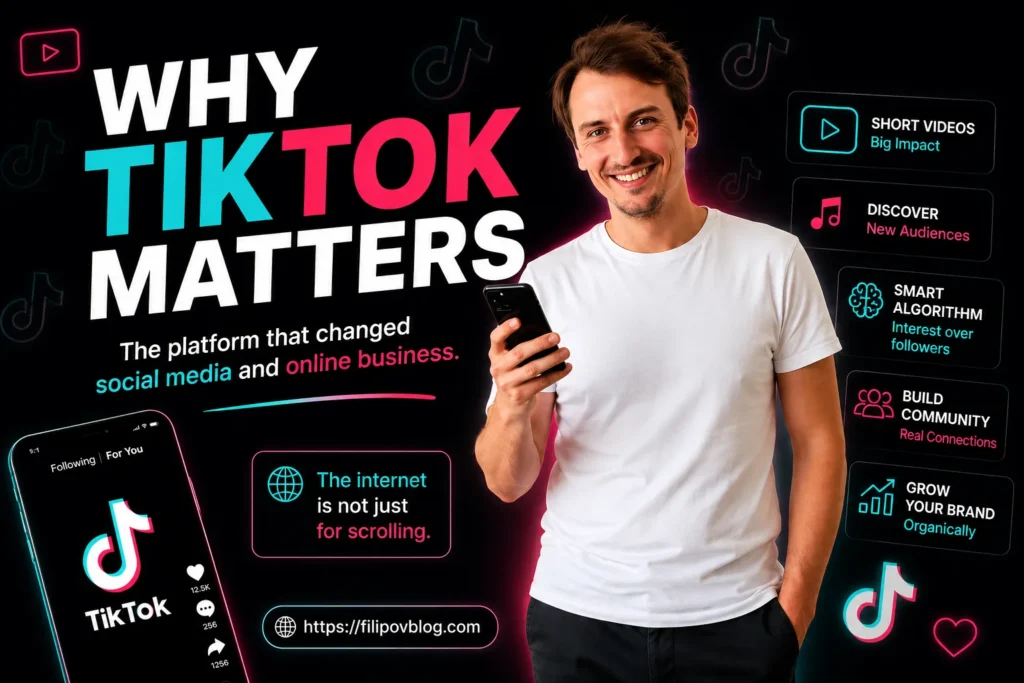
Why TikTok matters is not only a question about short videos.
It is not only a question about dances, trends, memes, or viral sounds.
It is a much bigger question.
Because TikTok changed the way people discover content.
It changed how creators think about followers.
It changed how businesses approach visibility.
And in many ways, it changed almost every major social media platform.
A few years ago, many people still said TikTok was only for kids.
Facebook was serious.
LinkedIn was professional.
Instagram was visual.
TikTok was often seen as a place for dancing, lip-syncing, and entertainment.
I understand that view.
For some time, I also did not see TikTok as my main platform.
I tested it.
I explored it.
I created content there.
But it never became my favorite social network.
If you have followed my content for a while, you probably know that Facebook has always felt more natural to me.
I like text.
I like groups.
I like conversations.
I like being able to combine articles, photos, videos, comments, and communities in one place.
TikTok is different.
But that does not mean we can ignore it.
Because the internet is not just for scrolling.
If we want to understand where online business, content creation, and digital ecosystems are going, we also need to understand the platforms that changed the rules.
And that is exactly why TikTok matters.
TikTok Changed the Meaning of Reach
For many years, social media worked in a fairly predictable way.
More followers usually meant more reach.
If you had a large audience, more people saw your content.
If you had a small audience, your content usually stayed small.
Of course, there were exceptions.
But in general, social platforms were built around the social graph.
You followed people.
They followed you.
Content moved mainly through existing connections.
TikTok changed that.
The platform made the interest graph much more important.
Instead of asking only who you follow, TikTok asked something different.
What do you actually watch?
What do you skip?
What do you watch again?
What do you share?
What do you comment on?
What keeps your attention?
This changed everything.
Suddenly, a creator with very few followers could reach thousands, hundreds of thousands, or even millions of people.
Not because they already had a massive audience.
But because one piece of content performed well.
That is one of the biggest reasons why TikTok matters in online business today.
It changed the belief that visibility only belongs to people who already have large audiences.
From Musical.ly to TikTok
TikTok did not appear from nowhere.
The story is connected to several important developments in short-form video.
Before TikTok became a global name, many younger users were already familiar with Musical.ly.
Musical.ly became popular as an app for lip-syncing, music clips, and short entertaining videos.
It was especially popular among teenagers.
At the same time, ByteDance, a Chinese technology company founded by Zhang Yiming, was developing a different kind of content recommendation system.
In 2016, ByteDance launched Douyin in China.
Then, in 2017, the international version appeared under the name TikTok.
In 2018, ByteDance acquired Musical.ly and merged it into TikTok.
That move helped TikTok grow quickly because millions of users were already familiar with short-form video culture.
Then came the pandemic.
People spent more time at home.
Video consumption increased.
Short-form entertainment exploded.
But something else also happened.
TikTok stopped being only about dancing and lip-syncing.
People started sharing:
- education
- recipes
- business advice
- technology tips
- music
- fitness
- comedy
- travel
- marketing
- personal stories
At that point, TikTok became much more than a youth entertainment app.
It became a major global content platform.
The Algorithm Was the Real Innovation
Many people think TikTok’s biggest innovation was short video.
I do not think that is fully true.
Short video existed before TikTok.
The bigger innovation was the algorithmic distribution system.
TikTok made the For You Page feel almost personal.
Sometimes strangely personal.
The platform learned from behavior quickly.
If you watched guitar videos, you saw more guitar videos.
If you watched cooking content, you saw more cooking content.
If you watched digital marketing tips, the algorithm started giving you more of that.
If you watched summer content, recipes, or even something simple like watermelon videos during the hot season, TikTok could quickly understand that interest and show you more similar content.
That is both powerful and slightly uncomfortable.
But from a content and business perspective, it is extremely important.
Because TikTok showed the entire internet that people do not always want to search.
Sometimes they want content to find them.
That shift changed user expectations.
And once users became used to that kind of discovery, other platforms had to respond.
Followers Became Less Important
This may be the biggest mental shift TikTok created.
Before TikTok, follower count was one of the strongest symbols of influence.
More followers meant more credibility.
More reach.
More opportunities.
TikTok made follower count less predictable.
On TikTok, a creator with 500 followers can sometimes get more views than a creator with 500,000 followers.
Because every video has to prove itself.
Watch time matters.
Replays matter.
Shares matter.
Comments matter.
Retention matters.
This created a new kind of content environment.
More democratic in some ways.
More unpredictable in others.
It gave new creators a chance.
But it also made consistency harder.
You could have one video explode and the next one disappear.
That is why TikTok can be exciting and frustrating at the same time.
Still, from a business point of view, this is one of the main reasons why TikTok matters.
It opened the door for people without large audiences to reach new viewers quickly.
Everyone Else Copied TikTok
TikTok did not only grow.
It forced other platforms to change.
Instagram introduced Reels.
Facebook began pushing short videos more strongly.
YouTube launched Shorts.
Snapchat created Spotlight.
Even platforms that were not originally built around short video started adapting to algorithmic discovery.
The entire social media landscape shifted.
This is why TikTok’s influence is larger than TikTok itself.
Even if you do not use TikTok, you are probably using platforms that were changed by TikTok.
Instagram Reels exist because of TikTok.
YouTube Shorts exist because of TikTok.
Short vertical video became one of the dominant formats online because TikTok proved how powerful it could be.
That is one of the clearest reasons why TikTok matters.
It changed the competition.
And when one platform changes how all the others behave, it becomes more than just another app.
It becomes a turning point.
TikTok for Business: Is It Right for You?
Now we come to the practical question.
Is TikTok right for your business?
The honest answer is:
It depends.
TikTok can be very useful if your business or personal brand can communicate through short, engaging, visual content.
It may work well for:
- creators
- educators
- coaches
- musicians
- product sellers
- local businesses
- personal brands
- digital marketers
- online business owners
- people comfortable with video
But that does not mean everyone must use it.
I do not believe every person needs to be active on every platform.
Actually, I believe the opposite.
Most people should not try to build a serious presence everywhere at once.
It is better to use one or two platforms well than to be present on seven platforms without a clear system.
TikTok is powerful.
But it requires a specific kind of energy.
Fast content.
Visual communication.
Regular testing.
Strong hooks.
Comfort with video.
If that fits your personality and business, it can be a great opportunity.
If it does not, another platform may be better.
The goal is not to chase every trend.
The goal is to understand which platform supports your long-term strategy.
My Own Experience With TikTok
I tested TikTok quite early.
I experimented with different types of content.
I wanted to understand how the platform worked.
I found it interesting.
But I also realized something about myself.
TikTok did not feel as natural to me as Facebook.
I enjoy writing longer thoughts.
I enjoy discussions.
I enjoy communities.
I enjoy combining different formats.
TikTok is much more focused around video-first communication.
That does not make it bad.
It simply means it has a different rhythm.
And this is important.
Sometimes people think they need to force themselves onto a platform because everyone says it is important.
But long-term content creation is difficult if the platform does not fit your style.
You can test.
You can learn.
You can adapt.
But you should also be honest with yourself.
For me, TikTok is a platform I respect.
A platform I study.
A platform I understand as important.
But not necessarily the platform where I feel most at home.
And that is fine.
TikTok and Organic Marketing
TikTok is often associated with viral reach.
But I do not think virality should be the main goal.
A viral video can bring attention.
But attention alone is not a business.
The better question is:
What happens after people discover you?
Do they understand what you do?
Do they trust you?
Do they visit your website?
Do they join your newsletter?
Do they start a conversation?
This is where organic marketing becomes important.
TikTok can help people discover you.
But your content still needs to provide value.
Teach something.
Entertain with purpose.
Share perspective.
Build trust.
Start conversations.
I have written more about organic marketing here:
The same principle applies to TikTok.
Before spending money on ads, understand your message.
Understand your audience.
Understand what people respond to.
Organic content gives you feedback that paid campaigns cannot replace.
TikTok Inside a Digital Ecosystem
This is where TikTok becomes especially interesting for me.
I do not look at platforms only as isolated tools anymore.
I look at them as parts of a larger digital ecosystem.
For example:
TikTok = Algorithmic Discovery
Instagram = Visual Trust
Facebook = Community
LinkedIn = Professional Authority
Pinterest = Search Discovery
X = Real-Time Conversation
Website = Ownership
Newsletter = Direct Relationship
Each platform has a different role.
TikTok can introduce you to people who have never heard of you before.
That is powerful.
But TikTok should not be the only place where your audience exists.
Your website gives people a deeper place to explore your work.
Your newsletter gives you a direct relationship.
Your community builds trust over time.
This is how I think about online business today.
Not as random posting.
Not as chasing algorithms.
But as building a connected system where each platform has a purpose.
That is another reason why TikTok matters.
Because it can be an important top-of-the-funnel channel when used strategically.
TikTok Changed Content Expectations
TikTok did more than popularize short videos.
It changed how people expect content to feel.
Fast.
Direct.
Human.
Less polished.
More immediate.
On older platforms, people often tried to create perfectly designed posts.
Perfect visuals.
Perfect captions.
Perfect branding.
TikTok made raw and authentic content more acceptable.
Sometimes even more effective.
A simple video filmed on a phone can outperform a polished production.
That changed creator culture.
It also changed how businesses communicate.
People want clarity.
They want personality.
They want useful information quickly.
This does not mean quality no longer matters.
Quality still matters.
But quality does not always mean expensive production.
Sometimes quality means relevance.
Timing.
Energy.
Usefulness.
Human connection.
The Risk of Endless Scrolling
Of course, TikTok also has a downside.
The same algorithm that makes discovery powerful can also make scrolling addictive.
You open the app for five minutes.
Then suddenly much more time has passed.
This is why I often return to the same idea:
The internet is not just for scrolling.
We need to use these platforms consciously.
As tools.
Not traps.
TikTok can teach you a lot about attention, communication, trends, and storytelling.
But if you only consume endlessly, it becomes a distraction.
The difference is intention.
Are you using the platform to learn, create, connect, and build?
Or are you simply being pulled into endless content?
That question matters for every social network.
But perhaps especially for TikTok.
My TikTok Profile
I may not use TikTok as intensively as some other platforms, but I still consider it worth exploring.
If you would like to connect with me there, you can find my TikTok profile here:
I plan to continue testing and observing how TikTok fits into the larger digital ecosystem.
Especially as short-form video continues influencing almost every other platform.
Final Thoughts
So, why TikTok matters is not only because TikTok became popular.
It matters because it changed the internet.
It changed social media algorithms.
It changed the meaning of followers.
It changed content discovery.
It changed how Instagram, YouTube, Facebook, and other platforms compete.
And it gave smaller creators a real chance to reach large audiences without already having a massive following.
That does not mean TikTok is perfect.
It does not mean everyone must use it.
And it does not mean it should become your entire online business.
But it does mean that TikTok deserves to be understood.
Especially if you are building an online presence, personal brand, digital project, or business system.
For me, TikTok is not necessarily my favorite platform.
But it is one of the most important platforms to study.
Because sometimes the platforms we do not use every day still shape the platforms we do use.
And that is exactly why TikTok matters.
Want to Go One Step Further?
Lately, I have been exploring business concepts that combine social networking, ecommerce, websites, newsletters, and digital infrastructure into one connected ecosystem.
The more I study platforms like TikTok, Instagram, Facebook, LinkedIn, Pinterest, X, and modern AI tools, the more I see the value of building systems instead of depending on one platform alone.
If this topic interests you, subscribe to my newsletter below.
As a thank-you, you’ll receive my free PDF:
Free Inbox Framework: Turn “I’m Interested” Into Real Conversations (No Pitching)
Inside, I share a simple framework I personally use to guide conversations naturally, build trust, and create stronger online relationships.
No hype.
No pressure.
Just practical ideas you can start using right away.
📬 Want more tips like this?
Subscribe to get fresh blog posts directly to your inbox.