
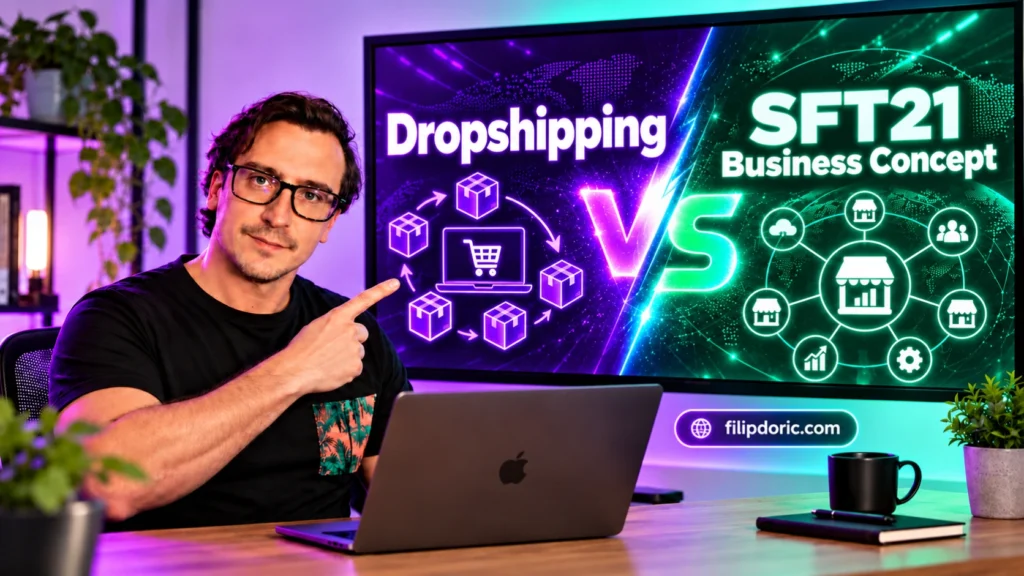
The dropshipping vs SFT21 Business Concept comparison becomes interesting when we stop looking only at products and start looking at everything required to build an online business around them.
Dropshipping solved an important ecommerce problem.
You can sell products without buying large amounts of inventory upfront or keeping boxes in your own warehouse.
That changed online commerce for thousands of entrepreneurs.
But removing the warehouse does not remove the business.
You still need a store.
Customers.
Marketing.
Payments.
Analytics.
Customer support.
Suppliers.
Content.
Traffic.
And a way to connect all those moving parts.
That is where the dropshipping vs SFT21 Business Concept comparison starts going in a very different direction.
One model primarily changes how products are fulfilled.
The other is being developed as a broader digital business infrastructure around ecommerce, community and participation.
First, What Exactly Is Dropshipping?
Dropshipping is an ecommerce fulfillment model.
The basic idea is relatively simple.
You create an online store and list products supplied by another company.
A customer places an order through your store.
Instead of keeping the product in your own warehouse and shipping it yourself, the supplier handles fulfillment.
Your role is largely focused on creating the store, generating sales and managing the customer relationship.
That can reduce one major barrier to ecommerce:
you do not necessarily need to purchase large quantities of inventory before making your first sale.
And that is a genuine advantage.
Traditional retail can require considerable capital.
Stock.
Storage.
Packaging.
Logistics.
Unsold inventory.
Dropshipping changes that part of the equation.
But it is important not to confuse:
“I don’t need my own warehouse”
with:
“I don’t need to build a business.”
Those are very different statements.
The Supplier Ships the Product — But Who Builds Everything Else?
This is where many simplified explanations of dropshipping stop too early.
The supplier may package and ship the product.
But someone still has to:
find the product,
evaluate the supplier,
build the store,
write the product pages,
connect payments,
create marketing,
attract visitors,
answer customers,
deal with refunds or delays,
measure performance,
and build trust around a store people may never have seen before.
Usually, that person is you.
Dropshipping removes part of the logistics burden.
It does not automatically provide the rest of the business infrastructure.
That distinction matters.
Finding Products Is Only One Side of Ecommerce
Search YouTube for dropshipping and you will quickly encounter videos about:
“winning products,”
trending products,
viral products,
and products that supposedly have enormous potential.
But even a genuinely good product does not sell itself.
You can have:
a beautiful Shopify store,
good photography,
a competitive price,
and a reliable supplier.
And still have no customers.
Then the real question becomes:
How do people find the store?
Maybe through Google.
Meta ads.
TikTok.
SEO.
Influencers.
Affiliate partners.
Content marketing.
Email.
Organic social media.
Suddenly, ecommerce becomes much more than selecting a product.
Distribution becomes just as important as inventory.
And this is one reason the idea of connecting ecommerce with a community becomes interesting.
Dropshipping vs SFT21 Business Concept Is Not an Identical Model Comparison
There is an important distinction to make before going further.
The dropshipping vs SFT21 Business Concept comparison is not really a comparison between two identical types of business model.
Dropshipping is primarily an ecommerce and fulfillment model.
SFT21 is being developed as a broader digital franchise and business ecosystem.
So I am not asking:
“Which dropshipping platform is better?”
The more useful question is:
How much of the online business infrastructure are you expected to assemble yourself?
That changes the comparison completely.
What the SFT21 Business Concept Is Trying to Connect
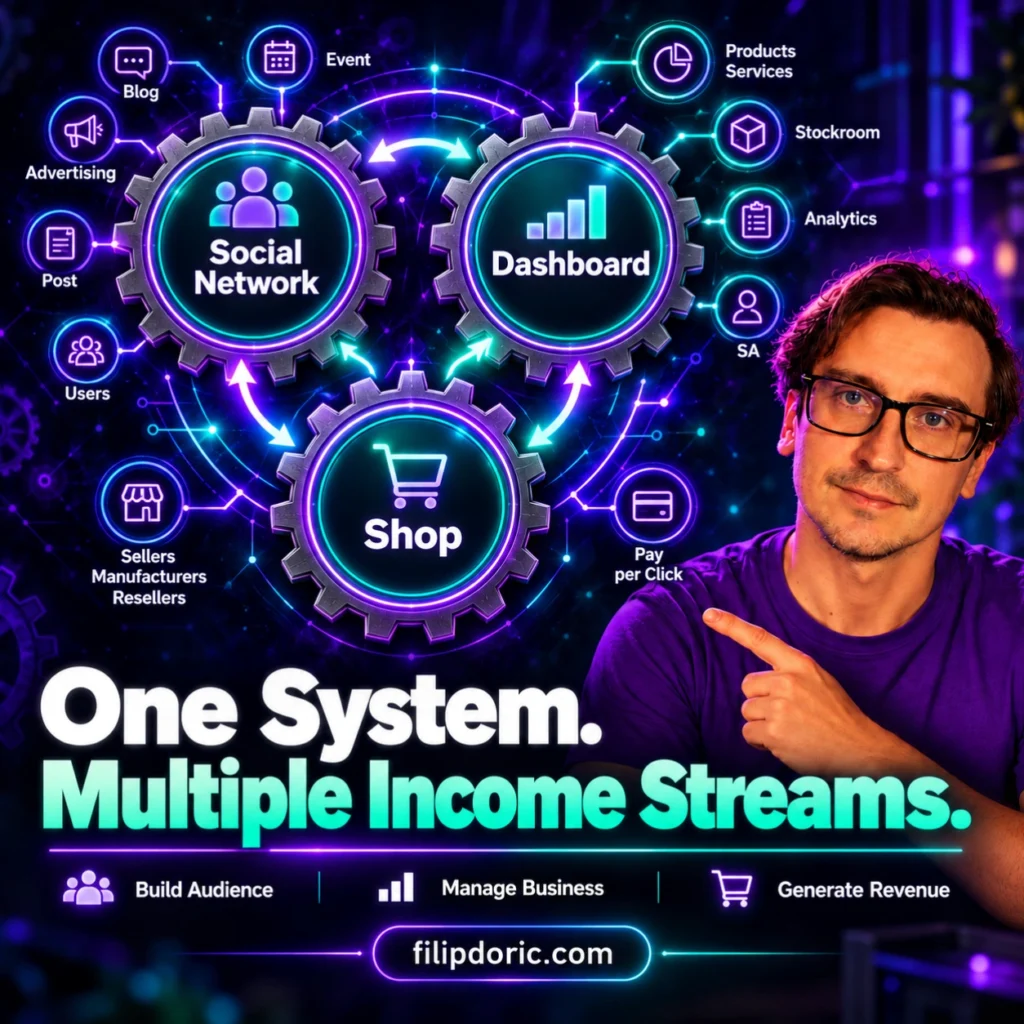
The SFT21 Business Concept is being built around three main digital layers:
SFshop – the ecommerce environment
SFnet – the verified social and community layer
SFoffice – the business dashboard and operational environment
The important idea is not simply that these three things exist.
There are already countless ecommerce platforms.
Countless social networks.
Countless dashboards.
The idea is that they are intended to work inside one connected ecosystem.
Shop.
Community.
Business infrastructure.
Users.
Products.
Business partners.
Franchisees.
Customers.
That creates a very different starting architecture from opening an independent dropshipping store and then connecting everything yourself.
SFshop: Ecommerce Inside a Wider System
With traditional dropshipping, you usually start by creating your store.
Then you need products.
Then suppliers.
Then traffic.
Then customers.
Then all the additional tools around those elements.
The SFT21 concept approaches ecommerce differently.
According to the currently presented model, SFshop is intended to provide franchise participants with ecommerce infrastructure connected to a wider product environment.
Instead of beginning with:
“Where can I find a supplier?”
the question could increasingly become:
“Which products available within this ecosystem make sense for the audience or market I want to serve?”
That is a different starting point.
The Croatian version of this comparison describes the planned model as giving franchise participants the ability to select products from a central virtual product environment and make selected offers available through their own shop infrastructure.
That potentially removes some of the fragmentation traditionally associated with finding products and connecting suppliers to a store.
SFnet Changes the Customer-Acquisition Question
This may be one of the most interesting differences.
Normally, the store and the audience exist in separate places.
Your Shopify store is here.
Your Instagram account is there.
Your Facebook community is somewhere else.
Your email list is in another tool.
Your analytics live in another dashboard.
And your customers need to move between all those environments.
With SFnet, SFT21 is attempting to build the social layer inside the wider ecosystem.
That could include:
users,
customers,
business owners,
creators,
producers,
franchise participants,
and people offering products and services.
The interesting question becomes:
What happens when ecommerce and community are designed to exist inside the same broader system?
That does not magically guarantee customers.
A social network still needs active users.
A shop still needs attractive products.
Businesses still need communication, marketing and trust.
But the architecture is different.
Instead of first creating an isolated store and then trying to build an audience around it, the store is intended to exist within an environment that already includes a community layer.
A Customer Does Not Need to Become a Business Partner
This is an important point whenever we talk about ecommerce inside a business opportunity.
If someone wants to buy a product, that person does not necessarily need to become a franchise participant.
A customer can simply be a customer.
Someone else may join because they are interested in the social network.
Another person may have products they want to distribute.
Someone may operate a business.
Someone else may become more involved with the franchise side.
Different users can have different roles inside the same ecosystem.
That distinction is important if the ecommerce layer is going to make sense as actual ecommerce.
SFoffice: The Business Side Behind the Store
Running an independent online business often means collecting dashboards.
One for your ecommerce platform.
One for payments.
Another for analytics.
One for email.
Another for affiliate tracking.
Another for hosting.
Another for marketing.
Eventually, your “online business” starts looking like fifteen browser tabs.
SFoffice is being developed as the central business dashboard within SFT21.
The idea is to bring operational information and business activity closer together instead of continuously adding unrelated systems.
This connects directly with another topic I recently explored:
SaaS vs Digital Franchise: What Makes SFT21 Different?
That article looks at the difference between simply accessing individual software tools and participating in a broader business structure where the software is being developed around the ecosystem itself.
The same distinction applies here.
The value is not necessarily another dashboard.
The potential value is integration.
Building Alone vs Building Inside Infrastructure
This is probably the biggest philosophical difference for me.
Independent online business gives you enormous freedom.
You choose your tools.
Your products.
Your platforms.
Your suppliers.
Your website.
Your marketing.
Your integrations.
But freedom also means responsibility.
You connect the pieces.
This is something I have written about separately when comparing building online alone with building inside a community and system.
The SFT21 approach is closer to:
the company builds the core infrastructure, while the individual builds activity within it.
That does not mean the franchise participant has nothing to do.
Quite the opposite.
The work simply shifts.
Instead of spending all your energy choosing plugins and integrating disconnected systems, more of your attention can potentially go toward:
content,
relationships,
promotion,
customers,
community,
products,
business connections,
and building your position inside the ecosystem.
Infrastructure does not remove work.
It changes which work you need to do.
Dropshipping Gives You Freedom – and Responsibility
This is also why I would not describe dropshipping as a bad model.
It can be extremely flexible.
You can choose almost everything.
Build your own brand.
Use Shopify or WooCommerce.
Choose suppliers from different parts of the world.
Experiment with niches.
Control the customer experience.
Change direction quickly.
For the right entrepreneur, that independence is valuable.
But you also carry much more responsibility for assembling the entire system.
The question is not:
“Is freedom good or bad?”
The question is:
“How much do I want to build and manage myself?”
Different people will answer differently.
Product Distribution Could Become Broader Than Traditional Dropshipping
There is another part of the SFT21 concept that I find interesting.
Dropshipping is often associated with sourcing products from large international supplier networks and selling them through independent stores.
But a connected ecommerce ecosystem can potentially work with many different types of providers.
Small manufacturers.
Local brands.
Existing businesses.
Digital products.
Services.
Specialized producers.
That makes the distribution question broader.
Instead of asking only:
“Which product can I import and resell?”
you can start asking:
“Which businesses and products could benefit from a connected digital distribution network?”
That creates possibilities far beyond the stereotype of a dropshipping store selling the latest trending gadget.
What About Affiliate Marketing?
This comparison also touches another online income model: affiliate marketing.
An affiliate marketer does not normally operate the store.
They recommend someone else’s product and receive a commission when qualifying sales happen.
Dropshipping is different.
The customer buys from your store, even though another supplier may fulfill the order.
And the SFT21 Business Concept introduces yet another structure where ecommerce, referrals, community participation and the wider franchise model can exist together.
If you want to understand that distinction more clearly, I have already written about how affiliate marketing differs from network-based models:
Solo Player or Community Builder? Discover Network Marketing
Understanding those differences matters because online business models often get grouped together simply because they all involve commissions or online sales.
They are not the same.
The Economic Model Goes Beyond One Product Margin
In a traditional dropshipping business, the basic economics are fairly easy to understand.
A customer pays for a product.
The supplier receives its part.
You have advertising, payment, platform and other costs.
Whatever remains contributes to your margin.
The SFT21 Business Concept adds another layer through its broader distribution model.
Under the currently presented structure, the company states that more than 80% of company profit is intended to be distributed back through its community-based economic system.
That changes the structure from:
“What margin did I make on this one product?”
toward a broader question:
“How does value move through the whole ecosystem?”
This is one of the reasons I do not see SFT21 simply as another ecommerce platform.
The ecommerce layer is only one part of the model.
Digital Franchise vs Online Course Is Another Useful Comparison
This same principle appears when comparing the model with education products.
An online course can teach you:
how to create a shop,
how to run ads,
how to research products,
or how to build funnels.
Useful knowledge.
But after learning, you still need somewhere to apply it.
That is why I previously wrote:
Digital Franchise vs Online Courses: What Most People Miss – filipdoric.com
The central distinction there is similar.
Information and infrastructure are not the same thing.
A course can teach you how something works.
A business system attempts to give you an environment in which to operate.
And that brings us back to dropshipping.
You can learn everything about dropshipping.
You still need to build the business around it.
What Does the Franchise Participant Actually Do?
If SFT21 develops the infrastructure, what remains for the franchise participant?
A lot.
Potential activities include:
building relationships,
creating content,
presenting products,
communicating with customers,
building trust,
increasing visibility,
connecting businesses or producers,
and, for those who choose that direction, developing a team.
The Croatian article (for content in Croatian visit https://digitalnafransiza.com) puts this particularly well:
the franchise does not remove work; it attempts to remove the need for each individual to invent every technical and business component independently.
That is exactly how I see the distinction.
Dropshipping vs SFT21 Business Concept: The Biggest Difference
If I had to reduce this entire comparison to one idea, it would be this:
Dropshipping removes the need to personally stock every product.
The SFT21 Business Concept is attempting to reduce the need to personally build every layer of the wider business infrastructure.
Those are different ambitions.
Dropshipping asks:
Do I need my own warehouse?
The digital franchise model asks:
Do I need to build the shop, community, business dashboard, product environment and wider infrastructure independently?
And that is why this comparison interests me.
Not because I expect dropshipping to disappear.
It will not.
The model solves a real problem.
But ecommerce continues to evolve.
The next step may not simply be finding a better product or faster supplier.
It may be finding better ways to connect:
products + customers + community + software + business infrastructure.
One System Instead of Twenty Pieces?
That is ultimately the broader idea behind SFT21.
SFoffice + SFnet + SFshop.
Business infrastructure.
Community.
Ecommerce.
Connected instead of completely separate.
The complete system is still being developed, and its real-world value will ultimately depend on execution and adoption.
That matters.
A concept can look excellent on paper.
Software still has to work.
People still need to use it.
Customers need reasons to buy.
Businesses need reasons to participate.
Communities need activity.
But if those pieces are successfully connected, the result would be very different from launching another standalone ecommerce store.
It would be closer to participating inside a digital business ecosystem.
Do You Want to Build Every Piece Yourself?
I think that is the most useful final question in the dropshipping vs SFT21 Business Concept discussion.
Some entrepreneurs genuinely enjoy building everything.
Choosing hosting.
Designing stores.
Connecting payment providers.
Finding suppliers.
Running advertising.
Installing software.
Testing integrations.
Creating automation.
And there is nothing wrong with that.
Others may prefer entering a structure where much of the infrastructure is already being developed and focusing their energy on business activity rather than assembling the underlying system.
Neither preference is universally correct.
But they lead to very different ways of building online.
And that is why I continue following the SFT21 Business Concept.
It is attempting to answer a question that becomes more relevant as online business becomes more complicated:
What if you did not have to connect every piece alone?
Dropshipping showed us that you do not necessarily need to own a warehouse to participate in ecommerce.
Perhaps the next evolution is asking how much more of the surrounding infrastructure can also become connected.
Not one product.
Not one tool.
Not one shop.
A system.
If you want to follow the development of SFoffice, SFnet, SFshop and the wider SFT21 Business Concept, join my newsletter.
I share new articles, practical explanations and updates as the digital franchise ecosystem develops.
If you are exploring ecommerce, affiliate marketing, freelancing, content creation or other ways of building online, understanding how those individual models can eventually connect into a wider system may be worth watching.
The internet is more than a place to scroll. It is also a place to build.
📬 Want more tips like this?
Subscribe to get fresh blog posts directly to your inbox.


