The freelancer vs influencer comparison looks simple at first.
Both can work from a laptop.
Both can use social media.
Both can build a personal brand.
Both can make money online.
But underneath that surface, they are often building two very different types of online business.
A freelancer primarily creates value through a skill and a result.
An influencer primarily creates value through attention, trust and distribution.
One builds around what they can do.
The other builds around who they can reach.
And once you understand that distinction, something even more interesting becomes visible:
the strongest long-term model may not always be choosing one or the other. It may be learning how to connect both.
Freelancer vs Influencer: Two Different Income Engines
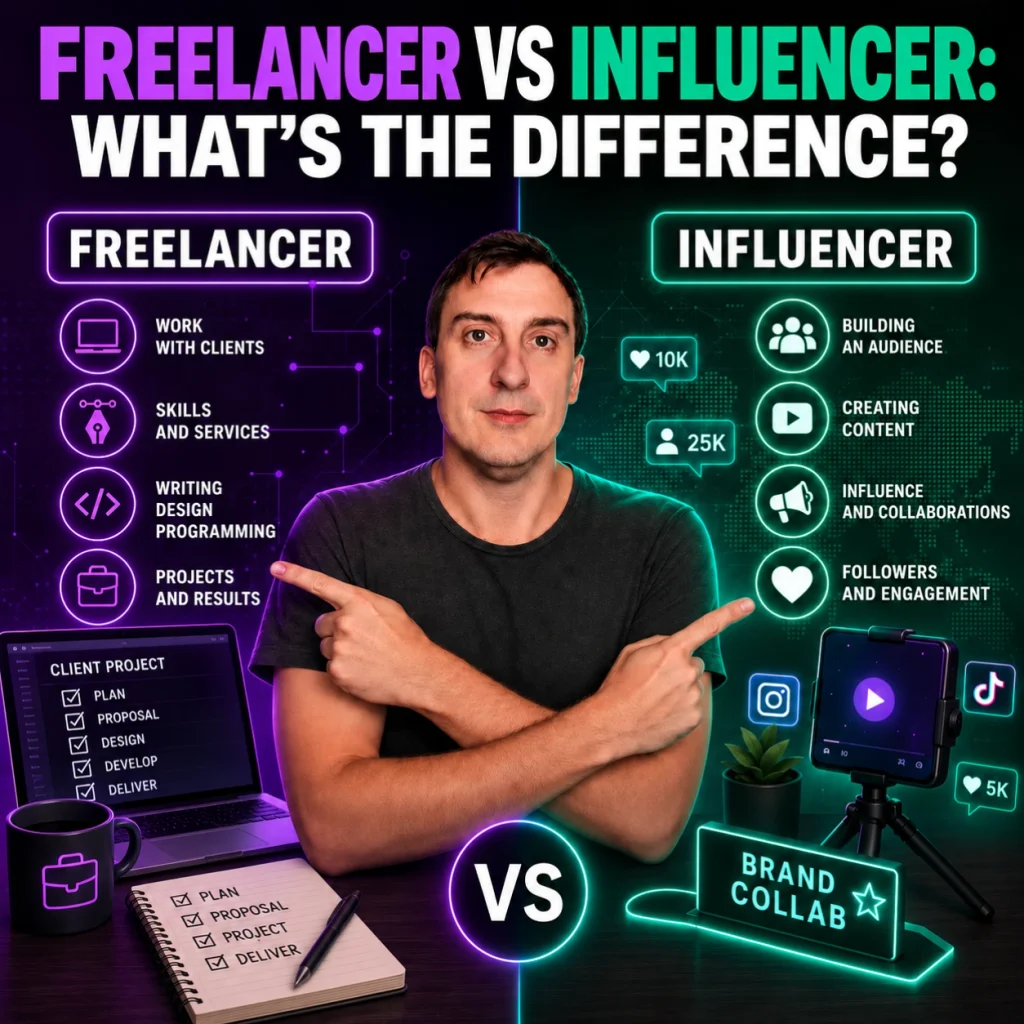
I like thinking about this as two different engines.
A freelancer operates mainly inside the skill economy.
Someone has a problem.
You have a skill that can solve it.
They pay you to produce a result.
A company needs a website.
A video needs editing.
A business needs copy.
A brand needs graphics.
A website needs SEO work.
The freelancer delivers the work and gets paid.
An influencer operates much more inside the attention economy.
The asset is different.
They have built an audience around a topic, personality, interest or point of view.
A company wants to reach that audience.
The influencer provides access through content.
That can eventually lead to sponsored posts, partnerships, affiliate commissions, products, memberships and other forms of monetization.
Both are legitimate online business models.
But the economic engine underneath them is different.
A Freelancer Builds Capability
Imagine a talented video editor.
She may have only 300 Instagram followers.
That does not prevent her from earning money online.
If she can edit a strong promotional video for a company, the client does not necessarily care whether she is famous.
The client cares about questions such as:
Can she do the work?
Is the quality good?
Can she deliver on time?
Does she understand what we need?
Her portfolio may matter considerably more than her follower count.
That is one of the attractive things about freelancing.
You can potentially monetize a valuable skill before you build a large audience.
Your first customer does not need to be one of 100,000 followers.
You need one person or business with a problem you know how to solve.
An Influencer Builds Distribution
Now imagine someone else.
He creates travel content.
Over several years, he builds an audience that regularly follows his hotel reviews, destination recommendations and travel tips.
A luggage company approaches him.
They are not hiring him because they need a suitcase designed.
They are interested because thousands of people who care about travel already pay attention to what he says.
The asset is distribution.
But I would go one step further.
It is not just reach.
A million random views can sometimes be less useful than a smaller audience that genuinely trusts the creator.
What makes an influencer valuable is usually some combination of:
attention, relevance, credibility and trust.
That is why a smaller creator in a very specific niche can sometimes be commercially interesting even without celebrity-level numbers.
What Are You Actually Building?
This is where the freelancer vs influencer discussion becomes more useful than simply defining two words.
Ask yourself:
What asset am I building?
For the freelancer, it may be:
- expertise
- experience
- a portfolio
- client relationships
- reputation
- systems for delivering work
For the influencer or creator, it may be:
- an audience
- content
- trust
- distribution
- a recognizable identity
- a community
Neither list is automatically better.
They simply create value differently.
And both have weaknesses.
The Freelancer Has a Time Problem
Freelancing can offer a lot of freedom.
I know that world well.
You can choose projects.
Work remotely.
Develop specialized skills.
Serve clients in different countries.
Increase your rates as your experience grows.
But traditional freelancing has an obvious limitation.
Your time remains closely connected to your income.
You finish one project.
Then you need another.
You complete that project.
Then another client needs something.
Even with retainers and long-term clients, capacity eventually becomes an issue.
There are only so many projects one person can handle well.
You can raise your prices.
Build an agency.
Delegate.
Create standardized packages.
Automate some work.
All of those can help.
But eventually many freelancers start asking:
Can something I create once continue producing value without requiring the same amount of my time every time?
That question often leads them toward content, digital products, affiliate marketing, education or community building.
The Influencer Has a Platform Problem
The influencer has a different weakness.
They may not be exchanging every working hour for a client payment.
But much of their business can depend on platforms they do not control.
Instagram changes.
YouTube changes.
TikTok changes.
Facebook changes.
Algorithms change.
Reach changes.
The type of content platforms prioritize changes.
A creator can spend years building an audience and still discover that reaching that same audience has become harder.
That does not make social media a bad place to build.
I use social platforms constantly.
They are incredible distribution systems.
But followers are not exactly the same thing as an asset you completely control.
That is why I keep coming back to:
your website, your email list, your content library and your own products or services.
Social media can bring people into your world.
But ideally, there should be more to that world than a social profile.
The Interesting Part Is Where the Two Models Meet
This is where modern online business gets much more interesting.
Imagine a WordPress freelancer.
For years, he builds websites for clients.
Then he starts publishing practical WordPress tutorials.
At first, perhaps 50 people read them.
Then 500.
Then some of those readers subscribe to his newsletter.
He starts a YouTube channel.
He recommends hosting products he genuinely uses.
He creates a website checklist.
Later, perhaps a template or small digital product.
What is he now?
Still a freelancer?
Yes.
Content creator?
Also yes.
Affiliate marketer?
Possibly.
Educator?
Maybe.
Influencer?
Depending on how we define it, perhaps that too.
The internet does not require us to remain inside one business-model box.
That is one of the biggest opportunities I see.
A Creator Can Move in the Other Direction Too
The movement can happen from the opposite direction.
Imagine someone spends several years creating content around short-form video.
She learns:
how hooks work,
how to edit,
how to structure videos,
how platforms distribute content,
how brands communicate,
and what keeps viewers watching.
Eventually, a company asks:
“Could you create our short-form content?”
Now she is no longer monetizing only her audience.
She is monetizing a skill she developed while building that audience.
Another company may ask her to manage its channel.
Another may want consulting.
Suddenly, a creator business starts producing freelance or consulting opportunities.
The labels begin to overlap.
That is normal.
Audience and Skill Can Strengthen Each Other
This is why I particularly like hybrid models.
A freelancer with an audience has an advantage.
Instead of constantly finding every new prospect manually, content can help potential customers discover them.
Their articles demonstrate expertise.
Their videos answer questions.
Their newsletter builds familiarity.
Their website gives potential customers somewhere to learn more.
The audience becomes part of their acquisition system.
At the same time, an influencer with a real professional skill has another advantage.
They do not have to depend entirely on sponsorships.
They may be able to offer:
consulting,
services,
education,
templates,
digital products,
or specialized expertise.
Skill creates another form of monetization. Audience creates another form of distribution.
Put them together and the business can become much more resilient.
The Goal Does Not Have to Be “Become an Influencer”
Some people hear “build an audience” and immediately imagine they need to become an influencer.
I do not think that is necessary.
A freelancer does not need millions of followers.
They may not even want 100,000.
Imagine you are a highly specialized consultant.
If 2,000 relevant people follow your work — including business owners who actually need what you do — that audience can be considerably more useful than 100,000 unrelated followers.
The same applies to newsletters.
A small email list of people genuinely interested in your expertise can become a meaningful digital asset.
The goal is not necessarily fame.
The goal is connection with the right people.
The Goal Does Not Have to Be “Get More Clients” Either
The reverse is also true.
Freelancers are often taught to think almost entirely in terms of clients.
How do I get another client?
Where do I find another project?
How do I send more proposals?
Those questions matter.
But I think there is another useful question:
What am I building while I serve those clients?
After five years, do you have only completed invoices?
Or do you also have:
a recognizable brand,
a useful website,
searchable content,
an email audience,
case studies,
a network,
a digital product,
affiliate relationships,
or a community?
Your client work can pay you today.
Some of those other assets can continue creating opportunities tomorrow.
Different Models Create Different Types of Leverage
This is another useful way to understand freelancer vs influencer.
A traditional freelancer creates leverage primarily through expertise.
Become better.
Work faster.
Charge more.
Specialize.
Develop systems.
An influencer creates leverage primarily through distribution.
One piece of content can reach thousands of people.
One recommendation can influence many buying decisions.
One video can continue generating views.
But modern online entrepreneurs can add more forms of leverage.
Content.
Software.
Email.
Products.
Affiliate relationships.
Community.
Automation.
Ecommerce.
Different pieces can support each other.
That is where we move away from thinking only about individual income methods and start thinking about online income systems.
Do You Need Multiple Income Streams?
Not necessarily.
There is nothing wrong with having one excellent income source.
If you have a profitable freelance business with clients you enjoy working with, you do not need to add seven complicated side projects simply because someone on the internet told you to “diversify.”
The same applies to creators.
More monetization methods do not automatically create a better business.
Sometimes they simply create more work.
But there is value in understanding what options exist.
A freelancer could eventually add affiliate income.
A creator could sell a digital product.
Either could build an ecommerce element.
Both could use a newsletter.
Both could participate in a wider business community.
Multiple income streams make sense when they connect naturally with what you are already building.
They should not feel like seven random businesses taped together.
From Individual Income Methods to a Digital Ecosystem
This is one of the reasons I increasingly use the term digital ecosystem.
Consider what happens when several elements start working together.
Someone discovers you through social media.
They read an article on your website.
They join your newsletter.
Later they buy a product.
Or hire you.
Or use an affiliate recommendation.
Or join your community.
The website supports the social content.
The social content feeds the newsletter.
The newsletter brings people back to the website.
The content builds trust.
The products create another income layer.
That is a system.
It is very different from constantly asking:
“What is the next platform where I can make money?”
The individual tools matter less than the way they connect.
Freelancer vs Influencer May Be the Wrong Final Question
At the beginning, the distinction is useful.
A freelancer primarily monetizes skill and delivery.
An influencer primarily monetizes attention and trust.
But after that, I think a more interesting question appears:
What are you building around your initial advantage?
If your advantage is skill, can you gradually build distribution?
If your advantage is attention, can you build products, services or assets behind it?
Can you own part of your audience relationship?
Can you create something that does not disappear with the next algorithm change?
Can you connect multiple digital activities into one coherent system?
Those questions are much more interesting to me than deciding which label belongs in your bio.
You Can Be More Than One Thing Online
The internet has blurred professional boundaries.
A designer can become an educator.
A developer can become a creator.
A YouTuber can become a business owner.
A freelancer can become an affiliate marketer.
An influencer can become a consultant.
A blogger can sell products.
A business owner can build a community.
You do not need to choose one identity forever.
The important thing is understanding how each activity creates value and where the income actually comes from.
That makes it much easier to decide what belongs in your system and what does not.
So, Freelancer or Influencer?
If you want the shortest possible version:
A freelancer is primarily paid for what they can do.
An influencer is primarily paid because of the attention and trust they have built with an audience.
But modern online business allows those worlds to overlap.
A freelancer can turn expertise into content.
A creator can turn experience into a service.
Both can build products.
Both can use affiliate marketing.
Both can build newsletters.
Both can create communities.
And both can move beyond relying on one platform or one source of income.
That is where this discussion becomes bigger than freelancer vs influencer.
It becomes a conversation about building something online that has multiple connected layers.
What Are You Building Online?
Maybe you are currently a freelancer.
Maybe you are an influencer or content creator.
Maybe neither label really fits.
That is fine.
The more useful question may be:
What are you building around the work you already do?
A skill?
An audience?
A brand?
A website?
A newsletter?
Products?
Relationships?
A community?
Or eventually, a system that connects several of them?
Because the internet gives us something previous generations of independent workers did not have at this scale:
the ability to build skill, distribution and digital assets at the same time.
And that creates far more possibilities than either label suggests.
One System, Multiple Possibilities
Whether you are a freelancer or influencer, there is one more project I think could be interesting to people who are already thinking beyond a single source of online income.
I am part of a team preparing a digital franchise ecosystem designed to connect several business layers within one system.
The wider concept includes a business dashboard, a verified social network, ecommerce infrastructure, community participation and multiple potential income streams within the same ecosystem.
It is a different direction from simply adding another freelance platform or another social media account.
And it is one of the reasons I spend so much time writing about online income systems and digital ecosystems here.
If you want to understand what we are building before the wider launch, join my newsletter.
I share new articles, explanations and project updates as the ecosystem develops.
No matter whether you currently earn through skills, content, an audience, products – or a combination of all of them – the next interesting question may be how those pieces can work together.
📬 Want more tips like this?
Subscribe to get fresh blog posts directly to your inbox.