
The internet is more than a place to scroll.
That sentence has become one of the simplest ways I can explain how I think about the online world.
We spend hours online.
We watch videos.
Read comments.
Open apps.
Check notifications.
Follow people.
Like posts.
Scroll.
And scroll some more.
There is nothing wrong with entertainment.
I do all of those things too.
But somewhere along the way, I think many of us forgot something important.
The internet is also one of the most powerful tools ever created for building something of your own.
A website.
A skill.
A reputation.
An audience.
An email list.
A small business.
A digital product.
A community.
A second source of income.
Or simply a body of work that did not exist before you created it.
That is why I keep coming back to this idea:
The internet is more than a place to scroll.
It can be a place to build.
We Spend More Time Online Than Ever
Think about how many parts of everyday life now happen through the internet.
We communicate online.
We shop online.
We learn online.
We work online.
We listen to music online.
We watch television online.
We search for restaurants, products, advice, jobs, directions and people online.
Even businesses that operate primarily offline depend heavily on the digital world.
A restaurant needs visibility.
A tradesperson can be discovered through search.
A local producer can reach customers outside the local area.
A consultant can work with someone on another continent.
A musician can distribute music globally without a traditional record store.
The internet is no longer something separate from the “real world.”
It has become infrastructure for the real world.
And once you start looking at it that way, your relationship with it changes.
Social Media Is Not the Internet
For many people, social media has effectively become the internet.
Open the phone.
Open Facebook.
Instagram.
TikTok.
YouTube.
Scroll.
Close the phone.
Repeat later.
But Facebook is not the internet.
Instagram is not the internet.
TikTok is not the internet.
They are platforms on the internet.
That distinction matters more than it may seem.
When you build your entire online presence on one social platform, you are building inside somebody else’s environment.
You do not control the algorithm.
You do not control reach.
You do not control which features stay.
You do not control whether the platform suddenly changes its priorities.
And sometimes you do not even have full control over whether your account continues to exist.
That does not mean social media is bad.
I use it.
It is extremely useful.
It can help you meet people, distribute ideas, discover opportunities and build relationships much faster than would have been possible in the past.
But I prefer thinking of social media as one layer of an online presence, not the entire thing.
Ask a Different Question
A lot of online activity revolves around numbers.
How many followers?
How many likes?
How many views?
How much reach?
Those numbers can be useful.
But I think another question is more important:
What are you building while you are online?
Imagine spending three years creating content on a platform.
At the end of those three years, what do you have?
Followers?
Useful.
But what else?
Do you have a website?
Do you have content that people can find through search?
Do you have an email list?
Do you have a portfolio?
A product?
A skill?
A network?
A community?
Something you can move from one platform to another?
Something that becomes more valuable over time?
That is where the idea that the internet is more than a place to scroll starts becoming practical.
The goal is not simply to spend less time online.
The goal is to use at least some of that time differently.
Create Something That Can Still Exist Tomorrow
One of the things I like about having a website is that it gives your online activity a home.
A social media post can disappear from someone’s feed within hours.
A good article can still be discovered months or years later.
That is a very different type of asset.
The same principle applies to other things.
A newsletter subscriber can hear from you again.
A useful video can continue getting views.
A tutorial can continue helping people.
A digital product can continue being sold.
A portfolio can continue showing what you know how to do.
A reputation can continue opening conversations.
None of those things are guaranteed to become valuable.
But they have one characteristic I find important:
they can accumulate.
Scroll disappears.
Building compounds.
You Do Not Need to Build a Huge Business
When people hear words like “online business,” they sometimes imagine that the next step must be dramatic.
Quit your job.
Create a company.
Build a huge ecommerce operation.
Become an influencer.
Make six figures.
No.
That is exactly the kind of thinking that makes the internet feel more complicated than it needs to be.
You can start much smaller.
You can use the internet to earn additional income without trying to create the next Amazon.
You can learn a freelance skill.
You can recommend products through affiliate marketing.
You can create a simple digital product.
You can start a niche blog.
You can sell something you already know how to make.
You can help a local business improve its website.
You can start an email newsletter around something you understand well.
The size of the first step matters much less than the fact that you move from pure consumption toward some form of creation.
The Internet Gives You Access to Distribution
This is perhaps one of the most important changes brought by the internet.
In the past, having an idea was not enough.
You also needed access to distribution.
Want to publish?
You needed a publisher.
Want to reach a large audience?
You needed traditional media.
Want to open a shop?
You needed physical space, inventory and local foot traffic.
Want to sell internationally?
That became much more complicated.
Today, an individual can publish globally in minutes.
That does not mean people will automatically care.
Distribution is available.
Attention still has to be earned.
But the door exists.
A person with a laptop can write an article, upload a video, launch a product, recommend a service, build an email list or communicate with customers on the other side of the world.
That is easy to take for granted because it has become normal.
But it is historically unusual.
Start With What You Already Know
One mistake beginners often make is assuming they need to invent something completely new.
Usually they do not.
You can begin with knowledge you already have.
Maybe you have used several hosting providers and can explain which one worked best for you.
Maybe you know how to repair bicycles.
Maybe you understand accounting.
Maybe you cook.
Maybe you know WordPress.
Maybe you train regularly and understand certain equipment.
Maybe you have travelled extensively.
Maybe you know a specific industry better than most people.
There are probably questions you can answer today that someone else is searching for right now.
That does not automatically make you an expert.
It makes you potentially useful.
And usefulness is one of the best places to start online.
Content Can Become Infrastructure
I used to think about content mostly as individual posts.
Now I think about it differently.
A good piece of content can become part of a larger structure.
One article links to another.
A social post leads to an article.
An article leads to a newsletter.
A newsletter brings someone back to the website.
A product or service becomes relevant later.
A reader becomes part of a community.
Suddenly you are no longer creating isolated posts.
You are creating pathways.
That is where digital ecosystem thinking begins.
And this is one of the biggest changes in the way I now look at online business.
The Problem Is Not a Lack of Tools
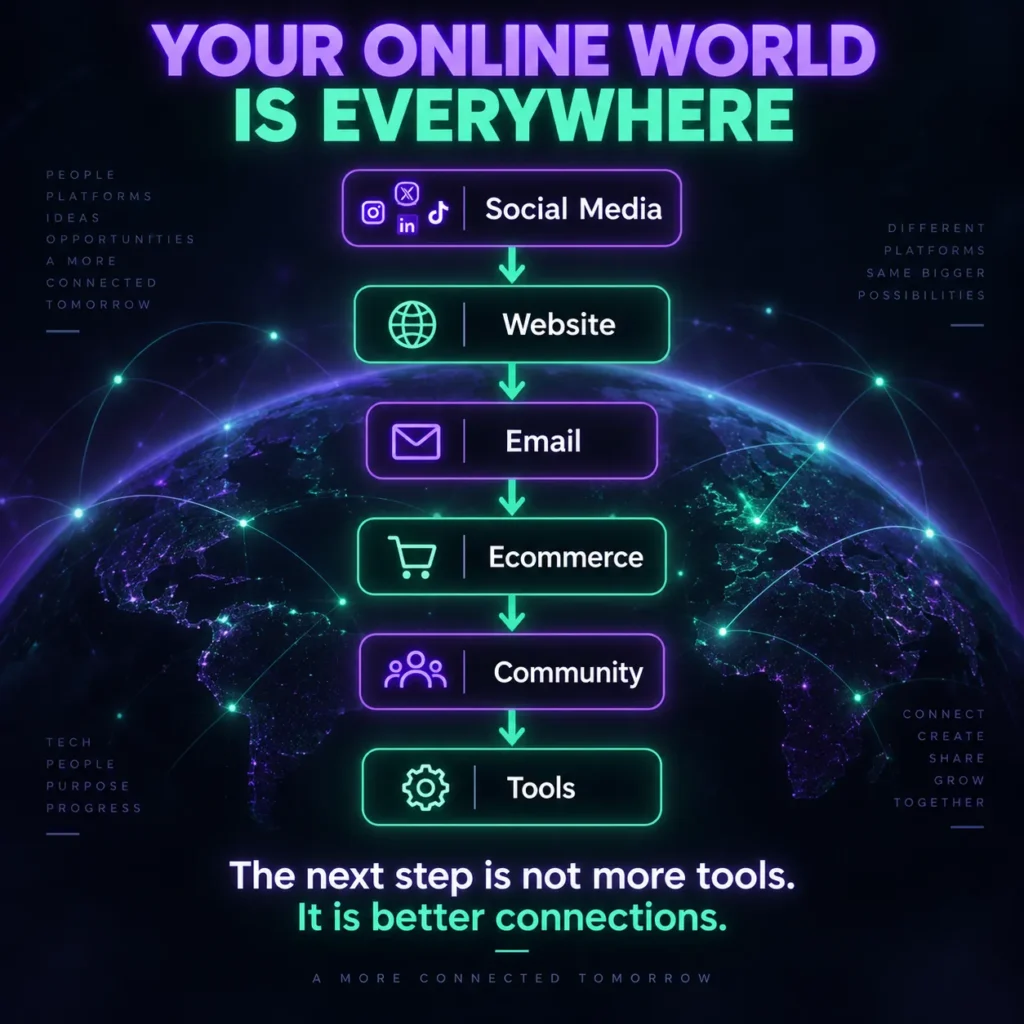
We have more digital tools than ever.
Sometimes the real problem is the opposite.
Too many tools.
Your social audience is in one place.
Your website is somewhere else.
Your newsletter is on another platform.
Your products use another system.
Payments happen elsewhere.
Your community exists somewhere else again.
Then you add:
analytics,
automation,
scheduling,
CRM,
AI,
cloud storage,
messaging,
video,
design tools.
Eventually your “simple online business” can involve fifteen different logins.
That is why I have become increasingly interested in connected digital systems.
The next phase of online business may not be about finding another tool.
It may be about connecting the tools, audiences and activities we already have.
A website should not exist in isolation.
Neither should social media.
Neither should email.
Neither should ecommerce.
The connections between them can become as important as the individual tools themselves.
Traffic Is Only the Beginning
Traffic is one of the most discussed words in online marketing.
Get more visitors.
More clicks.
More impressions.
More reach.
And yes, traffic matters.
Without people, nothing happens.
But traffic by itself does not create much.
Imagine a shop with 10,000 visitors.
There is nothing on the shelves.
Nobody helps them.
Nobody asks what they need.
There is no reason to come back.
All 10,000 leave.
Great traffic.
Terrible system.
Online, the same thing happens all the time.
People chase views but have nowhere meaningful to send those viewers.
Or they gain followers but have no relationship beyond the platform.
Or they receive website visitors but give them no reason to return.
The better question is:
What happens after somebody finds you?
Can they go deeper?
Can they read something useful?
Can they subscribe?
Can they ask a question?
Can they discover another part of your work?
Can they come back?
That is when attention begins turning into something you can actually build on.
A Website Can Become Your Digital Home
I am still a believer in websites.
Not because websites are new.
Exactly the opposite.
They have survived a lot of trends.
Social platforms change.
Algorithms change.
People move from one app to another.
A website gives you somewhere central to bring things together.
Your work.
Your story.
Your content.
Your services.
Your recommendations.
Your products.
Your contact information.
Your newsletter.
Your other channels.
It does not need to be complicated.
In fact, simpler is often better.
The important thing is that there is somewhere online that represents you, rather than only your profile inside somebody else’s platform.
Email Is Old – and That Is Part of Its Strength
Email does not look exciting compared with the newest social network.
That may actually be one of its strengths.
People have been declaring email dead for years.
It keeps working.
When someone subscribes to your newsletter, you gain another way to continue the relationship beyond an algorithmic feed.
You can publish something today and send it directly to people who chose to hear from you.
That is powerful.
Not because every email will be opened.
Not because email is perfect.
But because it adds another layer to your online presence.
Social media may create discovery.
Your website can provide depth.
Email can help the relationship continue.
Again, the important part is the connection between the pieces.
Online Income Does Not Have to Begin With a Big Investment
Another reason I think this topic matters is that many people are interested in earning online but assume they need significant capital.
Sometimes they do.
Certain business models require investment.
Others can be started much more gradually.
Affiliate marketing is one example.
You do not need to create the product.
A company creates it.
You recommend something useful.
If someone makes a qualifying purchase through your affiliate link, you can earn a commission.
Freelancing can start with a skill.
Content creation can start with knowledge and time.
A newsletter can begin with an email platform and something useful to say.
None of these models guarantees income.
But they demonstrate something important:
building online does not always have to begin with a huge financial commitment.
Sometimes it begins with learning how the internet actually works.
Do Not Confuse Opportunity With Easy Money
There is an important distinction here.
The internet provides opportunity.
It does not provide automatic success.
That is where a lot of online marketing goes wrong.
People see that the internet allows someone to build a business from a laptop and turn that into:
“Anyone can make money easily.”
Those are not the same statement.
Competition exists.
Skills matter.
Trust matters.
Execution matters.
Timing matters.
Consistency matters.
And sometimes things simply do not work.
That is normal.
I am much more interested in understanding what is possible than pretending every possibility becomes a guaranteed result.
You can recognize opportunity without turning it into hype.
Build Something Connected
This is where all of these ideas eventually meet for me.
A website by itself is useful.
Email by itself is useful.
Social media is useful.
Affiliate marketing can be useful.
Ecommerce can be useful.
Communities can be useful.
Digital products can be useful.
But what becomes especially interesting is when the pieces begin working together.
One channel feeds another.
One piece of content supports another.
A visitor does not disappear after the first click.
The system becomes more connected.
That is the direction I have increasingly been exploring through my work and writing.
Not just individual online tactics.
Digital ecosystems.
Systems.
Structure.
Connected digital activity.
And business models that attempt to bring more of those pieces together.
Start With One Thing
If this all sounds like a lot, ignore most of it for now.
You do not need a complete digital ecosystem tomorrow.
You do not need a perfect website.
You do not need ten social networks.
You do not need an ecommerce operation and sophisticated automation.
Start with one thing.
Create instead of consume for an hour.
Publish something useful.
Learn one skill.
Start a simple website.
Write your first article.
Make your first useful video.
Research an affiliate program for a product you already know.
Start collecting email subscribers.
Help one person.
Then add another piece when it makes sense.
You build systems gradually.
The Internet Is More Than a Place to Scroll
That is why this phrase continues to matter to me.
The internet is more than a place to scroll.
It is a place to learn.
Create.
Connect.
Publish.
Sell.
Recommend.
Communicate.
Build relationships.
Build skills.
Build assets.
And sometimes build a business.
You do not need to use every opportunity it offers.
Nobody does.
But perhaps the next time you open your phone and automatically start scrolling, ask yourself one question:
Could I create something today instead?
One article.
One idea.
One page.
One connection.
One useful answer.
Something small.
Something that exists because you decided not only to consume the internet, but to participate in building it.
That is where things become interesting.
Want to Explore What You Can Build Online?
On filipdoric.com, I write about online business, affiliate marketing, websites, ecommerce, email, digital tools, communities and the development of connected digital ecosystems.
If those topics interest you, you can also join my newsletter and follow new articles and ideas as I publish them.
No need to figure everything out today.
Start with one useful step. Then build from there.
📬 Want more tips like this?
Subscribe to get fresh blog posts directly to your inbox.