A Shopify online store gives you something very different from selling on a marketplace such as Amazon or Etsy.
You are not simply placing a product inside someone else’s digital shopping center.
You are building your own store.
Your domain.
Your design.
Your products.
Your brand.
Your customer experience.
That distinction may sound small at first, but it changes the way you approach ecommerce.
Shopify does not promise to bring millions of customers to your door.
What it gives you is the infrastructure to create your own online selling space without having to build every technical part from scratch.
And that is exactly why Shopify became such an important part of modern ecommerce.
Shopify Started With a Problem
Shopify did not begin with a grand plan to become one of the biggest ecommerce platforms in the world.
It started with a snowboard store.
In 2004, Tobias Lütke, Daniel Weinand and Scott Lake wanted to sell snowboard equipment online through a store called Snowdevil.
The ecommerce software available at the time did not give them the flexibility they wanted.
Lütke, who was a programmer, decided to build his own system.
Eventually, the founders realized that the software they had created could be more valuable than the snowboard business itself.
Shopify officially launched as an ecommerce platform in 2006.
I like this part of the story because it represents something that happens often in online business.
Sometimes the thing you build to solve your own problem becomes the actual opportunity.
What Made the Shopify Online Store Different?
Online shopping already existed before Shopify.
Amazon existed.
eBay existed.
People were already buying products online.
So Shopify did not invent ecommerce.
What it helped simplify was something else:
building an independent online store.
If you sell through Amazon, the customer enters Amazon’s environment.
Amazon controls the marketplace.
The layout.
The search system.
The rules.
The customer already trusts Amazon.
That can be incredibly valuable.
But there is also a downside.
The customer may remember that they bought something on Amazon without ever remembering the name of the seller.
A Shopify online store changes that relationship.
The customer visits your domain.
They see your visual identity.
They read your content.
They see your products in the environment you created.
They can join your email list.
They can return directly to your store later.
The platform becomes less visible.
Your brand becomes more visible.
For a business trying to build something long term, that matters.
Shopify Is Not a Marketplace
This is one of the most important things to understand before opening a Shopify store.
Shopify does not automatically give you customers.
You can build a beautiful store today and have almost nobody visit it tomorrow.
That is not necessarily a Shopify problem.
It is the difference between infrastructure and distribution.
Amazon already has enormous traffic.
Etsy already has people searching for specific types of products.
A Shopify online store gives you the infrastructure, but you generally need to create your own traffic.
That may come from social media.
Google search.
Content marketing.
Email.
Advertising.
Influencers.
Partnerships.
YouTube.
An existing offline audience.
Or several of those channels working together.
That is why I always make a distinction between:
opening a store
and
building an ecommerce business.
They are not the same thing.
What Does Shopify Actually Handle?
Shopify is a hosted ecommerce platform.
That means you do not need to start by configuring traditional web hosting, installing ecommerce software manually and building the basic store infrastructure from zero.
You can manage products, variations, inventory, orders, discounts, payments, store design, sales channels and analytics from one environment.
For a small business owner, that can remove a lot of technical friction.
Instead of thinking about server maintenance, security updates and databases on day one, you can spend more time thinking about:
your products,
your customers,
your offer,
your positioning,
and how people will find you.
That does not mean Shopify makes ecommerce effortless.
A simple store can be launched relatively quickly.
A larger business with complex logistics, multiple markets, special integrations, large catalogs or custom workflows can become much more demanding.
But the starting point is easier than building the whole technical stack yourself.
The App Ecosystem Is a Big Part of Shopify
One of the reasons Shopify became more than a basic store builder is its app ecosystem.
When Shopify opened its platform to external developers, merchants gained access to thousands of additional tools.
Apps can add functionality for things such as reviews, email marketing, upsells, subscriptions, shipping, SEO, automation, analytics and customer support.
That flexibility is useful.
But it can also become a trap.
A beginner opens a store.
Then installs one app.
Then another.
Then another.
Before long, the business depends on ten separate paid add-ons.
The monthly cost rises.
The store becomes more complicated.
Sometimes performance can suffer too.
This is why I would not approach Shopify with the mindset:
How many apps can I add?
I would ask:
What does my business actually need?
Use technology to solve real problems.
Do not create new problems because an app looked interesting.
Your Store Is Only One Layer
This is where I think a lot of ecommerce beginners get the wrong idea.
They believe the store is the business.
It isn’t.
The store is one part of the business.
Imagine someone launches a Shopify online store with excellent products.
Professional photos.
Good design.
Fast checkout.
Everything works.
But nobody knows the store exists.
What happens?
Probably very little.
The business still needs attention.
Trust.
Traffic.
Customer relationships.
Communication.
Repeat buyers.
That means a Shopify store usually works better when it is connected with other parts of your online presence.
Social media can create discovery.
Content can answer questions.
Google can bring people searching for solutions.
Email can bring customers back.
A community can create stronger relationships.
The store becomes the place where the transaction happens.
But the relationship often begins somewhere else.
That is why I increasingly think about ecommerce as part of a digital ecosystem, not as an isolated website.
Shopify Gives You More Space to Build a Brand
This is probably the biggest reason I find Shopify interesting.
Marketplaces are powerful because they already have customers.
But your freedom is limited.
You are selling inside someone else’s environment.
With your own store, you have much more room to shape the customer experience.
You can decide how the homepage looks.
How you explain the product.
What story you tell.
Which products you feature.
How you collect email subscribers.
What content surrounds the store.
How you present your brand.
For a business selling commodity products, perhaps that difference is less important.
For a brand trying to create loyalty, identity and a long-term customer relationship, it can be very important.
Shopify vs WooCommerce
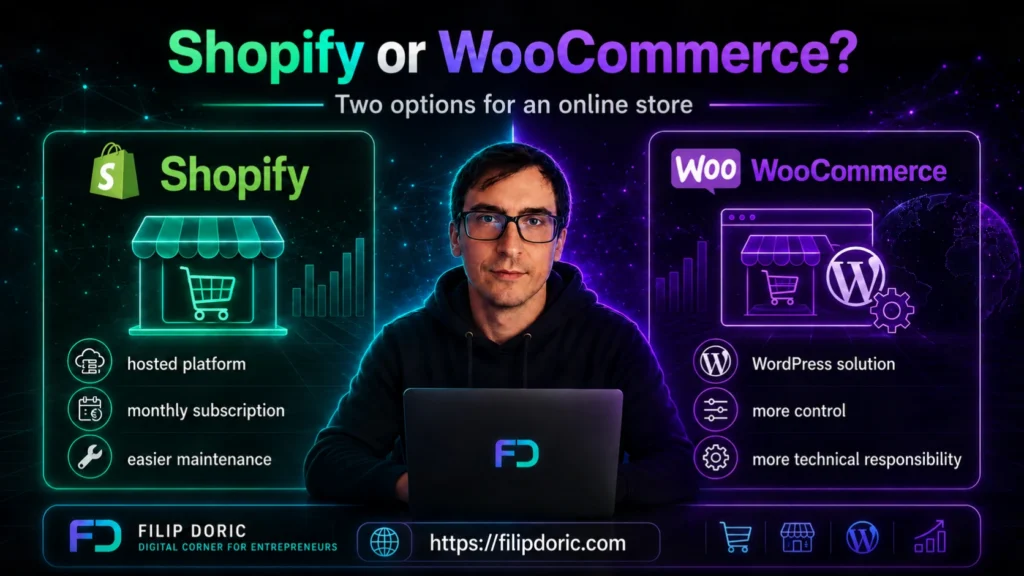
Shopify is not the only way to build an independent online store.
WooCommerce is another major option.
The difference begins with the infrastructure.
Shopify is hosted.
You pay for the platform, and much of the technical infrastructure is handled for you.
WooCommerce runs on WordPress.
The WooCommerce plugin itself can be free, but you are responsible for hosting, WordPress, maintenance, security, backups and the wider technical setup.
Shopify can therefore provide a simpler starting point.
WooCommerce can provide more direct control.
Neither approach is automatically better.
It depends on what you value.
If you want to launch faster and avoid managing many technical details, Shopify may be attractive.
If you already understand WordPress and want deeper control over the website, content, hosting and technical environment, WooCommerce can make a lot of sense.
I personally use WooCommerce for some of my own projects.
But that does not mean I think everyone should use it.
Different businesses need different systems.
The Cost Is More Than the Monthly Plan
When people compare ecommerce platforms, they often focus only on the advertised monthly price.
That can be misleading.
Your real cost may include the Shopify plan, apps, premium themes, payment processing, custom development, integrations and marketing.
And marketing is important.
Because again:
Shopify can build the store infrastructure. It cannot create demand for your product.
If your business depends heavily on paid advertising, that cost can quickly become much larger than the platform subscription itself.
That is why platform selection should come after business thinking.
Not before it.
Who Is Shopify Good For?
A Shopify online store can make sense for several types of businesses:
- small or medium-sized brands that want their own ecommerce presence
- producers selling their own products
- creators who already have an audience
- businesses testing a new product idea
- merchants selling across several digital channels
- companies that want ecommerce without managing every technical layer themselves
But I would add one condition.
You should have at least some idea of how customers will find you.
If the entire business plan is:
“I will open Shopify and people will come,”
you are missing a critical piece.
You Can Combine Shopify With Marketplaces
You also do not need to choose one channel forever.
A business can have its own Shopify store and also sell through marketplaces.
That can actually be a very sensible strategy.
A marketplace can help people discover the product.
Your own store can give you more space to build the brand and customer relationship.
Different channels can serve different purposes.
This is another reason I prefer thinking in ecosystems rather than isolated tools.
The real question is not:
Which platform wins?
It is:
Which combination helps my business work better?
Shopify Does Not Replace a Business Strategy
This is the point I would want every beginner to remember.
Shopify is a tool.
A very capable one.
But still a tool.
It cannot decide:
what you should sell,
who your customer is,
why they should choose you,
how you will reach them,
how much they are willing to pay,
or why they should return.
Those are business questions.
And they remain your responsibility.
A great platform cannot rescue a weak product-market fit.
But a good platform can make it much easier to execute a good idea.
The Bigger Shift Shopify Represented
Amazon helped show how large online retail could become.
eBay demonstrated how individuals could sell to other individuals at scale.
Shopify helped popularize another question:
Why not build your own online store?
That shift matters.
You no longer had to choose only between opening a physical store or selling through a giant marketplace.
A smaller company could build its own ecommerce presence using infrastructure provided by a platform such as Shopify.
That opened the door for thousands of brands that might never have built custom ecommerce technology themselves.
A Shopify Online Store Is a Starting Point, Not the Finish Line
If you are considering Shopify, do not begin with the platform.
Begin with your business.
What are you selling?
Who needs it?
Why would they buy from you?
Where are those people already spending time?
How will they discover you?
What happens after their first purchase?
Then decide whether a Shopify online store is the right infrastructure for that journey.
Because Shopify can help you create a professional place to sell.
It can simplify many technical parts.
It can connect products, payments, orders and other tools.
But the things that make a business memorable still come from you.
The product.
The story.
The trust.
The content.
The customer experience.
The relationship.
Shopify gives you the store.
You still have to build the business around it.
And that may be the most important thing to understand before clicking Create Store.
Where Ecommerce Fits Into the Bigger Picture
I write about ecommerce, websites, affiliate marketing, email, digital tools and connected online business systems on filipdoric.com.
If you are exploring ecommerce for the first time, start with my guide What Is Ecommerce? How Online Trade Changed Business Forever, and then continue with the individual platforms and models that interest you.
Over the next articles, I will also look more closely at Amazon and Etsy — two very different ways of selling online compared with building your own Shopify store.
Because ecommerce is not one model.
And a webshop is not the entire digital business.
It is one layer of a much larger system.
If you’re curious about what my team and I are working on in the world of ecommerce, join my newsletter and follow the journey as it develops.
📬 Want more tips like this?
Subscribe to get fresh blog posts directly to your inbox.