This digital franchise idea caught my attention for a simple reason: after spending enough time online, you eventually reach a point where you feel like you have seen almost everything.
The fake promises.
The recycled programs.
The “opportunities” that seem exciting for a few months and then quietly disappear.
The models where the people at the top seem to do very well while everyone else is told to “work harder.”
The endless rebranding of ideas that have already existed for years.
And, of course, the classic:
“This time it is different.”
If you have been around online business long enough, your first reaction eventually becomes skepticism.
Mine certainly did.
I have explored freelancing.
Affiliate marketing.
Websites.
Digital products.
Network marketing.
Content creation.
Ecommerce.
Different tools.
Different platforms.
Different business models.
Some were useful.
Some taught me valuable lessons.
Some worked better than others.
And some simply reminded me why you should never confuse excitement with a sustainable business model.
That is exactly why I did not become interested in this project because someone told me:
“This is the next big thing.”
I became interested because the more questions I asked, the more I found actual answers.
And that is where this story starts.
When You Have Already Seen Almost Everything Online
There is a strange stage people reach after spending years around online business.
At the beginning, everything looks exciting.
A new platform launches.
A new earning model appears.
Someone discovers a new marketing strategy.
A new tool promises to change everything.
You think:
“Maybe this is it.”
Then time passes.
You start recognizing patterns.
A new “revolutionary” affiliate system looks remarkably similar to one you saw three years earlier.
A new community model suddenly starts looking like an old network-marketing structure with better branding.
A new SaaS opportunity is really another white-label platform.
A “fully automated business” still requires someone to create content, find customers, communicate, sell and solve problems.
Eventually, the packaging stops impressing you.
You start looking underneath it.
That changed the way I evaluate online business opportunities.
Today, I am much less interested in presentation.
I want to know:
Who owns the company?
Where is the company registered?
What exactly is being built?
What does the customer actually receive?
Where does the money come from?
How is profit distributed?
What happens after launch?
What are the obligations of active participants?
What happens if I do nothing?
What happens if I want to build actively?
Which parts already exist and which parts are still being developed?
What does the agreement actually say?
Those questions are not as exciting as a motivational presentation.
But they are far more useful.
Why This Business Concept Made Me Keep Asking Questions
At first, I did not immediately understand what to call the SFT21 Business Concept.
Was it ecommerce?
A social network?
A franchise?
An affiliate model?
A network-based business?
A digital platform?
A community?
The answer turned out to be:
parts of all of them.
And that is why this business concept became more interesting to me as I studied it.
The idea is not based around one isolated product.
The broader system is being developed around several connected parts.
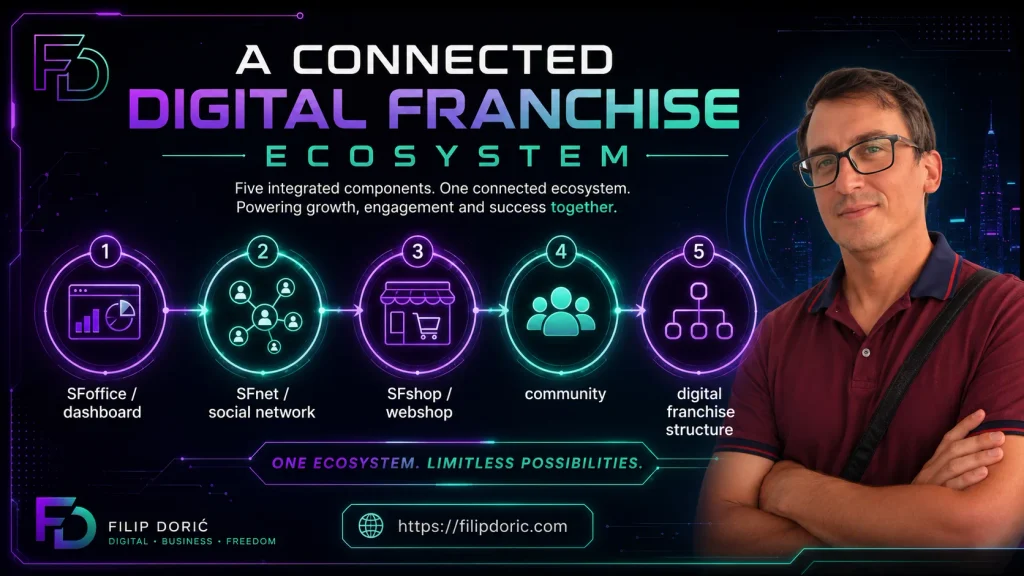
There is SFoffice, the business environment.
There is SFnet, the planned verified social network.
There is SFshop, the ecommerce layer.
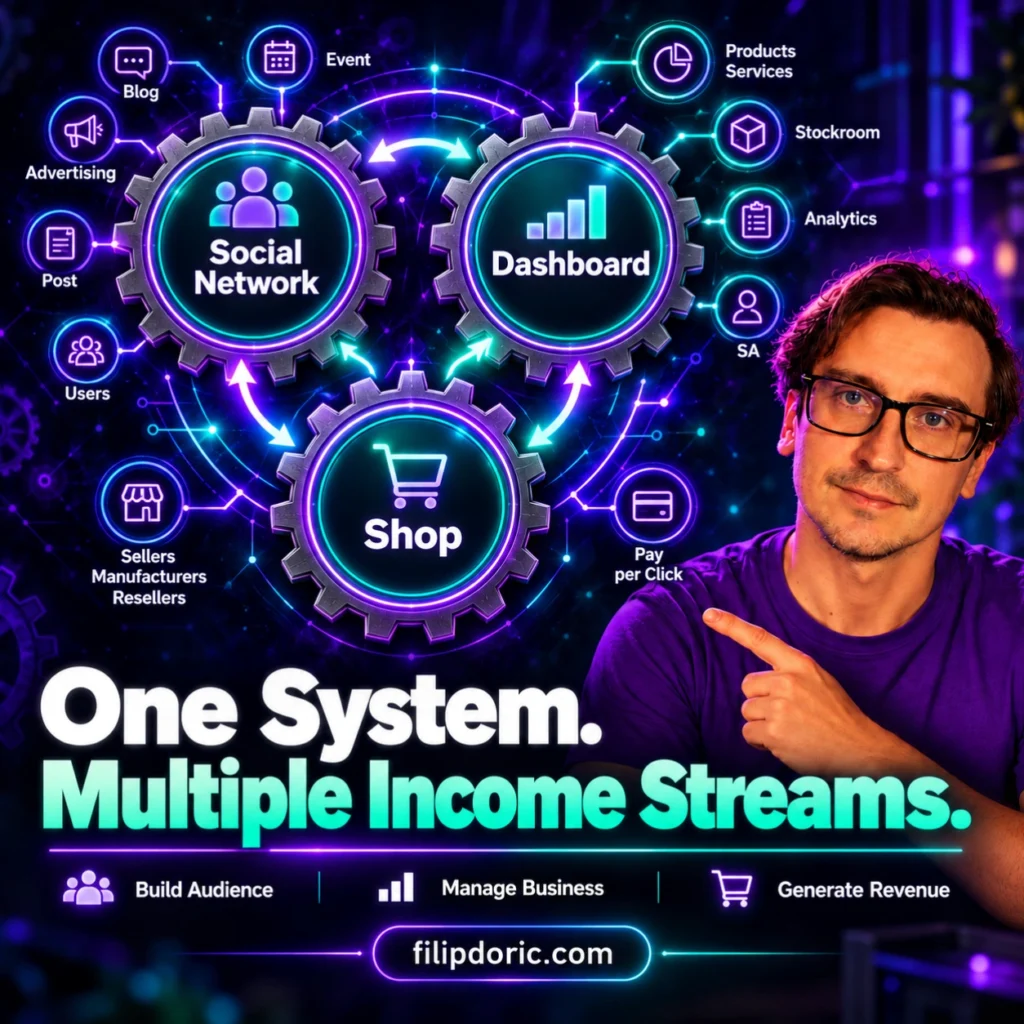
Around those tools sits a larger business concept that is intended to connect users, entrepreneurs, producers, business partners and franchise participants.
That is where the term digital franchise starts making more sense.
It is not simply:
“Here is a product. Go sell it.”
The concept is closer to:
“Here is an ecosystem. Find your role inside it.”
That distinction matters to me.
I Was Not Looking for Another Program
This part is important.
I was not looking for another online opportunity.
I was already building online.
I had websites.
I had client experience.
I had affiliate projects.
I had my own content.
I was learning about ecommerce.
I had already experimented with different business models.
So when I started looking deeper into this digital franchise idea, I was not asking:
“How quickly can I make money?”
I was asking:
“Does this structure solve any of the problems I have already experienced?”
One of those problems is fragmentation.
Online business often means building everything separately.
You need:
a website,
hosting,
email marketing,
a sales system,
social media,
payment tools,
content,
traffic,
products,
analytics,
customer support,
community,
and sometimes a dozen additional tools just to make everything communicate properly.
This can work.
But it creates complexity.
And complexity eventually becomes a cost.
Not only financially.
Mentally too.
That is why a connected system naturally caught my attention.
Real Tools Matter More Than Big Promises
One thing I have learned over the years is that motivation has a very short shelf life.
Tools and infrastructure last much longer.
If a business concept depends mainly on excitement, motivational events and recruitment, I become cautious very quickly.
I want to know what remains when the excitement disappears.
That is one reason SFoffice, SFnet and SFshop matter to the wider story.
They represent something concrete that the business concept is being built around.
The idea is that the ecosystem should provide actual infrastructure for:
business activity,
communication,
community,
ecommerce,
and future collaboration.
Will everything work exactly as planned?
That is something the market will ultimately decide.
But at least the conversation is not limited to:
“Join now and tell five friends.”
There is a broader infrastructure being developed underneath it.
The Difference Between a Story and a System
A story can be exciting.
A system needs to answer questions.
That is probably the biggest reason I kept studying this project.
When I ask who is behind it, there is a company structure.
When I ask what the legal entity is, there is a registered company.
When I ask what the products are, there are defined digital products and planned platforms.
When I ask what the license represents, there is an agreement.
When I ask how active participation is supposed to work later, there is a franchise structure.
When I ask how the ecosystem is supposed to generate business activity, there is an ecommerce, community and business-partner layer.
When I ask how the distribution model works, there is a defined structure behind it.
I may agree with every detail.
I may question some parts.
I may want to see certain elements proven in practice after launch.
That is normal.
But I can actually ask the questions.
And I can find structured answers.
That makes a huge difference.
Who Owns the Company?
This is one of the first questions people should ask when evaluating any online business project.
Not:
“Who invited me?”
But:
“Who actually owns and operates the company?”
The SFT21 Business Concept is being developed through SFT21 LLC, a company registered in Delaware, United States.
That does not automatically make a project good.
A legal entity is not proof of future success.
But it matters.
Because one of the biggest problems with questionable online opportunities is that basic questions about ownership and responsibility often lead nowhere.
Who owns it?
Nobody knows.
Where is the company?
Some virtual address nobody can explain.
Where are the agreements?
Hidden.
Who is legally responsible?
Unclear.
I do not like that kind of ambiguity.
A serious business concept should be open to questions about its legal structure.
What Is Actually Being Built?
Another important question is:
What are we waiting for?
Because SFT21 is still in development.
That has to be stated clearly.
This is not a mature ecosystem that has already operated at full commercial scale for years.
The main public-facing infrastructure is still being completed.
That means there is development risk.
Execution risk.
Market risk.
Adoption risk.
And all the other risks that come with building something new.
But it also means we can look at what is actually being developed.
The main structure revolves around:
SFoffice
SFnet
SFshop
and the wider franchise and community system around them.
The goal is not simply to create another social network.
Not simply another webshop.
Not simply another affiliate dashboard.
The goal is to connect those elements.
That is where the digital franchise idea becomes more interesting than any one platform by itself.
Why SFnet Matters
Social networks are powerful.
But most of us build on platforms we do not own.
Facebook.
Instagram.
TikTok.
LinkedIn.
YouTube.
They are useful.
I use them myself.
But they control the rules.
They control reach.
They control account access.
They decide which features exist tomorrow.
SFnet introduces a different idea inside this ecosystem.
A network that is part of the same broader business environment.
For an SFfranchiser, that creates possibilities beyond simply posting content.
The network can become a place to:
build visibility,
develop relationships,
connect with users,
discover producers and business owners,
communicate with potential customers,
and support activity across the wider SFT21 ecosystem.
Users.
Creators.
Entrepreneurs.
Business owners.
Producers.
Franchise participants.
Potential customers.
All existing inside the same connected environment.
But there is another side of SFnet that I think is equally important.
What Does SFnet Offer to a Free User?
You do not necessarily need to become a franchise partner to find value in the network.
One of the core ideas behind SFnet is an environment built around verified members.
That may sound like a small feature.
I do not think it is.
One of the biggest problems on today’s internet is that you often do not really know who is on the other side of a profile.
Fake accounts.
Impersonation.
Spam.
Automated profiles.
Scams.
People hiding behind disposable identities.
A network designed around verified users changes the starting point of communication.
It does not mean every member will automatically be trustworthy or that normal online caution becomes unnecessary.
But it can create a stronger level of identity accountability than an environment where anyone can create endless anonymous or fake profiles.
And that can matter even more when communication becomes business-related.
Imagine that you are a freelancer, consultant, designer, creator, local entrepreneur, or service provider.
You may not want to sell physical products through SFshop.
You may simply want to:
present what you do,
build a professional presence,
connect with other verified users,
start conversations,
find potential collaborators,
or offer your services directly through relationships created on the network.
In that situation, SFnet itself can have value even without using the ecommerce side of the ecosystem.
A web designer could connect with a business owner.
A photographer could meet a local producer.
A consultant could become visible to entrepreneurs looking for specific expertise.
A creator could discover new collaborations.
A small company could build relationships before any transaction takes place.
That is important because online business does not always begin with a checkout button.
Very often, it begins with:
a conversation,
a connection,
trust,
and knowing who is actually on the other side.
This is where the verified-member concept could become particularly valuable.
For the franchise partner, SFnet represents part of the infrastructure for building community and business activity.
For the free user, it can become a place to communicate, build visibility, make professional connections, and potentially generate opportunities without necessarily becoming a franchisee or using SFshop.
That gives the network a reason to exist beyond the franchise structure itself.
And I think that is essential.
A social network becomes much stronger when people can find value in using it even if they never join the business opportunity behind it.
Whether SFnet can build enough active users and meaningful interaction will ultimately have to be demonstrated after launch.
But if the verified-user model works as intended, it could create something increasingly rare online:
a digital environment where identity, communication, community, and business relationships are designed to work together.
Why SFshop Matters
Then there is ecommerce.
This is another part I find particularly important.
Because a business ecosystem becomes much more interesting when real products and services enter the picture.
SFshop is intended to connect commerce with the wider SFT21 network.
This opens a much broader question than:
“How many people can I recruit?”
The better question becomes:
“How many useful economic relationships can this ecosystem create?”
A producer needs customers.
A customer needs products.
A business needs visibility.
A creator needs content opportunities.
A franchise partner needs activity.
A marketplace needs supply and demand.
That is a real economic loop.
And that is the type of structure I want to see develop.
Local Producers Are Part of the Bigger Idea
This is one part of the story that I believe deserves much more attention.
Digital business conversations often focus on online marketers talking to other online marketers.
I think that becomes boring very quickly.
The internet becomes much more interesting when it helps people who are actually creating something.
Small producers.
Local businesses.
Craftspeople.
Service providers.
Independent entrepreneurs.
People who already have value but may not have strong digital distribution.
The broader SFT21 idea includes connecting those types of participants into the ecosystem.
That means someone in Croatia could potentially participate differently from someone in Germany, Italy, Africa or another region.
Every country has its own producers.
Its own entrepreneurs.
Its own products.
Its own local economic stories.
A global platform does not need to erase those differences.
It can potentially help connect them.
That part resonates strongly with the way I think about digital ecosystems.
How Is Profit Supposed to Be Distributed?
This is another question I asked very early.
Where does the money go?
If a business model talks about community, then the economic structure should also tell us something about how value is distributed.
The SFT21 model presents a significant portion of the company’s distributable structure as returning to the community through different mechanisms within the ecosystem.
The exact mechanics matter, and I cover them separately because this subject deserves more than one paragraph.
There are different bonus structures.
There is the SFalgorithm.
There are franchise-related mechanisms.
There are license-phase rights.

There are rules governing limits, points and different forms of participation.
The important point here is simpler:
there is a defined model behind the distribution story.
It is not just a vague promise that:
“Everyone wins.”
And it should never be presented that way.
Business results depend on actual business activity.
That means customers.
Transactions.
Products.
Services.
Partners.
Users.
Market adoption.
No real ecosystem survives on enthusiasm alone.
I Want Answers Before I Want Excitement
This is something I wish more people would apply to online business.
Before asking:
“How much can I make?”
Ask:
“How does it work?”
Before asking:
“Which package should I buy?”
Ask:
“What am I buying?”
Before asking:
“Who is already making money?”
Ask:
“Where will sustainable revenue come from?”
Before asking:
“How quickly can this grow?”
Ask:
“What needs to happen for it to grow?”
That way of thinking protects you from a lot of nonsense.
It also makes legitimate opportunities easier to understand because you are not evaluating them emotionally.
You are evaluating structure.
International Attention Before Full Launch
Another reason this project caught my attention is the level of international interest it has already generated before the full ecosystem is publicly launched.
That is unusual.
The project has already developed relationships and visibility beyond one country or one local community.
International representatives and ambassadors have become connected with the wider SFT21 story.
Different regions are being discussed.
International networking opportunities have emerged.
The company has been building relationships beyond the immediate online-business bubble.
That does not guarantee future commercial success.
Recognition is not revenue.
Attention is not adoption.
But it is still relevant.
A project that has not yet reached full public launch but is already creating cross-border relationships deserves at least a closer look.
That is what I have been doing.
Looking closer.
Recognition Is Useful – But Execution Still Matters
This is where I want to keep both feet on the ground.
It is easy to see international names, business relationships or interesting announcements and become overly excited.
I prefer another approach.
Recognition tells me:
people are paying attention.
Execution will tell me:
whether the business concept works.
That is the real test.
Will SFnet attract active users?
Will SFshop create meaningful transactions?
Will producers and business partners participate?
Will users return?
Will the ecosystem create value beyond internal activity?
Will the franchise structure work as intended?
Those are the questions that matter after launch.
And those are the things I intend to follow.
Why the Pre-Launch Phase Is Both Interesting and Risky
There are two completely different ways to view a pre-launch project.
The first person sees opportunity.
The second sees uncertainty.
Both are correct.
Early stages can offer different rights, positioning or participation opportunities.
They also come with more unknowns.
A finished ecosystem is easier to evaluate because you can simply use it.
A developing ecosystem requires more judgment.
You need to evaluate:
the company,
the team,
the documents,
the software development,
the structure,
the communication,
and whether the concept itself makes sense to you.
That is why I never tell people:
“You need to join now.”
Some people are comfortable with the current phase.
Others should wait.
There is nothing wrong with that.
The Official Company Information Matters
One of the advantages of doing your own research is that you do not need to depend entirely on what someone tells you in a social media post.
You can look at the company’s own information.
You can review the available documents.
You can study the business concept.
You can compare explanations from different sources.
You can read agreements.
You can ask questions.
You can follow development.
Official SFT21 Company Website: SFT21 LLC
That is what I recommend.
Do not outsource your decision completely to another person.
Not even to me.
What Does the License Actually Give You?
This is another area where clear answers matter.
The current phase includes SFlicenses.
An SFlicense is a digital product.
It is not a share in the company.
It does not make the holder a co-owner of SFT21 LLC.
The license provides specific rights defined by the License Purchase Agreement.
That distinction matters.
I have already written separately about:
License Packages,
Starter Packages,
the difference between the License Phase and future active franchise participation,
and how the current system is structured.
I prefer separating these topics because otherwise one article quickly becomes impossible to read.
The important point here is that the rights are defined.
There is documentation.
You can study what you are purchasing before making a decision.
That is exactly how it should be.
What Happens After the License Phase?
The current License Phase is not supposed to continue forever.
It belongs to the development period.
After the full franchise model launches, the system is designed to transition toward Starter Packages for new active participants.
That creates two different stages.
Today:
License Phase
Later:
Active franchise entry through Starter Packages
Existing license holders have their own rights and upgrade path according to the current structure.
Again, the details are available in my dedicated comparison article.
This article has a different purpose.
I want to explain why the larger concept made me stop and pay attention.
Having a System Changes the Starting Point
Think about the typical person trying to build something online.
They may need to learn:
how to build a website,
how to create content,
how to attract people,
how ecommerce works,
how email marketing works,
which tools to use,
how payment systems work,
how to build trust,
how to create offers,
how to communicate,
and how to put everything together.
That learning is valuable.
I have gone through much of it myself.
But it is also overwhelming.
A connected business system changes the starting point.
Instead of asking:
“How do I build every single piece?”
you can begin asking:
“How do I use the pieces that already exist?”
That is a fundamentally different problem.
And for many people, it may be a much more practical one.
A Beginner Still Needs to Work
A system is not magic.
This needs to be said clearly.
Having tools does not mean people automatically arrive.
Having a platform does not mean customers automatically buy.
Having a franchise structure does not eliminate the need for communication.
Having a community does not mean you can remain invisible forever.
People still need to learn.
Create.
Communicate.
Build relationships.
Understand what they are presenting.
Follow rules.
Develop skills.
A good system can reduce unnecessary complexity.
It cannot eliminate human effort.
I think that distinction is important because online business marketing often goes too far in the other direction.
Everything is supposedly:
automatic,
passive,
easy,
done-for-you.
Real businesses do not work like that.
The Value of Having Answers to Difficult Questions
This may sound strange, but one of the things that increases my confidence in a project is being able to discuss uncomfortable subjects.
What happened before?
What problems existed?
Who owns the company?
What is legally defined?
What is still unfinished?
What is guaranteed?
What is not guaranteed?
Where does profit come from?
What does the agreement say?
What happens if the business performs poorly?
What obligations exist?
What risks exist?
A concept becomes more credible to me when I can investigate those questions instead of being told:
“Stop being negative.”
Questions are not negativity.
Questions are due diligence.
And I think anyone considering a serious online business decision should ask many of them.
This Is Why I Write So Much About the Concept
Some people may look at my website and think:
“Filip, how many articles can you possibly write about one business concept?”
Quite a few, apparently. 😄
But there is a reason.
I do not want someone to arrive on my website and find only:
“Join my team.”
That tells them almost nothing.
I want someone to be able to explore.
What is SFT21?
What is an SFlicense?
What is the digital ecosystem?
How is the company structured?
What is SFnet?
What is SFshop?
How does the SFalgorithm work?
What are Starter Packages?
What are franchise work obligations?
Who are the people connected with the project?
What international developments are happening?
What are the risks?
What are the opportunities?
That is useful information.
And when people understand the structure, they can make better decisions.
My Role Is Also Changing
This project arrived at an interesting point in my own journey.
I started online primarily by exploring skills.
Websites.
Digital marketing.
Freelancing.
Affiliate models.
Different forms of online income.
Over time, I became less interested in constantly finding the next isolated project.
I became more interested in systems.
Assets.
Communities.
Long-term structures.
Connected business models.
That is one reason I increasingly describe my own transition as moving from freelancer to digital franchiser.
I am not throwing away the skills I developed.
I am putting them inside a broader structure.
That feels like a natural progression.
Why This Digital Franchise Idea Caught My Attention
So after all of that, the answer is actually quite simple.
This digital franchise idea caught my attention because it tries to solve several problems I had already noticed myself.
Online business is fragmented.
People often lack structure.
Platforms are disconnected.
Local businesses struggle with digital visibility.
Many online opportunities depend too heavily on constant recruitment.
Creators build audiences on platforms they do not own.
Small producers may have products but weak distribution.
Beginners face too many tools and too much information.
And people often enter business models without understanding what they are buying.
The SFT21 Business Concept attempts to bring several of those pieces into one connected environment.
Will every part succeed?
That remains to be seen.
But the architecture is interesting enough for me to participate, study it closely and document the journey.
Online Business or Science Fiction?
When you describe the entire idea quickly, it almost does sound like science fiction.
A verified social network.
An ecommerce ecosystem.
Business accounts.
Franchise infrastructure.
Community participation.
Local producers.
International connections.
Digital licenses.
A global structure.
Multiple economic roles inside one system.
It is ambitious.
Very ambitious.
And ambitious ideas are easy to announce.
The difficult part is building them.
That is why I continue watching the development rather than pretending the story is already finished.
The real proof will come from usage.
From transactions.
From people.
From products.
From communities.
From businesses.
From whether the ecosystem creates actual value once it is fully operational.
I Am Interested in the Build, Not Just the Promise
This is probably the best way to describe my perspective.
I am not interested only in what SFT21 says it wants to become.
I am interested in watching whether it can become it.
That means following:
software development,
company updates,
new partnerships,
international expansion,
user adoption,
producer participation,
platform launches,
business activity,
and how the franchise concept works in practice.
That is much more interesting to me than simply repeating promotional material.
Maybe You Have Seen Everything Too
If you have spent years online, perhaps you know the feeling.
Another program appears.
Another launch.
Another opportunity.
Another person tells you:
“This changes everything.”
You become skeptical.
That is healthy.
Keep the skepticism.
But do not let skepticism turn into refusing to investigate anything new.
Those are not the same thing.
You can be cautious and curious at the same time.
That is exactly how I approached this project.
I asked questions.
Then more questions.
And then even more questions.
Some answers led me to new questions.
Others made the structure clearer.
Eventually, I reached a point where I decided this was something I wanted to participate in rather than simply observe from the outside.
Information First. Decision Second.
That is also the approach I recommend to anyone reading this.
Do not join because I am involved.
Do not buy something because someone sent you a presentation.
Do not make a decision because an online post made you emotional.
Study the concept.
Read the documents.
Understand the stage of development.
Understand the risks.
Understand what is being built.
Understand what the license represents.
Understand what active franchise participation will mean.
Understand how the ecosystem is supposed to generate real business activity.
Then decide.
You may decide:
Yes, this is interesting to me.
You may decide:
I want to wait until launch.
You may decide:
I only want to use the platforms later.
Or you may decide:
This is not for me.
All of those outcomes are better than making a decision without understanding the concept.
The Story Is Still Being Written
SFT21 has not yet reached the stage where we can look back at the full ecosystem and say:
“Here is exactly how everything performed.”
That chapter comes later.
Right now, we are still watching the infrastructure being built.
The network.
The shop.
The business environment.
The partnerships.
The international relationships.
The franchise structure.
The community.
That makes this a particularly interesting moment to document.
Because later, when everything is live, we will be able to compare:
what was promised
with
what was actually built.
And I intend to do exactly that.
Final Thoughts
I have seen enough online business models to know that good branding is not enough.
A great presentation is not enough.
A charismatic founder is not enough.
A compensation table is not enough.
A big community is not enough.
A famous name is not enough.
A project has to eventually create real value for real people.
That is the standard I use.
And that is why this digital franchise idea has kept my attention.
It gives me enough structure to keep asking serious questions.
Enough tools to see a broader business architecture.
Enough international development to make the project worth watching.
And enough unanswered future questions to keep me realistic about what still has to be proven.
Maybe it works exactly as envisioned.
Maybe some parts evolve.
Maybe the market forces the concept to change.
That is what building something new looks like.
For now, I know why I am here.
I want to see what happens when:
technology,
community,
ecommerce,
local business,
digital infrastructure,
and a franchise system
are brought together into one ecosystem.
Online business or science fiction?
We will find out.
But this time, I do not want to watch from the sidelines.
Want to Follow the Development?
If you are curious about the SFT21 Business Concept, the developing digital ecosystem and what happens as SFoffice, SFnet, SFshop and the wider franchise model continue to evolve, you can follow my updates here on filipdoric.com.
I also share new articles, project updates and explanations through my newsletter.
No hype.
No guaranteed outcomes.
No need to decide before you understand what you are looking at.
Information first. Decision second.
The internet is more than a place for scrolling.
📬 Want more tips like this?
Subscribe to get fresh blog posts directly to your inbox.