My transition from freelancer to digital franchiser did not happen because I suddenly stopped believing in freelancing.
Quite the opposite.
Freelancing taught me how to build websites, work with clients, solve problems, communicate online and turn digital skills into something people were willing to pay for.
It gave me experience.
It gave me freedom.
And it proved something important to me:
the internet can be much more than a place where we consume content. It can become a place where we build something of our own.
But after spending years around websites, online marketing and different online income models, I started asking a different question.
Not:
“How do I get another client?”
But:
“What am I actually building for the long term?”
That question is gradually moving me from freelancer to digital franchiser.
And I think it says a lot about how my view of online business has changed.
We Already Live Much of Our Lives Online
Think about an ordinary day.
You check your email.
Open a messaging app.
Search for something.
Read reviews.
Pay a bill.
Book a trip.
Watch a video.
Talk to someone in another country.
Order something online.
Log into an account.
Use a map.
Maybe work remotely.
For most of us, some form of digital identity already exists whether we consciously built one or not.
An email address.
A Google account.
A Facebook profile.
LinkedIn.
Instagram.
A business website.
A payment account.
A customer account somewhere.
Our offline and online lives have become increasingly connected.
And I think work is moving in the same direction.
That does not mean every physical job disappears.
It does not mean everyone becomes an influencer.
And it certainly does not mean everyone suddenly becomes an entrepreneur.
But more and more people will have at least some part of their economic activity connected to the internet.
The interesting question becomes:
What role do you want to have in that economy?
Freelancing Was an Important Step for Me
I have written before about my online business journey and why structure became so important to me -including the period when I started questioning the traditional relationship between work, time and freedom.

I remember one particular period when I had three temporary jobs in the same week.
Technically, I was busy.
I was working.
Money was coming in.
From the outside, you could even call that progress.
But internally, it created a very different feeling.
I remember thinking:
Is the goal really to become better at finding more work to fill every available hour?
That question stayed with me.
Eventually, I began exploring online work more seriously.
Websites became an important part of that.
I learned.
Built.
Experimented.
Started helping other people with their online presence.
And freelancing became a very practical way to turn those skills into income.
There is something powerful about realizing that a client does not have to live in your town.
Or your country.
Your ability to solve a problem can travel much farther than you can.
That part of freelancing still fascinates me.
But Freelancing Has a Built-In Question
A freelancer creates value through a skill.
A client needs something.
You can do it.
You agree on the work.
You complete it.
You get paid.
Simple.
And often very effective.
But there is a question hiding underneath that model:
What happens when you stop working?

For many freelancers, income is still closely connected to:
projects,
hours,
deadlines,
availability,
and continuously finding or retaining clients.
You may no longer have one traditional employer.
But you can accidentally create ten smaller employers.
The names change.
The structure changes.
You work from home instead of an office.
But your income may still depend heavily on your next task.
That does not make freelancing bad.
It simply means that freedom of location is not automatically the same thing as freedom of structure.
That distinction became increasingly important to me.
I Started Looking Beyond the Next Client
There was a stage when much of my thinking naturally revolved around questions such as:
Where will the next website project come from?
Who needs help with their online presence?
Which service could I offer?
How much time will this project require?
Can I take another client?
Those are normal freelance questions.
But eventually I wanted to build things that existed even when there was no new client waiting.
My websites.
My articles.
My newsletter.
My content.
My community.
Affiliate relationships.
Digital products.
Online systems.
And eventually, my position inside a wider business ecosystem.
That represents a completely different way of thinking.
A client project creates income from work you perform.
A digital asset can continue existing after the project is finished.
That does not mean passive income magically appears.
Everything requires work.
But the type of work begins to change.
From Selling Time to Building Assets
This may be the simplest explanation of my transition from freelancer to digital franchiser.
As a freelancer, a large part of my value comes from what I can personally deliver.
As I move deeper into a digital franchise model, I am increasingly thinking about:
systems,
positions,
distribution,
community,
digital infrastructure,
and assets that can grow over time.
That does not mean I suddenly stop using my skills.
Quite the opposite.
Everything I learned as a freelancer becomes useful.
Understanding websites helps.
Understanding content helps.
Knowing how online tools work helps.
Knowing how to explain something simply helps.
Knowing how to communicate with people helps.
The skills remain.
The structure around those skills changes.
What Does “Digital Franchiser” Mean to Me?
The term may sound unusual if you are hearing it for the first time.
When I say digital franchiser, I am not talking about simply buying a website template and calling it a franchise.
I am talking about operating inside a larger digital business structure where infrastructure, community, ecommerce and business activity are designed to work together.
The project I am currently involved with is the SFT21 Business Concept.
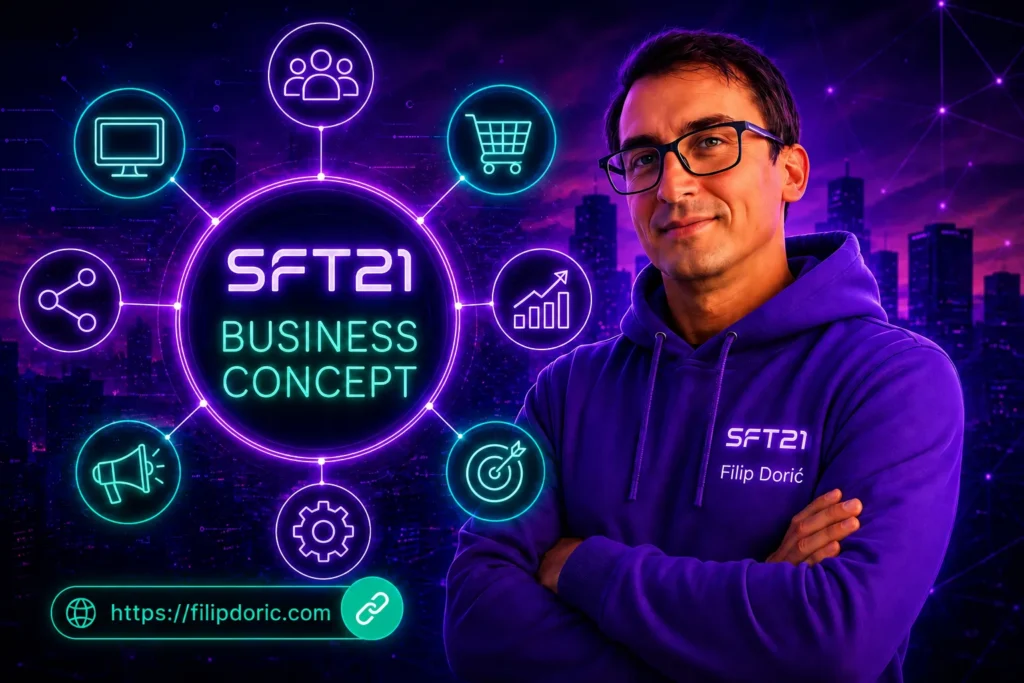
Its wider ecosystem is being developed around several connected elements, including:
SFoffice – the business environment and dashboard
SFnet – a verified social network
SFshop – the ecommerce layer
Alongside those digital platforms sits a wider franchise structure and community.
That combination is what caught my attention.
Not simply:
“Here is another way to make money online.”
But:
“What happens when multiple parts of online business are built to work as one system?”
That question is much closer to the direction I want to explore.
I Am Not Throwing Away My Freelance Experience
Sometimes career transitions are presented as:
Old thing bad. New thing good.
I do not see mine that way at all.
Freelancing gave me skills I would not want to lose.
Working with clients taught me to listen.
Website work taught me how many moving parts sit behind a seemingly simple online presence.
Digital marketing taught me that attention is not enough without trust.
Content taught me that ideas become much clearer when you have to explain them to someone else.
Even difficult projects taught me something.
So when I say I am moving from freelancer to digital franchiser, I am not deleting the previous chapter.
I am building the next chapter on top of it.
I Want to Build More Than a Job for Myself
This is probably the deeper motivation.
One of the risks of freelancing is creating a job that you technically own but cannot leave.
You become:
the salesperson,
the designer,
the support department,
the administrator,
the marketer,
the project manager,
and the person actually doing the work.
Congratulations.
You escaped having a boss and accidentally became seven employees. 😄
I have nothing against work.
I actually enjoy building things.
But I want the work I do today to contribute to something that can become bigger than today’s task list.
That may mean:
content that keeps being discovered,
a newsletter that keeps growing,
relationships that strengthen over time,
a community,
business infrastructure,
a position inside an ecosystem,
or income sources that are not all dependent on finding another client.
That is the shift.

One System Can Support More Than One Income Activity
I have spent a lot of time researching different online income models.
Freelancing.
Affiliate marketing.
Digital products.
Ecommerce.
Network-based models.
Content creation.
Each can work.
Each also has limitations.
The thing I increasingly find interesting is not:
“Which one is the winner?”
It is:
“Can several of these activities support each other?”
Imagine a system where:
content creates visibility,
community creates relationships,
ecommerce creates transactions,
affiliate activity creates another income layer,
a business network creates opportunities,
and digital infrastructure connects the pieces.
That is much closer to how I now think about online business.
Not twenty unrelated side hustles.
One connected structure with multiple possibilities.
I Also Want More Time for Things I Love
There is another part of this story that is much more personal.
I love music.
That has been true for most of my life.
I grew up around records.
My grandmother played piano.
I played tambura.
Later I moved toward guitar.
I recorded music in my room.
Taught other people some guitar.
Created my own tracks.
And over the years, music became another part of my digital identity.
Not because I sat down one morning and decided:
“Excellent. I need another monetization funnel.”
No.
I simply love creating music.
And this is something I think about more as I get older:
What is the point of building freedom if you never create time to use it?
I do not want online business only so I can spend sixteen hours a day doing online business.
I want a structure that can eventually give me more room for:
music,
travel,
ideas,
writing,
people I care about,
and projects I genuinely want to explore.
That is a much stronger motivation for me than simply saying:
“I want to earn online.”
Income matters.
But what that income allows you to do with your life matters too.
My Personal Brand Is Becoming Broader
This transition has also changed the way I think about personal branding.
For a while, it would have been very easy to describe myself as:
“I build websites.”
Simple.
Clear.
But not complete anymore.
Today I write about:
online business,
digital ecosystems,
affiliate marketing,
ecommerce,
AI tools,
social platforms,
organic marketing,
digital franchise systems,
and the changes happening across the internet.
I still build.
I still experiment.
I still help people understand digital tools.
And music remains part of who I am too.
At first, that may look like too many things.
But there is actually one common thread:
I am interested in what people can build using the internet.
A website.
A business.
An audience.
A community.
A piece of music.
A digital identity.
A new income stream.
A new direction.
That is the personal brand.
Not one job title.
The pattern underneath the work.
So, Filip – What Do You Actually Do?
This is the question I sometimes get.
And I understand why. 😄
The shortest answer today would probably be:
I build and explore digital systems that help people create stronger online businesses, while developing my own position within a digital franchise ecosystem.
Or even more simply:
I am transitioning from freelancer to digital franchiser.
I still work with digital content, websites and online tools.
But my primary direction is increasingly about:
online income systems,
digital ecosystems,
community,
and the development of the SFT21 digital franchise model.
That sentence probably describes where I am today better than any job title I used five years ago.
Why Community Became More Important to Me
Freelancing can sometimes be lonely.
You have your laptop.
Your client.
Your project.
Your deadline.
Finish.
Repeat.
There is freedom in that.
But there can also be isolation.
Over time, I became more interested in building with people instead of only working for people.
Those are not the same thing.
A client relationship usually has a beginning and an end.
A community can grow.
People can exchange knowledge.
Create introductions.
Support projects.
Find collaborators.
Connect products with customers.
Help each other understand something.
That community layer is one reason the digital franchise concept interests me.
It adds something I was missing when everything revolved around individual projects.
The Internet Changed What a Small Business Can Be
There is something remarkable about the period we live in.
One person with a laptop can now potentially:
build a website,
publish globally,
accept payments,
create videos,
write a newsletter,
sell products,
provide services internationally,
use AI,
connect with people around the world,
and build a recognizable brand.
None of that guarantees success.
The internet has not eliminated competition.
It has not eliminated risk.
And it certainly has not eliminated the need to work.
But it has reduced barriers that would have been enormous for previous generations.
That makes this an interesting time to build.
The question is not whether everyone needs to become an entrepreneur.
They do not.
The question is whether people recognize how much the definition of what an individual can build has changed.
Online Work and Online Business Are Not the Same Thing
This is another distinction that has become increasingly important to me.
You can move a traditional job online.
You receive tasks.
Complete them.
Get paid.
That is online work.
Useful.
Legitimate.
But it is not automatically an online business.
A business begins introducing other elements:
assets,
systems,
distribution,
customers,
brand,
processes,
relationships,
and ways for value to continue moving without every transaction beginning from zero.
That was a major mental shift for me.
I was no longer asking only:
“How can I work online?”
I started asking:
“How can I build online?”
Those questions lead to very different places.
I Still Believe Skills Matter
There is sometimes an unfortunate idea in certain online-business circles that skills no longer matter.
Just find the right system.
Press the right button.
Automate everything.
Money arrives.
I do not believe that.
Skills matter enormously.
Communication matters.
Writing matters.
Sales matters.
Technical understanding matters.
Relationships matter.
Judgment matters.
The difference is that a good system can help you use those skills with more leverage.
My freelance experience did not become irrelevant when I entered the digital franchise world.
It became an advantage.
And someone else’s skills may be completely different.
A producer understands products.
A creator understands content.
A salesperson understands people.
A programmer understands technology.
A business owner understands operations.
An influencer understands attention.
A connected ecosystem becomes interesting when different types of people can contribute different forms of value.
I Am Moving Toward Structure
If there is one word that summarizes my online journey, it might be:
structure.
For years, I explored.
Tried different things.
Learned tools.
Built sites.
Looked at business models.
Some worked.
Some taught me what I did not want.
Eventually, the thing I kept searching for became clearer.
I did not need another random opportunity.
I wanted a structure where multiple parts made sense together.
That is why the digital franchise direction feels like a natural progression rather than a sudden pivot.
I am still the same person.
Still curious about the internet.
Still building.
Still experimenting.
Still writing.
Still making music.
The architecture around those activities is changing.
From Freelancer to Digital Franchiser Does Not Happen Overnight
I also want to be clear about something.
A transition does not mean:
Monday — freelancer.
Tuesday — digital franchiser.
Done.
Real transitions overlap.
I still have freelance skills.
I still work with websites and digital projects.
I still maintain everything I have built.
At the same time, more of my energy is moving toward:
my content,
my websites,
my audience,
my newsletter,
my franchise position,
my team,
and the wider ecosystem I am helping build around.
That is why I use the word:
transitioning.
It describes the reality much better.
I Want My Work to Compound
This may be the biggest difference in how I think today.
Freelance work often resets.
You complete Project A.
Great.
Then you need Project B.
You complete Project B.
Now find Project C.
I increasingly want to work on things where yesterday’s effort can support tomorrow’s effort.
An article strengthens the website.
Another article strengthens the topic cluster.
A newsletter subscriber remains part of the audience.
A relationship can lead to another relationship.
A community grows.
A business position develops.
Content creates discoverability.
Your reputation accumulates.
Your knowledge accumulates.
The work starts to compound instead of constantly resetting to zero.
That is extremely attractive to me.
Maybe the Real Goal Is Not “Escape Freelancing”
I do not think my story is:
How I escaped freelancing.
That would be unfair.
Freelancing has been an important chapter.
Perhaps the better description is:
I stopped expecting freelancing to be the final destination.
It became one layer.
One skill set.
One source of experience.
One way of creating value.
And now I want to connect it with something bigger.
That feels much more accurate.
From Freelancer to Digital Franchiser: Where I Am Now
So where am I today?
Somewhere in between.
And I am comfortable with that.
I have experience from freelancing.
I have websites and content.
I am building my personal brand.
I create music.
I research online income models.
I mentor people who want to understand the digital franchise concept.
And I am helping build awareness around an ecosystem that I believe has interesting long-term potential.
I do not know exactly what every part of that will look like five years from now.
Nobody does.
But I know the direction.
Less dependency on constantly finding the next client.
More emphasis on assets.
More emphasis on systems.
More emphasis on community.
More connected income opportunities.
More room for creativity and the things I actually enjoy doing.
That is what the move from freelancer to digital franchiser represents to me.
Not simply a new title.
A different way of thinking about work.
The Internet Is More Than a Place to Work
For years, people were told the biggest benefit of the internet was that we could work from anywhere.
That is useful.
But I think the bigger opportunity is this:
we can increasingly build from anywhere.
There is a difference.
Working remotely can still mean exchanging all of your hours for tasks.
Building online can mean creating:
assets,
systems,
relationships,
content,
communities,
products,
distribution,
and opportunities that continue developing over time.
That is where my attention is going now.
And perhaps this article will be useful if you are somewhere in a similar transition yourself.
Maybe you are freelancing.
Maybe you have a traditional job.
Maybe you create content.
Maybe you already run a business.
Maybe you are simply exploring.
You do not need to copy my path.
But I think one question is worth asking:
Are you only doing work online – or are you gradually building something online too?
For me, that question changed a lot.
And it is one of the reasons I can now say:
I am slowly transitioning from freelancer to digital franchiser.
One step at a time.
If you want to follow that transition and understand more about the digital franchise system, online income models, digital ecosystems and the project my team and I are building, join my newsletter.
I share new articles, explanations and updates as the journey develops.
No shortcuts. No guaranteed outcomes. Just information, experience and a system I believe is worth understanding.
The internet is more than a place for scrolling.
It can also be a place where you gradually build a life with more room for the things that matter to you.
📬 Want more tips like this?
Subscribe to get fresh blog posts directly to your inbox.