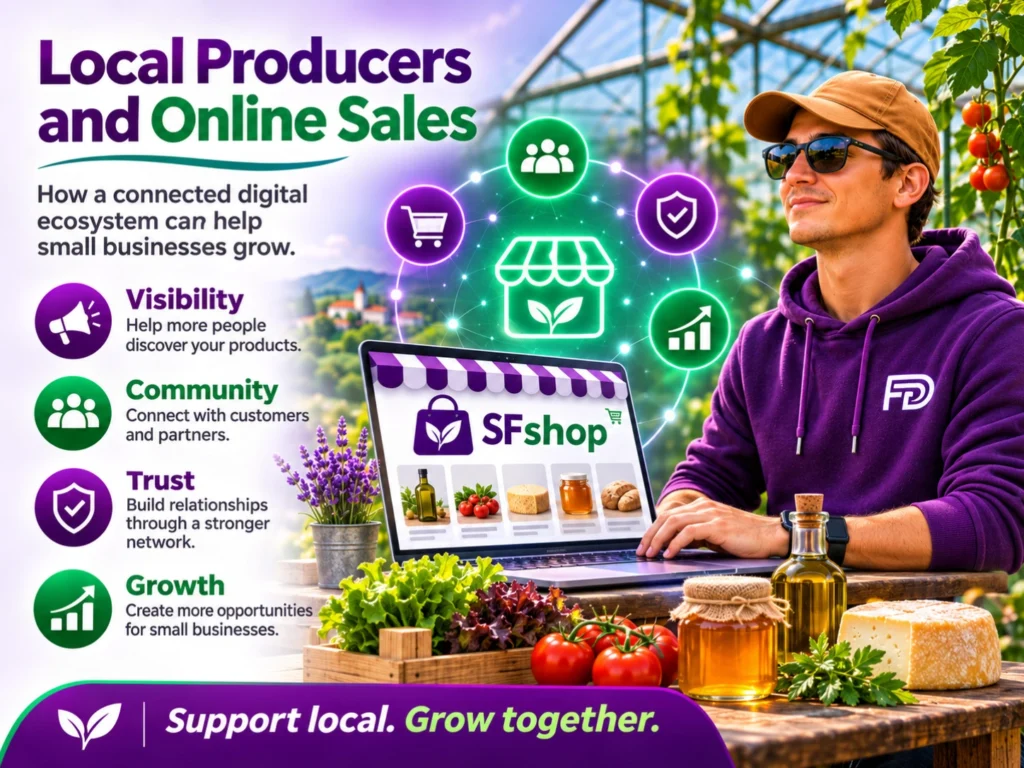
Local producers and online sales should be a perfect match.
A small producer can create an excellent product in a village, town, or local workshop and technically reach customers almost anywhere.
That is what the internet promised us.
But there is still a problem.
Being online does not automatically mean being visible.
A beekeeper can produce excellent honey.
A small family business can make cheese, wine, natural cosmetics, clothing, handmade products, or specialty food.
A designer, consultant, photographer, developer, or other service provider may also have something genuinely useful to offer.
They can build a website.
Open a webshop.
Create an Instagram account.
Post on Facebook.
Run advertising.
And still struggle to reach enough people.
That is why I increasingly believe the interesting question is no longer simply:
“Can local producers sell online?”
Of course they can.
The better question is:
“Can we build a digital system where producers, customers, community, marketing and distribution actually support each other?”
That is one of the parts of the SFT21 Business Concept that interests me most.
A Great Product Can Still Be Invisible
Small producers often have something large companies spend enormous amounts of money trying to manufacture:
authenticity.
A real person.
A real story.
Real knowledge.
A connection with a place.
A product that may have been developed through years or even generations of experience.
But authenticity alone does not create distribution.
Large companies have:
marketing departments,
advertising budgets,
sales teams,
distribution networks,
retail relationships,
agencies,
data,
and established audiences.
A small producer may have:
the product,
a Facebook Page,
a basic webshop,
and perhaps a few hours in the evening to think about marketing.
That is an enormous difference.
The problem is therefore often not:
product quality.
The problem is:
visibility, distribution and access to customers.
And that is where local producers and online sales become much more interesting when we start thinking in terms of ecosystems rather than isolated tools.
Another Webshop Is Not Enough
There is nothing wrong with having your own webshop.
I am a strong supporter of building your own digital presence.
WooCommerce can work.
Shopify can work.
Marketplaces can work.
Social media can work.
But putting a product online is only the first step.
The difficult question comes immediately afterwards:
Who is going to see it?
Who tells people that your product exists?
Who explains the story?
Who recommends it?
Who brings buyers?
Who helps create repeat business?
That is why I think distribution may ultimately matter as much as the shop itself.
SFT21 approaches this problem differently because SFshop is being designed as one part of a connected ecosystem rather than as an isolated online store.
Around it sit:
SFnet — the community and social layer
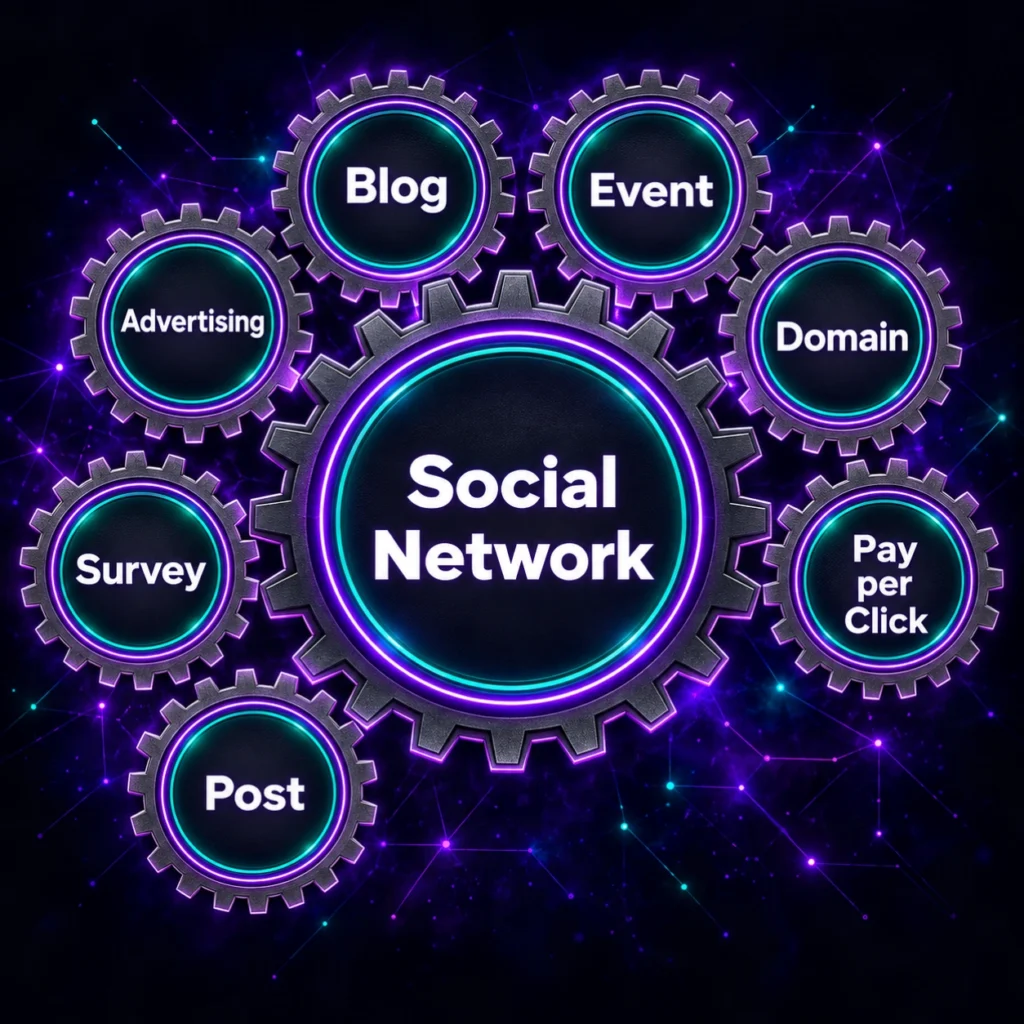
SFoffice — the business infrastructure
and
SFfranchisees — active business participants whose role includes helping develop activity across the ecosystem.
That changes the equation.
The Local-to-Global Idea
There is another aspect of the model that I think deserves more attention.
SFT21 is being developed internationally.
But that does not necessarily mean filling every country with exactly the same products.
The more interesting idea is almost the opposite:
global infrastructure with local participation.
Where the SFT21 franchise community develops, local producers, merchants, service providers, and entrepreneurs can potentially become part of the ecosystem in that market.
Croatia has its producers.
Italy has its producers.
Germany has its producers.
African markets have their own businesses, products, specialties and services.
Other countries have theirs.
The digital infrastructure can be global while much of the economic activity remains local and regional.
I think that is an important distinction.
Global technology does not have to mean replacing local economies.
It can also become infrastructure that helps local businesses reach more people.
Local Does Not Mean Small Anymore
For most of history, geography determined the size of your market.
A producer in a small town primarily sold to people nearby.
Maybe the next city.
Maybe a regional distributor.
The internet changed that.
Today, someone can discover a local Croatian product while living hundreds or thousands of kilometers away.
A regional business can build international visibility without opening physical stores in multiple countries.
That does not mean every local product should suddenly become a global brand.
It means the potential market is no longer defined exclusively by physical distance.
That is one reason the phrase:
think globally, act locally
makes sense here.
The network can grow globally while local producers continue producing what makes their region unique.
Two Ways for a Producer to Enter the Ecosystem
This is where I think the SFT21 model becomes particularly practical.
A producer does not necessarily have to become an SFT21 franchisee simply because they want access to the ecosystem.
Under the planned structure, there are two very different positions:
| Free Business Account | Franchise Business Account | |
|---|---|---|
| Main purpose | Sell and present your own products or services | Build an active business inside the wider ecosystem |
| SFshop presence | Yes | Yes |
| Visibility inside the ecosystem | Yes | Yes |
| Access to customers/community | Yes | Yes |
| Products can be promoted through the wider network | Yes | Yes |
| Franchise work obligations | No | Yes |
| Build a franchise team/position | No | Yes |
| Participate in franchise bonuses/profit distribution | No | Yes, according to franchise rules |
| Additional business activities beyond own product sales | Limited | Yes |
| Best suited for | Producers mainly seeking more visibility and sales | Producers who also want to build a wider SFT21 business |
This distinction is important.
A person who loves producing honey should not automatically be required to become interested in franchise algorithms, business structures and team development.
Maybe they simply want one thing:
more people to discover and buy their honey.
That should be a valid position.
The Free Business Account: “Help Me Reach More Customers”
Imagine a local producer who already has a functioning business.
They have products.
Customers.
Perhaps a small webshop.
Maybe a physical store.
They are not looking for a new career.
They do not want to build a franchise team.
They do not want additional business obligations.
Their question is straightforward:
“Can this system help more people discover what I already produce?”
For that person, the planned free business account could be the logical entry point.
They can participate as a business.
Present products or services.
Become visible to the community.
Potentially gain additional customers.
Use the network around SFshop.
And benefit from activity created by franchisees and users inside the ecosystem.
At the same time, they do not take on the work obligations associated with an active franchise position.
And they do not participate in the company’s franchise profit-distribution mechanisms simply because they have a free business account.
Their primary benefit remains:
more visibility, more potential customers and another sales channel.
That may be completely sufficient.
A Producer Should Not Have to Become a Franchisee
I actually think this separation is healthy.
A business ecosystem becomes much more useful when people can choose roles that match what they actually want to do.
A producer can produce.
A customer can buy.
A creator can create content.
A service provider can provide services.
A franchisee can actively build the business network.
Not everyone needs the same role.
That is how functioning economies work offline too.
We do not expect the person who makes cheese to also operate the supermarket, manage advertising, recruit salespeople, develop software and run the payment system.
Different people contribute different things.
A digital ecosystem should work in much the same way.
What Changes If the Producer Becomes a Franchisee?
Now imagine the same producer uses the ecosystem for a while.
Their products gain visibility.
They understand how SFnet and SFshop work.
They meet people.
They see business activity developing.
And eventually they say:
“I want to participate more actively in this system.”
That opens the second option:
a franchise business position.
Now the producer is doing more than selling their own product.
They can participate in:
building the community,
connecting other producers,
promoting products and services,
developing user activity,
building their own franchise position,
and other forms of business activity defined by the SFT21 franchise model.
That means the producer adds a second business layer to what they already do.
Their first business remains:
their product or service.
Their second layer becomes:
participation in the wider digital franchise ecosystem.
The Producer Is No Longer Limited to Income From Their Own Product
This distinction is especially interesting.
Imagine someone owns a small family farm.
With a free business account, their economic activity inside SFT21 is primarily connected with:
their own products.
They sell honey.
Wine.
Cheese.
Olive oil.
Cosmetics.
Whatever they produce.
If that person becomes an active franchisee, their activity can become broader.
They can also:
connect other businesses,
help develop the community,
promote other products,
introduce users,
develop their business position,
and participate in the various earning and distribution mechanisms defined by the franchise model.
In other words:
their own product does not have to be their only economic connection with the ecosystem.
That is a fundamentally different position.
One of the Biggest Benefits: Producers Gain a Sales Network
This may be the most interesting part for me.
A small producer often has to be everything.
Producer.
Salesperson.
Marketer.
Content creator.
Customer support.
Social media manager.
Photographer.
Delivery coordinator.
And after doing all of that, apparently they should also learn how Instagram Reels work this week. 😄
That is difficult to sustain.
The SFT21 concept introduces another possibility.
Franchisees can become part of the marketing and distribution force around the ecosystem.
Their role is not limited to explaining what SFT21 is.
A functioning franchise network needs economic activity.
That means:
users,
customers,
business partners,
products,
services,
transactions,
and people who create demand.
So franchisees have a reason to help discover and promote quality businesses operating inside the ecosystem.
This creates an interesting alignment of interests.
The producer wants:
sales and visibility.
The franchisee wants:
business activity and ecosystem growth.
The customer wants:
a useful product at a fair price.
The model tries to connect those interests.
What If Your Product Had Hundreds of Potential Promoters?
Think about that from the perspective of a small business.
Normally, marketing is an expense.
You pay:
Google.
Meta.
An agency.
An influencer.
A marketplace.
Or someone else who controls access to an audience.
Now imagine another model.
People inside the ecosystem already have an economic interest in helping the ecosystem grow.
Some of them discover your product.
They like it.
They introduce it to other people.
They create visibility.
They bring customers into the environment.
Suddenly, the producer is not completely alone in distribution.
That does not guarantee sales.
Nothing does.
The product still needs:
quality,
competitive pricing,
good presentation,
reliable service,
and genuine customer demand.
But the starting position is very different from uploading something to an empty webshop and hoping Google eventually finds it.
SFnet Adds the Trust Layer
This is where SFnet becomes particularly relevant.
SFT21 is designing SFnet around verified users.
Identity verification is intended to be required for users of the network.
For casual social-media use, people may debate whether they like that idea.
For business communication, I see an interesting advantage.
If you are a producer and somebody contacts you about:
your product,
a possible collaboration,
distribution,
a service,
or another business relationship,
you know there is an identified person behind the profile.
That creates a different starting point for communication.
It does not mean every verified person is automatically honest.
It does not eliminate the need for normal business judgment.
But it can reduce one of today’s biggest online problems:
not knowing whether the person you are talking to is even real.
For local producers and online sales, trust matters enormously.
SFnet + SFshop Is More Interesting Than Either One Alone
This is where the ecosystem idea becomes clearer.
SFshop gives the product a place to be sold.
SFnet gives the product a place to be discovered and discussed.
The producer can tell their story.
Users can discover the business.
Franchisees can introduce products.
Customers can communicate.
Business relationships can develop.
Instead of commerce and community existing on completely separate platforms, the goal is to connect them.
That matters because many purchasing decisions do not begin with:
“Add to cart.”
They begin with:
“I saw someone talking about this.”
“I know the producer.”
“Someone recommended it.”
“I saw how it was made.”
“I trust the person behind it.”
Then the transaction happens.
A Simple Example: The Local Honey Producer
Imagine a small beekeeper.
They already produce excellent honey.
Their current online presence is:
a Facebook Page,
perhaps an Instagram account,
and maybe a simple website.
Their main problem is not production.
It is discovery.
They join the SFT21 ecosystem through a free business account.
Their products become available through SFshop.
They can build a presence around their business.
Users discover their story through SFnet.
A franchisee in their region notices the product.
Another franchisee mentions it to their audience.
Customers try it.
Some recommend it.
The producer gains additional visibility.
That producer still does not have to become a franchisee.
They can continue doing what they do best:
making honey.
But suppose that six months later they become interested in the business side of the ecosystem.
Then they can explore the franchise role as a separate decision.
That is how I think the distinction should work.
Start with what you need. Expand only if you want more.
This Is Not Only About Physical Products
When I say local producers, I do not mean only food producers.
The same wider ecosystem can potentially include:
craftspeople,
designers,
small manufacturers,
artists,
consultants,
photographers,
digital creators,
service businesses,
local tourism providers,
educators,
and other entrepreneurs.
Some sell physical products.
Others sell expertise.
Others provide services.
And some may not need SFshop in the traditional ecommerce sense at all.
They may find value simply through:
visibility,
networking,
verified business communication,
and access to potential customers.
That broadens the idea significantly.
Wherever the Community Grows, Local Business Can Grow With It
This is one part of the SFT21 vision that I find especially compelling.
Imagine the franchise network expanding into different countries.
The goal does not have to be:
replace local products with one global catalog.
Instead:
connect each market with its own businesses and producers.
Where there are active franchisees, there is a reason to identify:
local producers,
merchants,
services,
entrepreneurs,
and businesses worth introducing to the community.
That creates a decentralized local layer inside a global system.
A Croatian franchise community can work with Croatian producers.
An Italian community can develop relationships with Italian businesses.
A community in an African market can connect local producers and entrepreneurs from that region.
And because the infrastructure itself is digital, those local layers can also connect internationally.
That is where local producers and online sales can move beyond simple ecommerce.
The Community Needs Real Economic Activity
There is also a bigger reason I think producers matter so much.
A digital business ecosystem cannot survive indefinitely by talking only about itself.
It needs:
real products.
Real services.
Real customers.
Real transactions.
Real businesses.
Otherwise, you have a business community discussing the business community.
That is not enough.
Producers bring the real economy into the digital ecosystem.
Customers bring demand.
Franchisees help create distribution and activity.
The platforms connect them.
That is when the word ecosystem starts to mean something.
Supporting Local Does Not Mean Rejecting Global
I do not see this as:
local good, global bad.
International trade gives us enormous benefits.
We have access to products, technologies and services that would have been unimaginable a few decades ago.
But there is value in balance.
If a quality product exists locally, why should nobody know about it?
If a small producer can compete, why should digital visibility automatically belong only to companies with the largest advertising budgets?
Technology can help level part of that playing field.
And perhaps global digital infrastructure can help local businesses become more competitive, rather than simply making them compete against even larger global players.
Where Does the Money We Spend Go?
Every purchase is also a small economic decision.
When you buy from a local producer, part of that value remains closer to the community where the product was created.
The producer can:
hire people,
buy equipment,
purchase local services,
grow production,
pay suppliers,
invest,
and continue operating.
That economic activity has consequences beyond one transaction.
This does not mean consumers should buy a poor product simply because it is local.
Quality still matters.
Price still matters.
Service still matters.
But when quality and value are there, visibility should not be the reason a good local business disappears.
What Still Has to Be Proven
I also want to keep this realistic.
SFT21 is still developing the wider ecosystem.
The real test comes when the platforms are operating at scale.
We need to see:
how many users actually participate,
how active SFnet becomes,
how many producers join SFshop,
whether customers buy,
whether franchisees genuinely help producers gain visibility,
how smoothly business accounts work,
how international and local layers connect,
and whether the ecosystem creates sustainable economic activity.
Those things cannot be proven by a presentation.
They have to be demonstrated in practice.
That is what I will be watching.
Which Account Makes Sense for a Producer?
I would make this decision very simply.
If you already have a business and your main goal is:
more visibility, another sales channel and access to a new community,
start by looking at the free business account when it becomes available.
You do not need to turn your entire business model upside down.
Use the infrastructure.
Explore the community.
See whether it creates value.
If later you decide:
“I want to actively participate in building this ecosystem and develop an additional online business position,”
then investigate the franchise side.
That is a separate decision.
And I think it should remain a separate decision.
Local Producers and Online Sales: The Bigger Opportunity
When I look at local producers and online sales, I no longer think the main challenge is simply getting products onto the internet.
We have solved that technical problem.
Anyone can create a store.
The harder problems are:
visibility.
Trust.
Distribution.
Community.
Customer acquisition.
Repeat relationships.
That is why the SFT21 concept interests me.
SFshop can provide the commerce layer.
SFnet can provide community and communication.
SFoffice provides business infrastructure for active participants.
Franchisees can become a distributed promotional and business-development network.
Producers bring products and services.
Customers bring real economic demand.
And each participant can choose the role that makes sense for them.
A producer does not need to become a franchisee.
But they can.
A customer does not need a business account.
A service provider may use the network differently from a manufacturer.
Different roles can coexist.
That is what a real ecosystem should allow.
Final Thoughts
One question keeps coming back to me:
How many excellent local products never reach us simply because we never discover them?
Probably far too many.
The answer is not necessarily another advertisement.
Or another isolated webshop.
Or another social-media account competing with millions of other accounts for a few seconds of attention.
Maybe the more interesting answer is connection.
Connect producers with customers.
Connect commerce with community.
Connect digital visibility with real businesses.
Connect people who have something valuable with people who are looking for it.
And create economic incentives for others to help those connections happen.
That is the part of the SFT21 Business Concept I think could have consequences far beyond the franchise business itself.
Because if technology can help a local producer sell more, become more visible and build stronger relationships with customers, the value does not remain only online.
It enters the real economy.
The business grows.
People work.
Products are made.
Money circulates.
Communities become stronger.
That is why local producers are not a side story in this concept.
They could become one of the most important parts of it.
And wherever the SFT21 community develops, I want to see local entrepreneurs, producers and service providers become part of that story.
Global infrastructure.
Local impact.
If you are a producer, merchant, craft business, service provider or entrepreneur and want to follow the development of SFshop, SFnet and the SFT21 Business Concept, you can follow my updates here on filipdoric.com.
And if you are wondering whether a future free business account or an active franchise position would make more sense for you, I will continue explaining both options as the ecosystem develops.
Information first. Decision second.
The internet is more than a place for scrolling.
📬 Want more tips like this?
Subscribe to get fresh blog posts directly to your inbox.