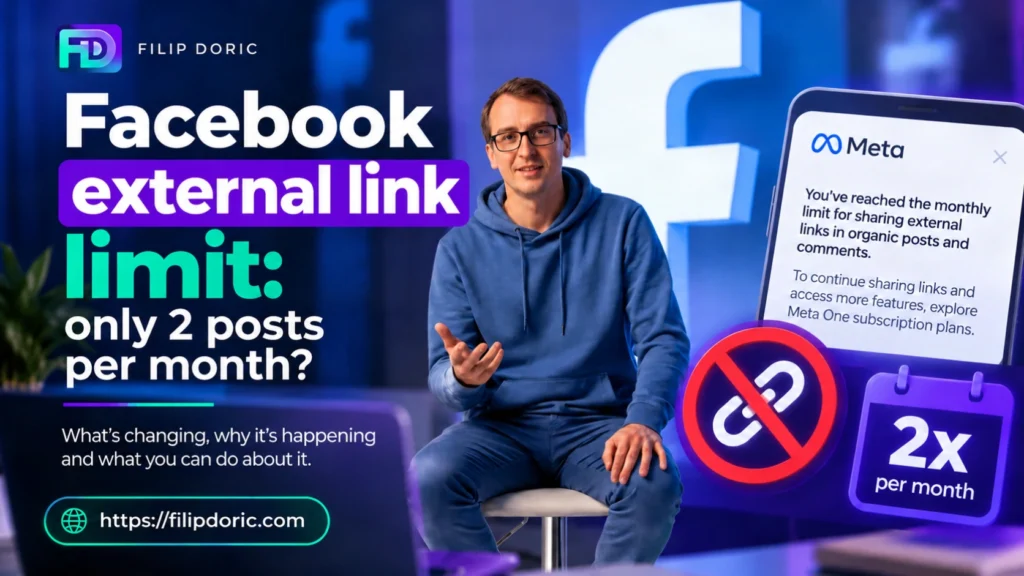
The Facebook external link limit caught my attention for a very simple reason.
At first, I was not sure how seriously to take it.
Facebook without the ability to freely share links to your own website?
That sounds strange when you remember what the web was originally built around:
pages connecting to other pages.
Then I saw the notice on one of my own Facebook Pages.
Suddenly, this was no longer just another social media rumor I had seen someone discussing online. I had the message in front of me.
And after looking more closely at Meta’s current rules, the situation becomes even more interesting.
For Facebook Pages included in the rollout, Meta currently allows links in only two organic posts or comments per month without a qualifying higher-tier Meta One subscription. The restriction does not yet apply to every Page, which is an important distinction.
But I think the bigger story is not really about two links.
It is about something I have been saying for a long time:
If you are building something online, do not build your entire presence on a platform you do not control.
What Is the Facebook External Link Limit?
Let’s start with the practical part.
If your Facebook Page is included in the current system, links can be included in up to two organic posts or comments during the month on the free tier.
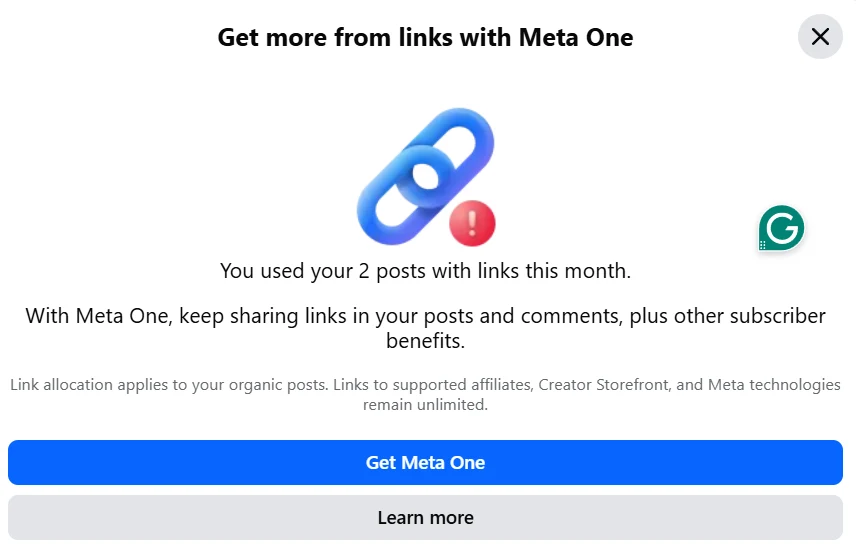
The allowance resets monthly, and unused slots do not carry over.
Importantly, this is not currently a universal rule affecting every Facebook Page.
Some Page administrators already see the restriction.
Others do not.
Meta’s current guidance explicitly allows for that difference, and organizations managing multiple Pages have reported seeing the restriction on some accounts while others remain unaffected.
That matters because headlines like:
Facebook now allows only two links per month.
are too broad.
A more accurate statement is:
Meta is applying a two-link monthly limit to certain Facebook Pages as part of its evolving subscription and link-sharing system.
Whether your Page is affected depends on the account and rollout.
Yes, Links in Comments Can Count Too
This is one of the details I find particularly important.
For years, one of the most repeated Facebook strategies has been:
“Don’t put the link in the post. Put it in the first comment.”
People did this for different reasons.
Some believed external links reduced reach.
Others simply preferred cleaner posts.
But under the current rules for affected Pages, a link published by the Page in a comment can also count toward the monthly limit.
So the old:
“Link in the first comment 👇”
approach is not necessarily a workaround anymore.
If you have an organic post without an external URL and then use your Page to drop a website link underneath it, that comment can use one of your available link slots.
There is an interesting exception.
If the original post already contains a link and therefore already counts toward the limit, additional links in comments under that same post do not necessarily consume another slot under the current rules.
That makes the system a little more nuanced than simply counting every URL.
But the main lesson is clear:
moving a link from the post into a comment no longer automatically solves the problem.
Not Every Link Is Treated the Same
There are also exceptions.
Under the current guidance for affected Pages, links to Meta’s own services — such as Facebook, Instagram, WhatsApp and Threads — are excluded from the monthly external-link allowance.
Links used in ads are also excluded.
Certain affiliate links connected through Facebook’s official affiliate partnerships are treated differently as well.
And that creates an interesting distinction.
A link sending someone deeper into the Meta ecosystem is not treated the same way as a link sending someone to:
your website,
your blog,
your ecommerce store,
your newsletter,
your landing page,
or another external platform.
From the perspective of someone building an independent online presence, those external links are often exactly the links that matter most.
Because that is where your own digital infrastructure begins.
Meta One Changes the Number of Links You Can Share
The link limit is also connected with Meta’s growing subscription strategy for creators and businesses.
As of October 2026, Meta One business plans are being offered in multiple tiers, with pricing and benefits that can vary by region, application and account.
The currently published U.S. structure associated with the Facebook Page link allowance looks roughly like this:
Free – 2 posts or comments with links
Essential – 2
Advanced – 8
Expert – 20
Max – unlimited
Current starting prices reported for those business tiers are approximately $14.99, $49.99, $149.99 and $499.99 per month respectively, although Meta says regional pricing and availability can vary.
One detail is worth emphasizing:
paying for the cheapest Essential tier does not necessarily increase your Facebook Page link allowance.
Under the current structure, the increase begins with Advanced.
That is significant if your only reason for considering a subscription is:
I want to keep sharing links normally.
Almost $50 per month may be perfectly reasonable for a business that also benefits from the other tools included with the plan.
But for a small blogger, freelancer, creator or micro-business?
That is not an insignificant amount of money.
Do Not Subscribe Out of Panic
If the Facebook external link limit appears on your Page, I would not immediately reach for a credit card.
First, look at how you actually use Facebook.
How many external links did you publish last month?
Twenty?
Ten?
Two?
Does Facebook generate meaningful traffic to your website?
How many people click?
Do those visitors subscribe?
Do they buy?
Do they read another article?
Do your external-link posts perform better or worse than your native content?
These questions matter.
A business Page generating significant revenue from Facebook traffic may make a completely different decision from a small blog that receives five clicks per month.
Look at your numbers before you pay to solve a problem.
Sometimes the notification itself feels more dramatic than the practical effect on your business.
But the Principle Behind the Change Matters
Even if your Page has not received the restriction yet, I still think this development deserves attention.
Not because Facebook is suddenly useless.
It isn’t.
I use Facebook regularly.
It remains one of the places where I publish, communicate, meet people, test ideas and distribute content.
But there is a difference between:
using Facebook
and:
building your entire digital identity inside Facebook.
That distinction becomes increasingly important whenever a platform changes the rules.
Today it might be external links.
Tomorrow it could be reach.
A feature.
A format.
Monetization.
API access.
Search visibility.
Account requirements.
Or something we have not considered yet.
Platforms evolve.
Their business models evolve.
And our strategies need to evolve with them.
Social Media Is Rented Digital Space
I sometimes describe social media as rented digital space.
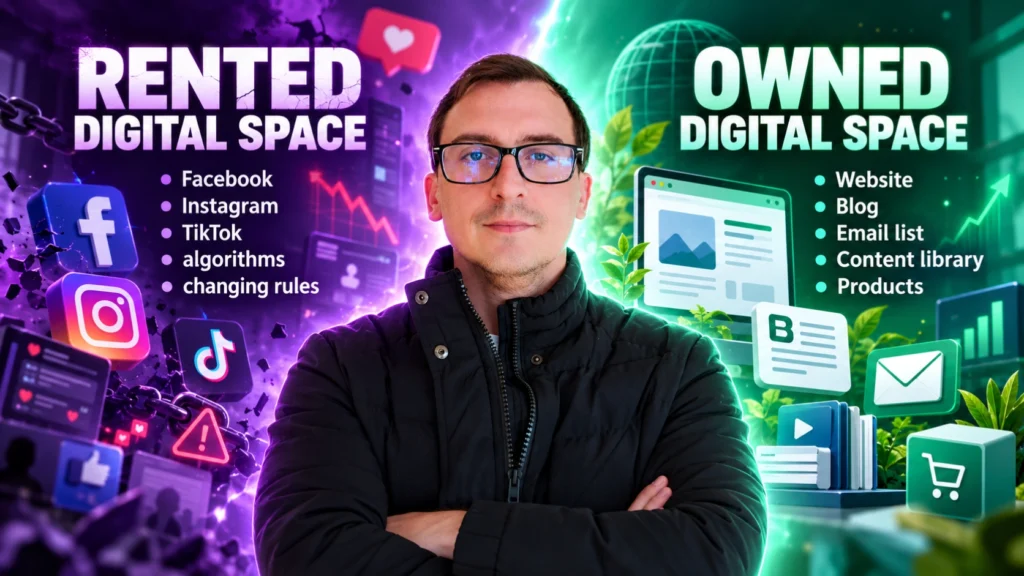
You can make the space beautiful.
Build an audience.
Publish every day.
Create years of content.
Develop relationships.
Build credibility.
But the platform still controls the building.
That does not mean you should leave.
I rent things in real life too.
Renting can be extremely useful.
The problem begins when everything you own depends on the landlord never changing the rules.
Facebook determines how Facebook works.
Instagram determines how Instagram works.
TikTok determines how TikTok works.
LinkedIn determines how LinkedIn works.
You can influence your strategy.
You cannot control the platform.
That is why the Facebook external link limit interests me far beyond Facebook itself.
It is another reminder to ask:
What part of my online presence actually belongs to me?
This Is Why I Still Believe in Websites
Websites sometimes get treated as old-fashioned.
People say:
“Why do I need a website? I have Instagram.”
Or:
“My Facebook Page is my website.”
I understand why.
Social media is easier.
Create an account.
Upload a photo.
Write a bio.
Start publishing.
A website requires more work.
You need a domain.
Hosting.
A platform.
Design.
Maintenance.
SEO.
Content.
But the trade-off is control.
On filipdoric.com, I can publish a 2,000-word article if I want.
I can update it next month.
Change the title.
Add another image.
Embed a video.
Connect related articles.
Build categories.
Create a landing page.
Add a newsletter form.
Change the menu.
Improve the SEO.
Link to a product.
Create an archive.
And I do not need to ask Facebook whether I have already used my second external link for the month.
That difference matters.
A website is not completely independent either.
You still depend on hosting providers, domain registrars, software and traffic sources.
But the level of control is dramatically different.
Your website can become your digital home.
Social networks can then become roads leading people toward it.
Facebook Can Be the Entrance Without Being the Entire House
This is the model I increasingly prefer.
Facebook is useful for discovery.
Conversation.
Short-form content.
Comments.
Community.
Visibility.
A blog serves another role.
It gives me room to go deeper.
YouTube provides another format.
Email gives me a more direct way to stay connected with people who actively want updates.
A landing page can give someone a clear next step.
An ecommerce environment can handle products and transactions.
Different tools perform different jobs.
Connected properly, those pieces become something much stronger than one social profile.
Facebook can be an entrance.
It does not need to be the entire house.
This is also why I keep writing about digital ecosystems.
Not because everyone needs twenty platforms.
They don’t.
The point is to avoid making one platform responsible for absolutely everything.
Your Newsletter Becomes More Important Too
There is another asset I would pay attention to here:
email.
Social followers are valuable.
But you do not decide whether Facebook shows every follower your next post.
You do not control Instagram’s feed.
You do not control whether TikTok recommends your next video.
With an email list, you have a much more direct connection.
That does not mean every email will be opened.
Spam filters exist.
People unsubscribe.
Inbox competition is real.
But the relationship is different.
Someone has explicitly said:
“Yes, you can contact me here.”
That is powerful.
The Facebook external link limit is another reason I like the combination:
social media → website → newsletter
rather than:
social media → more social media → hope the algorithm remembers me tomorrow.
What Would I Do With Only Two External-Link Posts?
If my Page is limited to two link posts during a month, I would not stop publishing.
I would simply become more selective.
Most Facebook posts do not actually need a URL.
You can still:
share a useful observation,
tell a story,
publish a photograph,
upload a native video,
create a Reel,
ask a question,
start a discussion,
share a quick lesson,
or document something you are working on.
Then I would reserve external links for content where moving someone off Facebook has a clear purpose.
For example:
a major new article,
an important landing page,
newsletter registration,
a webinar,
a product,
a free resource,
or another page with a meaningful next step.
That makes each link more intentional.
Not:
“I wrote something, therefore I need to paste the URL.”
But:
“Why should someone leave Facebook for this?”
That is actually a useful marketing question regardless of whether Meta limits links.
Native Content Becomes Even More Important
This also reinforces something that was already happening.
Social platforms generally work best when you create content suited to the platform.
A Facebook post should provide value on Facebook.
A LinkedIn post should make sense on LinkedIn.
A short video should not exist only as an advertisement for somewhere else.
That does not mean every post has to contain your entire article.
A 2,000-word blog post does not need to become a 2,000-word Facebook status.
Instead, extract one idea.
One story.
One argument.
One useful takeaway.
Give the reader something worthwhile even if they never leave the platform.
Then use external links strategically when deeper content makes sense.
That is a healthier content strategy than treating every social network as a notice board covered in:
NEW BLOG POST — CLICK HERE.
Repurposing Becomes More Valuable
Suppose I publish a substantial article on filipdoric.com.
That article does not have to generate only one Facebook post.
I can turn it into:
one short observation,
one longer text post,
a Reel,
a question,
an infographic,
a quote,
a video explanation,
a newsletter topic,
and perhaps one carefully chosen external-link post.
The website remains the source asset.
The social network becomes the distribution and conversation layer.
That is much more resilient.
And it gives every platform content that actually fits the way people use it.
Measure Whether Facebook Traffic Is Worth Paying For
There is another practical lesson here.
If external links become increasingly tied to paid subscriptions, website owners should understand what social traffic is actually worth.
Use analytics.
Look at:
sessions from Facebook
engaged visits
newsletter signups
sales
time on site
pages visited
conversions
Then compare.
Maybe Facebook sends fantastic traffic.
Great.
Perhaps paying for additional functionality eventually makes business sense.
Or maybe you discover that organic search brings ten times more valuable visitors.
Maybe your newsletter drives more sales.
Maybe LinkedIn works better for your audience.
Maybe YouTube sends people who spend much longer on your site.
Without measurement, you are guessing.
Traffic is not valuable simply because it exists.
The right traffic matters.
What About Professional Mode?
There is some history worth mentioning here.
Meta confirmed a limited test in December 2025 involving certain Facebook Pages and some Professional Mode accounts, where users were restricted in how many link posts they could publish without a paid subscription.
The more recent Help Center guidance around the current monthly allowance is specifically framed around Facebook Pages, and the rollout remains uneven.
So I would not assume every Professional Mode profile currently has exactly the same rule.
I use Professional Mode myself, and my approach is simple:
watch what Facebook actually shows on the account.
Policies can change.
Tests expand.
Tests disappear.
Account types differ.
Regions differ.
Whenever Meta changes something important, I would rather work from the current notice and official guidance than from a screenshot someone posted six months ago.
The First-Comment Trick Is Not a Strategy
This deserves repeating because it represents a bigger problem in digital marketing.
People love tactics.
“Put your link in the first comment.”
“Post at exactly 7:43 PM.”
“Use three hashtags.”
“Never say this word.”
“Do this to beat the algorithm.”
Some tactics work for a while.
Then the platform changes.
That is why I prefer principles over hacks.
A useful principle is:
create content people actually want.
Another:
build direct connections where possible.
Another:
do not depend completely on one traffic source.
Another:
measure what works.
Those principles survive algorithm changes much better than tricks.
The current Facebook rules are a perfect example.
If your entire link strategy depended on hiding the URL in the first comment, one policy update can make that tactic largely irrelevant.
This Is Bigger Than Facebook
The deeper lesson from the Facebook external link limit is not:
Facebook bad. Website good.
That would be too simplistic.
Facebook is useful precisely because it offers something my website cannot easily reproduce:
a huge existing network of people.
Discovery.
Conversation.
Communities.
Sharing.
Social context.
My website gives me something different:
ownership and control over the content environment.
Email gives me something else.
YouTube something else.
Search something else.
A good online strategy does not need one winner.
It connects the strengths of different channels.
That is the model I find increasingly interesting.
Build a System, Not Just an Account
Imagine two creators.
The first has 50,000 followers on one social network.
No website.
No email list.
No searchable content library.
No direct audience channel.
The second has 5,000 followers.
But also:
a website,
50 useful articles,
an email list,
a YouTube channel,
search traffic,
a clear personal brand,
and several ways for people to reconnect with them.
Who is in the stronger position if the social platform suddenly changes its rules?
Follower count alone does not answer that question.
Infrastructure matters.
Connections matter.
Diversification matters.
And that is what I mean when I talk about building a digital ecosystem around your work.
Do Not Abandon Facebook – Use It More Intentionally
Nothing about this makes me want to leave Facebook.
Quite the opposite.
If a platform continues giving me access to people I genuinely want to communicate with, I will use it.
But I want to know what role it plays.
For me, Facebook can be:
a discovery channel,
a place for conversations,
a way to test ideas,
a distribution channel,
and a community layer.
My website does not need to replace Facebook.
Facebook does not need to replace my website.
The problem starts when one platform becomes responsible for everything.
The Web Was Built on Links
There is also something slightly ironic about the entire situation.
A hyperlink is one of the simplest and most powerful ideas behind the web.
One page points to another.
You discover something.
You follow the connection.
The open web grows through those connections.
Social platforms created enormous value by organizing people and content inside centralized environments.
But creators, businesses and publishers still need routes back to the places where they build their own assets.
That is why turning external-link capacity into an increasingly premium feature feels significant.
Whether this test expands, changes or disappears later, the signal is still useful:
never assume today’s free distribution channel will operate under the same rules forever.
What I Am Changing
My response is not dramatic.
I am not deleting Facebook.
I am not stopping social media.
I am not rushing to buy the most expensive Meta subscription.
Instead, I am continuing to do what I already believe makes sense:
build my own websites,
publish useful long-form content,
grow my newsletter,
use social media for distribution and relationships,
repurpose content intelligently,
and avoid depending completely on one algorithm.
The Croatian version of this story came directly from seeing the limitation appear on my own Page, which made an abstract platform-policy discussion suddenly very practical.
The English version leads me to a broader conclusion.
Platform rules can change faster than the business you are trying to build.
Your strategy needs to survive that.
Facebook External Link Limit: The Question I Would Ask
Instead of asking only:
“How do I get around Facebook’s link limit?”
I think there is a better question:
“If Facebook stopped sending me traffic tomorrow, what would remain?”
Would you still have:
a website?
Google traffic?
an email list?
customers?
a blog?
a community?
a brand people recognize?
other social channels?
direct relationships?
If the answer is yes, a Facebook policy change is an inconvenience.
If the answer is:
“Not much.”
then perhaps the link limit has revealed a bigger weakness.
Build Something You Can Keep
Social networks are incredibly useful.
Use them.
Learn how they work.
Create content.
Meet people.
Build relationships.
Experiment.
Grow.
But remember:
their platforms are theirs.
Your website can be yours.
Your articles can become your content library.
Your email list can become a direct connection.
Your knowledge can become an asset.
Your products can become part of a business you control.
And the relationships you build can extend beyond whatever platform introduced you in the first place.
That is the part worth protecting.
The Facebook external link limit may eventually change again.
Maybe the rollout expands.
Maybe Meta adjusts the numbers.
Maybe the subscription structure changes.
Maybe some accounts never receive it.
But the larger lesson does not depend on what Meta does next.
Do not build your entire house on borrowed digital land.
Use the platforms.
But build something of your own too.
If you are interested in social networks, digital tools, online business and building a stronger online presence that does not depend on a single platform, join my newsletter.
I share new articles, practical observations and updates from the digital projects I am building and following.
The internet is more than a place to scroll.
It is also a place to build something you can still use when the algorithm changes tomorrow.
📬 Want more tips like this?
Subscribe to get fresh blog posts directly to your inbox.