
Email marketing with Systeme.io may not sound as exciting as launching a new TikTok account, publishing a viral Reel, or testing the latest AI tool.
Email feels old.
Familiar.
Almost too simple.
Some younger people entering the digital world may even wonder why anyone still talks about newsletters.
They have TikTok.
Instagram.
YouTube.
Facebook.
Messages arrive through Messenger, WhatsApp, and dozens of other applications.
Why would they need email?
That is a fair question.
But old does not automatically mean outdated.
A website is older than TikTok.
Search engines are older than Instagram.
Blogs existed long before short-form video became popular.
Yet people still use all of them to research products, compare services, learn new skills, and make business decisions.
Email continues to play an important role for the same reason.
It gives you a way to continue communicating with people after the social media post disappears from their feed.
And that is where the real story begins.
Social Media May Create the First Contact
Social networks are excellent at attracting attention.
Someone may discover you through a Facebook post.
They may watch your Instagram Reel.
They may find one of your videos on TikTok or YouTube.
Perhaps they see your comment under someone else’s post and visit your profile.
That first contact matters.
It may be the beginning of a customer relationship, collaboration, friendship, or business opportunity.
But it may also last only ten seconds.
The person looks at your profile.
Scrolls through several posts.
Then something else appears.
A message arrives.
A new video starts playing.
Someone calls them.
They close the application.
Your content may have been useful, but the person may never find you again.
This does not mean social media failed.
It did its job.
It created discovery.
The question is:
What happens after discovery?
I have already written about [why Facebook still matters for organic marketing and online presence] and the different roles of a [Facebook profile and Facebook Page].
Those platforms can help you become visible.
But visibility alone does not create a complete online system.
You also need somewhere to send that attention.
And you need a way to continue the relationship.
What Is Email Marketing?
Email marketing is the use of email to communicate with people who have voluntarily expressed interest in your content, products, services, or project.
That communication may include:
- regular newsletters
- educational email sequences
- new article notifications
- product updates
- project news
- invitations
- recommendations
- customer onboarding
- reminders
- personal stories
- special offers
Email marketing is not simply sending promotions.
It is not collecting as many addresses as possible and sending everyone the same sales message.
At its best, email marketing gives interested people a reason to stay connected with your work.
Someone may join your list because they downloaded a guide.
Another person may want your new articles.
Someone else may be following the development of a business project.
A customer may subscribe because they want information about future products.
These people do not necessarily need the same message.
But they have all taken one important step.
They have given you permission to contact them again.
Imagine Your Favourite Creator Suddenly Disappears
Imagine you follow a creator online.
Let us call the brand Blue Whale.
You have seen Blue Whale’s Facebook posts for months.
You enjoy the videos.
You recognize the tone.
You understand what the person talks about.
Then one day, Blue Whale becomes silent.
No new posts.
No videos.
No explanation.
You may wonder whether the creator stopped working.
Perhaps the account was restricted.
Perhaps the platform changed its reach.
Perhaps Blue Whale simply decided to spend less time publicly posting.
But the business may still be active.
The creator may be publishing articles.
Working with clients.
Developing a product.
Sending useful information to newsletter subscribers.
If your entire relationship existed inside one social feed, silence on that platform looks like disappearance.
If you joined the creator’s email list, the conversation can continue elsewhere.
That is one of the most useful roles of email.
It creates continuity.
You Are Not Only Building Followers
When people begin creating content, they often focus on follower numbers.
How many people follow the profile?
How many viewed the Reel?
How many liked the post?
Those numbers can be useful.
They show whether content is reaching people.
But a personal brand is not simply a follower count.
A personal brand is the collection of ideas, experiences, values, messages, and expectations that people connect with your name.
You do not need a Spider-Man-level brand symbol that people recognize across the entire planet.
But you do need consistency.
People should gradually understand:
- who you are
- what you talk about
- who you help
- what you believe
- what kind of work you do
- why they should continue following you
Social media can introduce that brand.
Your website can explain it.
Your newsletter can deepen it.
That is an important difference.
A social post may give someone one small piece of your story.
An email gives you more space to provide context.
You can explain why you changed your opinion.
Describe what you learned.
Share what happened behind the scenes.
Answer a question that cannot be properly addressed in a fifteen-second video.
Personal brands are rarely built through one viral moment.
They are built through repeated, recognizable communication.
A Follower Is Not the Same as a Direct Contact
People sometimes say:
You own your email list.
I understand the idea behind that statement, but I would phrase it more carefully.
You do not own people.
Subscribers can leave whenever they choose.
An email platform is also an external service.
It can change its pricing, policies, or features.
Email providers decide whether a message reaches the primary inbox, a promotional tab, or the spam folder.
So email does not give you complete independence.
What it gives you is a more portable and direct communication channel.
Most reputable email platforms allow you to export your contacts and transfer them to another provider.
You cannot normally export all your Facebook followers and move them to Instagram.
You cannot download your TikTok audience and import it into a different social network.
Your email list can move with you, provided you collected those contacts properly and continue respecting their consent.
That gives your online business more stability.
Your Website Gives Attention a Destination
A website is another important part of this structure.
Someone can discover you on a social network and then visit your website to understand the larger picture.
Your website can answer questions that a social profile cannot always answer clearly:
Who are you?
What do you do?
Who do you help?
What do you offer?
What should a new visitor explore first?
How can someone contact you?
Where can they read your best content?
How can they stay connected?
A website gives your personal brand a home.
But a website visitor can still leave.
They may read one article and disappear.
They may like your work but not be ready to contact you.
They may plan to return and then forget the website’s name.
A newsletter creates a possible next step.
The visitor does not have to buy anything.
They do not have to book a call.
They can simply say:
This topic interests me. You may contact me again.
That is a small step.
But it can become the beginning of a longer relationship.
How Email Connects Your Content
Suppose someone discovers one of your Facebook posts.
The post leads them to an article on your website.
At the end of the article, you offer a useful PDF.
They enter their email address and receive the guide.
Several days later, you send another article connected to the same subject.
Later, they watch one of your videos.
Perhaps they join your Facebook group.
Eventually, they explore your product, service, or business project.
This is not a collection of random activities.
The parts support each other.
Social media creates discovery.
The website provides depth.
The lead magnet gives a reason to subscribe.
Email continues the communication.
The community creates participation.
The product or service provides the next practical step.
That is the beginning of a digital ecosystem.
Email Marketing Is One Part of a Digital Ecosystem
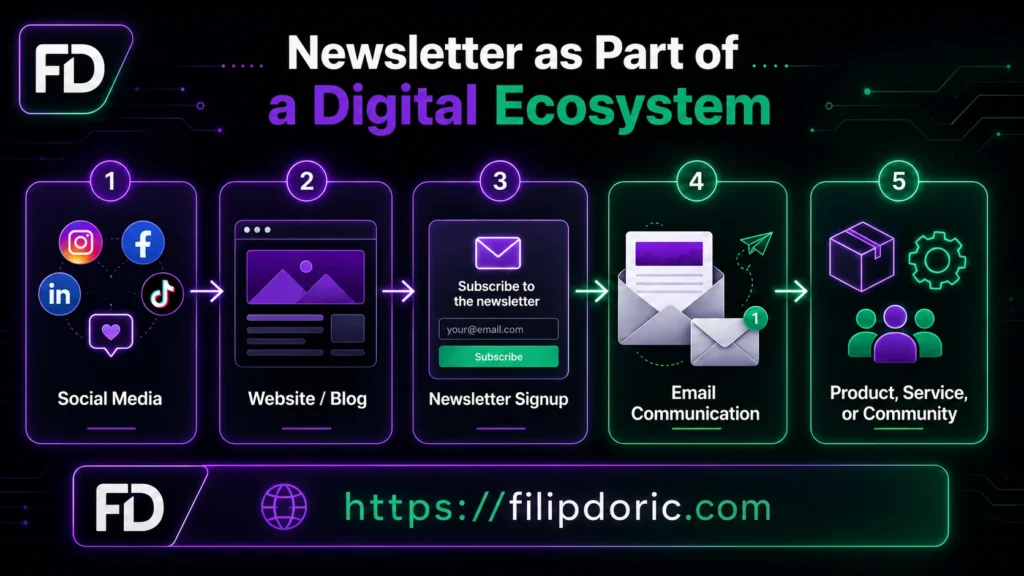
I do not see a newsletter as an isolated marketing trick.
It is one layer of a larger structure.
A digital ecosystem may include:
- social media profiles
- a website
- a blog
- search traffic
- videos
- an email list
- a community
- an online store
- digital products
- services
- business tools
- customer support
You do not need every element on the first day.
More tools do not automatically create a better business.
You can have six social profiles, three websites, four landing-page builders, and fifteen AI applications—and still have no clear system.
The real question is whether the parts are connected.
Where do people discover you?
What do they find after arriving?
What is their next useful step?
How can they continue following the topic?
Where do you direct them later?
Email often acts as the bridge between those parts.
A Sales Funnel and Digital Ecosystem Are Not the Same
Email marketing is frequently discussed in the context of sales funnels.
That makes sense.
A basic funnel might work like this:
A person sees an advertisement or social post.
They visit a landing page.
They download a free resource.
They receive several automated emails.
The final message introduces an offer.
The funnel has a defined direction.
It guides someone toward a specific action.
A digital ecosystem is broader.
A person may discover you through Google.
Later, they see your Facebook post.
They subscribe to your newsletter.
Then they watch a video.
After several weeks, they join your community.
They return to the blog through another email.
They may buy a product months later—or never buy one but still recommend your work to someone else.
The journey is not always a straight line.
A funnel asks:
How do we guide someone toward a particular result?
A digital ecosystem asks:
How do all parts of our online presence create long-term value together?
An email campaign can be part of a funnel.
Your newsletter can also remain active long after that funnel has ended.
I explored this distinction in more detail in [Digital Ecosystem vs Sales Funnel: What’s the Difference and Why It Matters More Than Ever]. The two concepts can work together, but they should not be treated as identical.
Where Systeme.io Fits Into the Structure
Once you understand the role of email, you need a tool that can collect contacts and send messages.
There are many good email marketing platforms.
Some are designed primarily for newsletters.
Some focus on ecommerce.
Others offer advanced customer relationship management and automation.
The tool I currently use and often recommend to people starting online is Systeme.io.
Systeme.io describes itself as an all-in-one marketing platform.
Inside one account, you can create:
- opt-in forms
- landing pages
- email broadcasts
- automated email sequences
- tags and segments
- sales funnels
- online courses
- digital products
- affiliate programs
This is useful because your email list does not have to remain disconnected from the rest of your online system.
A person can subscribe through a landing page and automatically enter an email campaign.
A customer can make a purchase and receive a different sequence.
A contact can be tagged according to an action or interest.
The platform’s email tools currently include broadcasts, automated sequences, newsletter scheduling, segmentation, a visual editor, and performance data such as opens and clicks.
Why I Recommend Email Marketing With Systeme.io
I do not recommend Systeme.io because I believe it is the only good option.
It is not.
I recommend it because it lowers the barrier to starting.
A beginner does not necessarily want to connect:
- one tool for forms
- another for email
- another for landing pages
- another for automation
- another for digital products
- another for affiliate management
Each additional connection creates another place where something can break or become confusing.
Systeme.io puts many of those functions in one dashboard.
That does not mean you must use every feature.
You can have your main website on WordPress and use Systeme.io only for:
- collecting subscribers
- delivering your lead magnet
- sending newsletters
- running an automated welcome series
That is close to how I use it.
My website remains my main digital asset.
Systeme.io supports the email and campaign layer behind it.
What Is Included in the Free Systeme.io Plan?
At the time of writing, Systeme.io’s free plan supports up to 2,000 contacts and includes unlimited email sending.
It also includes limited access to funnels, automation, a custom domain, a course, and other core tools. The free account does not require a credit card and does not expire automatically.
That is enough for someone who wants to:
- test a newsletter idea
- create a simple opt-in page
- deliver a free PDF
- write a welcome campaign
- send regular emails
- learn how the platform works
The free plan has limits.
For example, you cannot create unlimited campaigns, automation rules, tags, and funnels.
But limits are not always a problem at the beginning.
They may encourage you to build one simple system before creating ten complicated ones.
Because plans and prices can change, always check the current details before choosing or upgrading.
A Simple Email Marketing System for Beginners
You do not need twenty automations.
You do not need complex behavioural scoring.
You do not need to email people every day.
Your first system can be very simple.
Step 1: Give people a clear reason to subscribe
“Join my newsletter” is not always enough.
Explain what they will receive.
Perhaps you offer:
- a free guide
- your newest articles
- practical online business insights
- recommendations for useful tools
- updates about a developing project
- early information
- a short educational email series
The promise should be honest and specific.
Step 2: Create a simple form or landing page
Ask only for the information you really need.
In many cases, an email address is enough.
You can also request a first name if you plan to personalize your messages.
Do not make the process unnecessarily complicated.
Step 3: Send a welcome email
Confirm that the subscription worked.
Deliver the promised resource.
Remind the reader what type of content they can expect.
Tell them briefly who you are.
Give them one useful next step.
Step 4: Continue with several helpful messages
The next email could introduce your main topic.
Another could share a useful article.
The third might answer a common question.
Only after providing context should you present a relevant product, service, or opportunity.
Step 5: Send regular broadcasts
An automated welcome series is useful.
But your list should not hear from you only through old automation.
Send new thoughts.
Fresh articles.
Updates.
Lessons from your work.
Recommendations you genuinely use.
Your newsletter should feel alive.
What Should You Write About?
Many people delay starting because they do not know what to send.
You do not need to invent a completely new topic for every email.
Start with the work you already do.
Turn a blog article into a shorter email.
Expand on a social media post.
Answer a question someone asked you.
Explain a decision you made.
Share a mistake.
Recommend a tool.
Describe what you are currently learning.
Show what is happening behind a project.
A useful newsletter may contain only one idea.
One story.
One lesson.
One link.
You do not need to fill every email with five promotions, three videos, and an emergency countdown clock.
Give the message one purpose.
Email Should Strengthen Your Brand, Not Damage Trust
Email is direct.
That makes it powerful.
It also means you should treat the inbox with respect.
Do not pretend every subscriber is your close friend.
Do not manufacture urgency every week.
Do not hide the unsubscribe link.
Do not buy lists of people who never asked to hear from you.
Do not disappear for a year and then return with an aggressive sales sequence.
Trust grows when people understand why they receive your messages and consistently find something useful inside them.
A smaller engaged list is more valuable than a large list of people who do not remember you.
Systeme.io Is a Tool, Not the Strategy
Installing Systeme.io will not create your message.
It will not define your audience.
It will not decide why someone should subscribe.
It will not make weak content interesting.
It will not turn strangers into loyal customers automatically.
The platform provides infrastructure.
You still need to answer the important questions:
Who are you helping?
What do they want to understand?
Why should they trust you?
What will you send?
How often will you communicate?
What should they do after reading?
The same principle applies to every digital tool.
A good tool supports a clear strategy.
It cannot replace one.
Start Email Marketing With Systeme.io
You do not have to abandon social media.
You do not have to become an email marketing expert.
You do not need a large audience.
Start with one simple connection:
Social media → website or landing page → email subscription → useful communication
Then gradually connect the other parts.
Your blog.
Your digital products.
Your community.
Your services.
Your online store.
Your wider business idea.
That is how separate tools begin becoming a system.
And that is why I continue using and recommending email marketing with Systeme.io.
It gives me a practical way to connect content, subscribers, campaigns, and future offers without building an unnecessarily complicated technical setup.
Final Thoughts
Email marketing is not new.
That is not a weakness.
The internet changes quickly, but people still need reliable ways to communicate.
A social network can help you become visible.
Your website can explain your work.
Your personal brand can make you recognizable.
Your newsletter can help people remain connected long enough to understand what you are building.
Not every subscriber will become a customer.
Not every email will be opened.
Not every campaign will perform equally well.
But every person who joins your list has given you something valuable:
Permission to continue the conversation.
Treat that permission carefully.
Use it to help.
Use it to explain.
Use it to build trust.
And connect it with the wider digital ecosystem around your work.
Start Your Free Systeme.io Account
Systeme.io allows you to begin building your email list without an initial monthly subscription.
Create your first form.
Write your welcome email.
Share something useful.
You can improve the system as your audience and experience grow.
START YOUR FREE SYSTEME.IO ACCOUNT
Disclosure: This is an affiliate link. If you later purchase a paid Systeme.io plan through my link, I may receive a commission at no additional cost to you. I recommend the platform because I personally use it in my online projects.
Stay Connected With My Digital Journey
I write about social networks, websites, ecommerce, email marketing, digital tools, and the connected systems behind modern online business.
I also share updates about the developing SFT21 Business Concept and the wider movement toward digital ecosystems.
Join my newsletter to receive new articles, practical insights, and early information directly in your inbox.
No daily spam.
No manufactured urgency.
Just useful information and the next part of the story.
📬 Want more tips like this?
Subscribe to get fresh blog posts directly to your inbox.


