A digital franchise model may represent something many online marketers have been looking for without knowing exactly how to describe it.
Not another course.
Not another short-lived launch.
Not another program in which everyone promotes the same opportunity to the same recycled audience.
Something more structured.
Something that connects people, products, tools, communities, and business roles inside a wider system.
I have spent enough time in online marketing to remember when affiliate marketing felt much simpler.
You used a product.
You liked it.
You shared your recommendation.
And if someone purchased through your link, you received a commission.
That was the basic idea.
Simple.
Useful.
Based on real experience.
Affiliate marketing still works that way in many cases.
I still believe honest recommendations can be a valuable part of an online business.
But the term “affiliate marketing” is now used for so many different activities that it sometimes becomes difficult to know what people are actually talking about.
Are they recommending a useful product?
Are they promoting a course about affiliate marketing?
Are they recruiting people into a coaching program?
Are they joining a system that primarily teaches its members how to promote the same system to someone else?
These are not necessarily the same business model.
Yet they are often placed under the same label.
At some point, we need to look beyond the terminology and ask a more important question:
What are we actually building?
I Miss the Old Days of Affiliate Marketing
Sometimes I genuinely miss the old days of affiliate marketing.
Not because everything was perfect.
It was not.
There were poor products, exaggerated claims, unreliable merchants, and programs that disappeared without warning.
But the basic relationship was easier to understand.
A business created a product.
An affiliate used or studied that product.
The affiliate recommended it to an audience.
The business paid a commission when a sale occurred.
The product remained at the centre of the relationship.
Today, the product is sometimes difficult to identify.
A person joins a program that teaches affiliate marketing.
The main task is to promote that program to other people who want to learn affiliate marketing.
Those people join and begin promoting the same program to the next group.
The educational product may still contain useful information.
The coaches may be knowledgeable.
Participants may receive genuine support.
But the commercial structure often depends heavily on continuously bringing new people into the same environment.
At that point, it begins to feel less like the affiliate marketing I remember.
The recommendation is no longer primarily:
I used this tool and it helped me solve a problem.
It becomes:
Join the program I joined so you can learn how to promote the program you joined.
That difference matters.
There Is Nothing Wrong With Earning a Commission
I want to be clear about this.
There is nothing wrong with earning affiliate commissions.
There is nothing wrong with promoting a course when you genuinely believe it can help someone.
There is nothing wrong with building an online income.
Businesses need sales.
Creators need to be compensated.
Marketers should be rewarded when they connect the right product with the right customer.
Affiliate marketing can be an excellent arrangement.
The business gains a customer.
The customer discovers a useful solution.
The affiliate earns a commission.
Everyone can benefit.
The problem begins when the commission becomes more important than the usefulness of the recommendation.
Or when people are taught to promote products they have barely used.
Or when every conversation becomes a path toward the same coaching program.
Or when an entire online presence exists only to recruit the next participant.
That may still create income for some people.
But is it building a lasting digital asset?
Is it creating a recognizable brand?
Is it building a community with value beyond recruitment?
Is it giving the participant a defined long-term position?
Those are different questions.
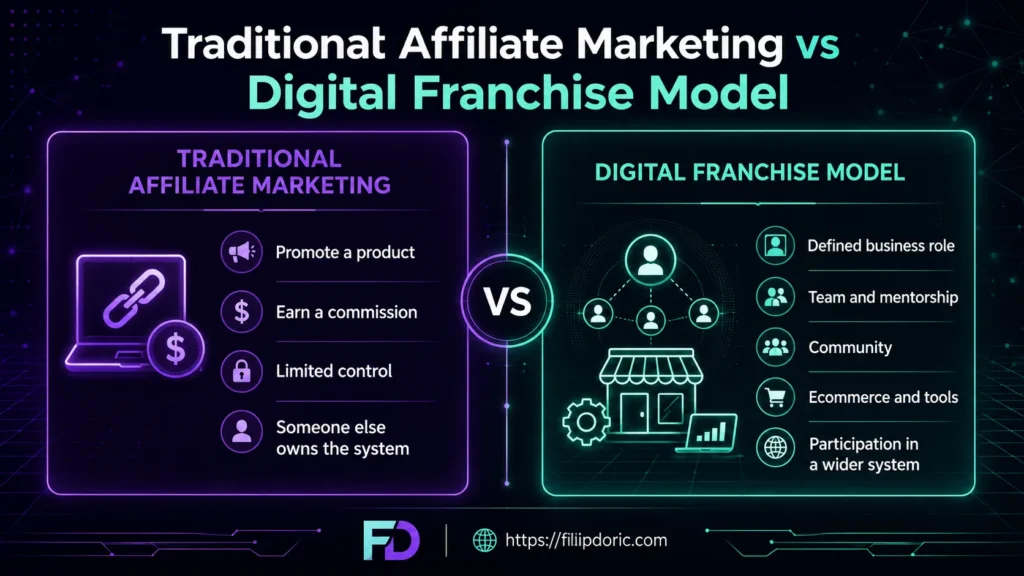
Affiliate Marketing Is Often Built Around Someone Else’s System
When you are an affiliate, you usually operate inside a structure that belongs to someone else.
Someone else owns the product.
Someone else controls the sales page.
Someone else determines the commission.
Someone else manages the customer relationship.
Someone else can change the rules.
The program may reduce its commission rate.
The product may disappear.
The company may close its affiliate program.
The sales page may stop converting.
The market may become saturated.
Your income can depend on decisions you do not control.
This does not make affiliate marketing bad.
It means affiliate marketing should be understood for what it is.
It is a distribution model.
You help distribute someone else’s product and receive compensation when your promotion produces a result.
That can be one useful layer of a wider online business.
But it does not always create a complete business structure for the affiliate.
What Happens When You Want to Build More Than Promotions?
Some people do not only want to share links.
They want to build a team.
They want to mentor others.
They want to participate in the development of something larger.
They want access to tools, products, customers, and different ways of creating value.
They want to build a position rather than constantly search for the next program to promote.
That is where the idea of a digital franchise model becomes interesting.
A traditional franchise gives someone the right to operate within an established business system.
The person does not usually invent the entire structure from zero.
The brand, processes, products, training, and operating model already exist.
The franchise partner enters that structure and develops a business within it.
A digital franchise attempts to bring parts of that logic into an online environment.
The exact structure can vary.
But the general idea is broader than receiving a unique affiliate link.
It may involve:
- a defined business role
- digital tools
- training and mentorship
- a community
- products or services
- ecommerce
- customer acquisition
- team development
- operational systems
- multiple ways of participating
The goal is not only to promote one offer.
The goal is to operate within a connected business structure.
A Digital Franchise Model Is Not Just Another Funnel
Sales funnels are useful.
They help guide a person from attention toward a specific action.
A simple funnel may look like this:
A person sees a post.
They visit a landing page.
They download a guide.
They receive several emails.
They are introduced to an offer.
That process can work very well.
But a funnel is not the entire business.
A digital franchise model can contain funnels, but it should provide a wider structure around them.
It may connect:
- a social network where people discover and communicate
- a webshop where products are presented and purchased
- a dashboard where business activities are managed
- a community where participants receive support
- a mentorship structure
- customer and partner roles
- content and education
- rewards or compensation mechanisms
A funnel focuses on movement toward one outcome.
An ecosystem focuses on how many different parts continue working together.
That is why I regularly distinguish between a sales funnel and a digital ecosystem.
A funnel may bring someone into the system.
The ecosystem gives them reasons to remain, participate, purchase, contribute, and grow.
Affiliate Marketing Can Still Be Part of the Ecosystem
Moving toward a digital franchise model does not mean affiliate marketing becomes irrelevant.
Affiliate marketing can remain one component.
A participant may still recommend products.
A creator may still receive a commission for generating a sale.
A business may still use referral links to track customer acquisition.
The difference is that the affiliate relationship is no longer the entire structure.
Imagine a digital environment that includes:
- content
- social interaction
- an online store
- independent producers
- customers
- business partners
- teams
- educational resources
- referral opportunities
- long-term community participation
Affiliate marketing can help connect customers with relevant products inside that environment.
But the wider system does not need to depend entirely on recruiting new affiliates into another affiliate course.
That is the bigger picture.
Why the Same Online Programs Keep Appearing
Many online marketers operate inside relatively small circles.
The same people follow the same coaches.
They join the same launches.
They promote the same products.
Their feeds are filled with the same messages.
A new course launches, and suddenly dozens of people begin posting about it.
A new software platform appears, and the same audience receives recommendations from multiple affiliates.
A new coaching program opens, and everyone begins discussing the same framework.
Then the launch ends.
The attention moves somewhere else.
This cycle can create money.
It can also create exhaustion.
The audience sees similar promises repeatedly.
Marketers begin selling to other marketers.
Those marketers attempt to sell to the next group of marketers.
The circle becomes smaller, even when the language sounds global.
But the online business world is much larger than one Facebook circle.
There are entrepreneurs, producers, customers, creators, communities, and organizations developing projects that many mainstream marketers have never seen.
That is why something can be built quietly for years and still surprise a market when it becomes more visible.
Something Different Can Appear
Imagine that while much of the market is promoting another launch, another project is being developed in the background.
Not simply a course.
Not simply a compensation plan.
Not simply a webshop.
A connected structure.
A social network.
A marketplace.
A business dashboard.
A community.
A digital franchise model.
When such a project begins attracting wider attention, some people will ask:
How did I not hear about this before?
The answer may be simple.
They were watching the same people.
Following the same launches.
Reading the same posts.
Participating in the same recycled conversations.
Meanwhile, another team was gathering outside that circle.
The SFT21 Business Concept as a Developing Example
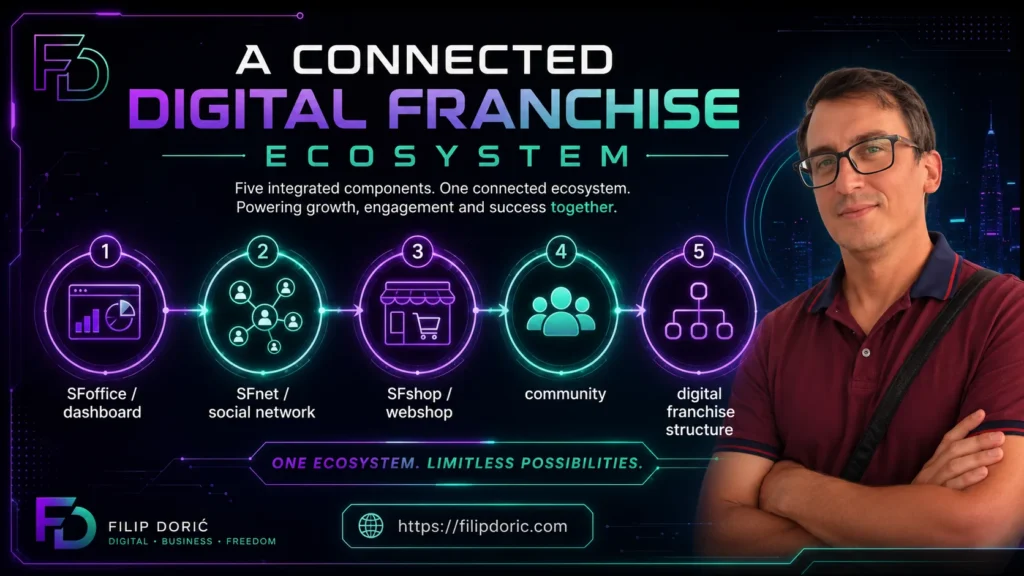
The SFT21 Business Concept is one project attempting to develop this broader kind of structure.
The concept connects several ideas:
- a digital ecosystem
- a social network
- a webshop
- business tools
- community participation
- customer and business roles
- a digital franchise structure
The project is still in its pre-launch stage.
That point should not be hidden.
A developing project is not the same as a fully proven business operating at scale.
Features must be completed.
Systems must be tested.
The market must respond.
The team must execute.
Announcements can show direction.
Execution determines results.
That is why I do not believe people should participate based only on excitement.
They should study the available information.
Ask questions.
Understand what exists today and what is still being developed.
Review the legal and contractual framework.
Understand the role they are considering.
And decide whether the concept aligns with their goals and risk tolerance.
Early information is valuable only when it gives you more time to understand.
It should not be used to pressure you into a decision you do not understand.
Being Early Does Not Mean Acting Blindly
Online marketers often create urgency around being early.
Sometimes timing does matter.
Entering a project before wider market attention can create different possibilities than discovering it after everyone is already talking about it.
But “early” should never become a replacement for due diligence.
Being early should give you:
- time to study
- time to observe
- time to ask questions
- time to understand the structure
- time to meet the people involved
- time to decide whether it fits you
It should not mean:
- ignore the risks
- stop asking questions
- believe every announcement
- expect guaranteed income
- rush because someone says the opportunity will disappear
There is a difference between recognizing an emerging direction and blindly following hype.
That difference matters to me.
Is a Digital Franchise Model Right for Everyone?
No.
Some people prefer traditional affiliate marketing.
They do not want to build a team.
They do not want an operational role.
They want to recommend useful products, create content, and receive commissions.
That is completely valid.
Other people want full independence.
They want to create their own products, build their own company, and control every part of the business.
That is also valid.
A digital franchise model may be more interesting to someone who wants:
- a structured system
- mentorship
- a defined business role
- a community
- team-building possibilities
- access to connected tools
- participation in a larger project
- more than one potential business activity
But structure comes with responsibility.
A serious business model requires work.
It requires communication.
Learning.
Consistency.
Customer understanding.
Team support.
And patience.
A digital franchise is not a magic button simply because it uses a new name.
The quality of the structure and the people executing it still matters.
What Should You Examine?
Before becoming involved in any digital franchise model, ask practical questions.
What exactly is being built?
Which parts already exist?
Which parts remain under development?
Who legally operates the project?
What agreements define your role?
How does the company generate revenue outside partner participation?
What products or services provide value to customers?
What responsibilities do participants have?
How are commissions or rewards calculated?
What happens if you stop participating?
Can you exit?
What support and training are available?
How dependent is the model on constant recruitment?
Clear answers do not remove every risk.
But vague answers increase it.
A serious project should be able to explain its basic structure without hiding behind excitement, complicated terminology, or promises of future wealth.
Are You Looking for Another Program or a Bigger Picture?
That may be the central question.
Are you searching for another affiliate program to promote for several months?
Or are you looking for a position inside something designed to develop over a longer period?
Do you want one more link?
Or a wider business structure?
Do you only want commissions?
Or do you also want tools, community, mentorship, products, customers, and a role in building a team?
There is no universally correct answer.
But you should know which question you are actually trying to answer.
Sometimes people join affiliate programs while secretly wanting something much larger.
They want belonging.
Leadership.
Structure.
Long-term participation.
They want to help build something.
If that describes you, another recycled affiliate course may not solve the real problem.
A digital franchise model may be worth studying.
Not because every digital franchise will succeed.
Not because new automatically means better.
But because online business is evolving beyond isolated tools, links, and short-term launches.
Final Thoughts
Affiliate marketing still has a place in online business.
I continue to recommend tools and products I personally use.
When someone purchases through one of my links, I may earn a commission.
I do not see anything wrong with that.
The recommendation should be relevant.
The relationship should be transparent.
The product should provide real value.
But affiliate marketing does not have to be the final stage of someone’s online journey.
For people who want to build teams, participate in communities, connect commerce with social interaction, and work within a more structured system, a digital franchise model offers a different direction.
The SFT21 Business Concept is still early.
The ecosystem is still being built.
The wider market has not yet seen the full picture.
That creates time.
Time to observe.
Time to ask questions.
Time to understand what is being developed before the larger conversation begins.
The question is not whether you can promote one more program.
The question is:
Are you ready to look at the bigger picture?
Follow the Development Before the Wider Launch
Through my newsletter, I share updates, explanations, and personal observations about the developing SFT21 Business Concept, digital ecosystems, online business, and the tools connecting this space.
No guaranteed-income promises.
No manufactured hype.
Just information, context, and the opportunity to study the project while it is still early.
[JOIN THE NEWSLETTER]
You can also join my private Facebook group, Digital Franchise Hub, where I share additional updates and discussions connected to the project.
[JOIN DIGITAL FRANCHISE HUB]
📬 Want more tips like this?
Subscribe to get fresh blog posts directly to your inbox.