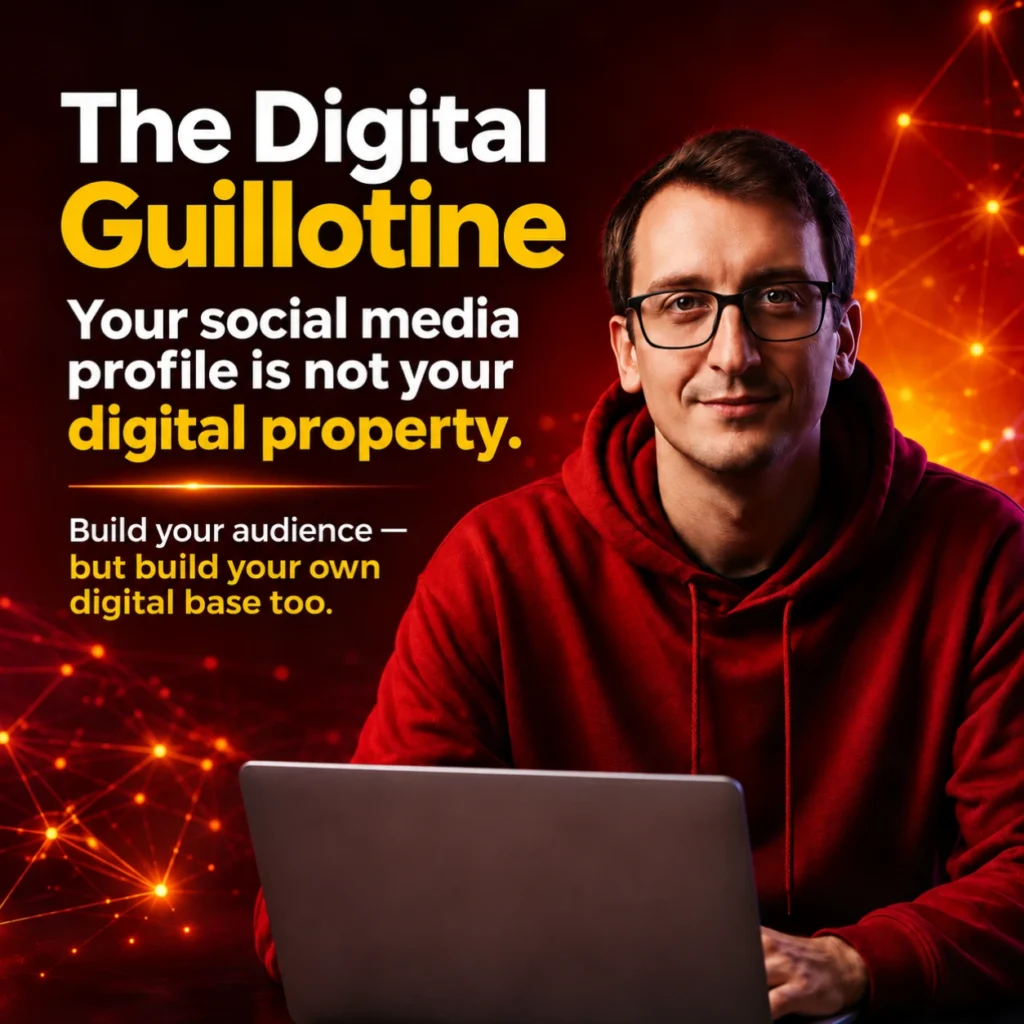
The digital guillotine can fall much faster than most people expect.
You can spend years building a Facebook or Instagram profile.
You publish content.
Collect contacts.
Build relationships.
Maybe you even build part of your business around that audience.
Then one morning, you try to log in and see something like:
“Your account has been disabled for violating Community Standards.”
No detailed explanation.
No conversation.
Sometimes, no obvious path to a real person who can help.
That is the uncomfortable side of social media that many people ignore while everything is working normally.
We talk constantly about followers, reach, engagement and algorithms.
But there is another question that matters just as much:
Who actually owns the digital space you are building on?
And that is where the idea of the digital guillotine becomes important.
Because your profile may feel like your digital property.
But legally and technically, you are using somebody else’s platform.
Your Social Media Profile Is Not Really Yours
This is probably the simplest way to explain the problem.
Facebook and Instagram are not your digital property.
You use them.
Meta owns the platforms.
You can build an audience there.
You can create thousands of posts.
You can spend years building relationships.
You can invest money in advertising.
You may even depend on the platform for leads, sales or customer communication.
But access still depends on the rules and systems of the platform.
That distinction is easy to forget.
Especially when a social account becomes part of everyday life.
You log in every morning.
You publish.
People know where to find you.
Everything feels permanent.
Until it suddenly isn’t.
The Digital Guillotine Can Fall for Different Reasons
When people hear about someone losing a social media account, they often assume one thing:
“They must have done something wrong.”
Sometimes that is true.
But not always.
There are several ways someone can lose access to an account.
Some involve their own mistakes.
Some involve security systems.
Some involve hackers.
Some may begin with reports from other users.
And sometimes the exact reason is simply not clear to the account owner.
That uncertainty is part of what makes the digital guillotine so frustrating.
False Reports and Coordinated Reporting
Many users assume every report is carefully reviewed by a person before action is taken.
In reality, large platforms depend heavily on automated systems to process enormous amounts of content and account activity.
That creates a difficult environment.
A report does not automatically mean someone has violated the rules.
But repeated reports, unusual activity or signals associated with serious violations can trigger reviews, restrictions or security actions.
This also creates room for abuse.
A person may have:
a jealous competitor,
an angry former customer,
someone they argued with online,
or simply a malicious individual who wants to create problems.
There are also coordinated reporting campaigns and automated abuse attempts across social platforms.
That is why I never assume:
“My account is safe because I follow the rules.”
Following the rules matters.
But it does not protect you from every possible problem.
The Problem With Automated Decisions
Automation is necessary when platforms operate at massive scale.
But automation also has limitations.
Algorithms do not always understand:
context,
sarcasm,
local language,
inside jokes,
cultural references,
or the intention behind a post.
A human may immediately understand that something is harmless.
A system may only detect a word, image or pattern that matches a risk category.
And once an account is restricted, the appeals process can sometimes feel just as automated as the original action.
That is where users experience the worst version of the digital guillotine:
a major consequence triggered by a system they cannot properly talk to.
Phishing Is Still One of the Biggest Risks
Not every lost account is caused by Meta.
Sometimes the account owner unknowingly gives access to an attacker.
And modern phishing can be extremely convincing.
A scam message may look almost identical to an official notification.
The language may sound professional.
The branding may look correct.
The message may create urgency.
For example:
“Your Page has violated copyright rules.”
“Your account will be disabled within 24 hours.”
“Verify your identity immediately.”
Or perhaps:
“We would like to offer you a sponsorship.”
The victim clicks a link.
A login page appears.
They enter their credentials.
Sometimes they even enter a two-factor authentication code.
At that moment, the attacker may gain enough access to change account information and lock the legitimate owner out.
The problem often begins with a single click.
Fake Copyright Warnings
Copyright scams are particularly effective because they create fear.
If you run a business Page or creator account, the thought of losing it because of copyright violations can cause an immediate reaction.
And scammers know that.
They want you to act before thinking.
That is why a message that says:
“Your Page will be permanently deleted unless you appeal now”
can be dangerous.
The safer habit is simple:
do not trust the link inside the message.
Open the platform directly.
Check your account status.
Look at official notifications inside your account.
If the warning is real, you should be able to verify it through the platform itself.
Fake Collaboration Offers
Creators and business owners face another type of attack.
A message arrives with an attractive collaboration opportunity.
A company supposedly wants to sponsor you.
They may send a link to:
view a contract,
download campaign material,
access a media brief,
or log into a supposed partner platform.
That can be enough.
A successful phishing attempt does not need to look suspicious.
It only needs to look normal enough for you to trust it once.
Breaking Rules You Did Not Know Existed
Sometimes nobody is attacking you.
The problem comes from content you publish yourself.
Social platforms have extensive rules.
Most users have never read all of them.
And even when you understand the general rules, automated moderation can still interpret content differently than you expect.
A joke may be misunderstood.
A phrase may trigger moderation.
An image may be detected incorrectly.
Copyrighted material may create a warning.
A video may contain music you did not even intentionally add.
That last one is especially easy to overlook.
Imagine recording a video while music plays in the background.
You did not upload the song intentionally.
It was simply playing nearby.
But the platform may still recognize copyrighted audio.
One incident may not destroy an account.
But repeated warnings can create bigger problems.
Connected Accounts Create Connected Risk
This is another issue people often forget.
Your Facebook and Instagram accounts may be connected.
Your business assets may depend on your personal profile.
Pages may be connected to a Business Portfolio.
Instagram may be connected to Facebook.
WhatsApp may be connected to the same ecosystem.
That creates convenience.
But convenience can also create dependency.
If one connected account becomes compromised or restricted, the consequences may spread further than expected.
Imagine an old Facebook profile you barely use getting hacked.
The attacker posts prohibited content.
The platform reacts.
Suddenly, the problem may affect assets you actively use today.
That is why old and forgotten accounts should not be ignored.
Suspicious Logins and Security Checks
Not every lockout is punishment.
Sometimes the system is trying to protect you.
Travel.
VPN use.
A new phone.
A new computer.
Repeated login attempts.
Unusual geographic activity.
These things can trigger security checks.
In principle, that is good.
You want the platform to notice when something looks unusual.
The problem begins when the verification process does not work smoothly.
Identity checks.
Video selfies.
Codes.
ID documents.
Recovery emails.
If something fails technically, you can find yourself locked outside an account that is actually yours.
The intention may be security.
The experience can still feel like the digital guillotine.
The Biggest Mistake: Depending on One Platform
For me, this is the bigger lesson.
I like social media.
I use social media.
I think Facebook, Instagram and other platforms can be incredibly useful.
They help us:
reach people,
build communities,
share ideas,
promote content,
find customers,
and stay connected.
But I do not want my entire digital presence to depend on one account.
Because there is an important difference between:
an audience you can reach
and
an audience you can access only while the platform allows you to.
That difference becomes obvious only when something goes wrong.
You Are a Tenant on Social Media
I often think about social media like rented property.
You can make the place beautiful.
You can invite people in.
You can build a business there.
You can become known there.
But you still do not own the building.
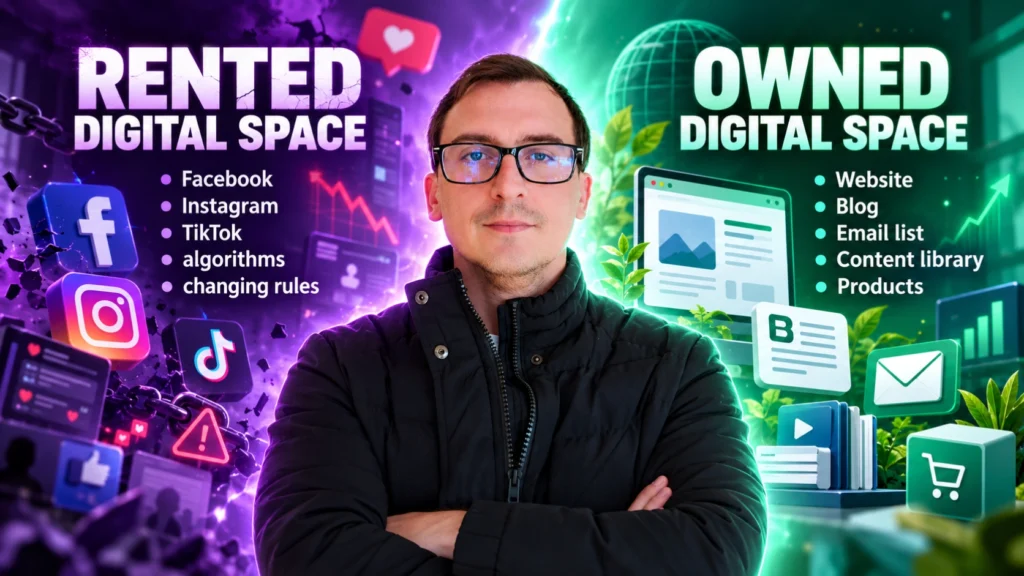
The owner can change the rules.
Change the algorithm.
Limit your reach.
Change monetization.
Restrict links.
Remove features.
Suspend an account.
Or require something new from you.
That does not mean you should leave social media.
It means you should understand what social media is.
A distribution platform.
Not your entire digital foundation.
Build Something You Control Too
This is why I keep returning to the same idea:
build owned digital assets alongside social media.
For me, that means things such as:
a website
a blog
an email list
a content library
products
direct relationships
These things are not completely risk-free either.
Nothing online is.
But they give you much more control than depending entirely on a social profile.
If Facebook disappears tomorrow, your website can still exist.
If Instagram restricts your account, your newsletter still exists.
If an algorithm reduces your reach, people can still search for your content.
That is digital resilience.
Your Website Is More Than a Business Card
A lot of people still think of a website as something static.
Home.
About.
Contact.
Done.
I think that view is outdated.
A website can become your digital base.
Your social platforms can send people toward it.
Search engines can discover it.
Articles can build long-term visibility.
Your newsletter can connect to it.
Your products can live there.
Your story can live there.
Your content can remain accessible even when a social media algorithm decides not to distribute today’s post.
That is why I do not see social media and websites as competitors.
They have different roles.
Social media creates reach.
Your website creates ownership and continuity.
Your Email List Matters for the Same Reason
Email is not glamorous.
It does not have infinite scrolling.
It does not have viral reels.
It does not usually create instant dopamine.
But it gives you something valuable:
a direct communication channel.
If someone joins your email list, you are no longer completely dependent on whether Facebook or Instagram decides to show your next post.
You can communicate directly.
That is powerful.
Especially for creators, freelancers, entrepreneurs and small businesses.
Protect the Accounts You Already Have
Building owned assets is the long-term strategy.
But you should also protect the social accounts you already use.
There are several basic steps worth taking.
Enable Two-Factor Authentication
Use 2FA.
A password alone should not be your only protection.
Authentication apps can add another security layer and make unauthorized access more difficult.
Be Suspicious of Urgent Messages
Urgency is one of the oldest manipulation techniques online.
Act now.
Your account will be deleted.
You have 24 hours.
Verify immediately.
That emotional pressure is designed to make you click before checking.
Do the opposite.
Check first.
Avoid Logging In Through Random Links
If a message tells you to verify your Facebook or Instagram account, do not automatically use the link provided.
Open the platform yourself.
Check your settings.
Check account status.
Verify whether the warning actually exists.
Keep Backup Access to Business Assets
If you manage an important business Page, do not make access depend on one person whenever possible.
Having another trusted person with appropriate access can help if your own profile becomes unavailable.
It should obviously be someone you genuinely trust.
Back Up Important Content
Photos.
Videos.
Business information.
Important contacts where appropriate.
Copies of content.
Do not assume that because something is on social media today, it will remain accessible forever.
Separate Your Digital Identity From One Account
This is another idea I think will become increasingly important.
A personal brand should be bigger than:
@username
Your digital identity should not disappear because one company closes one account.
If people know:
your name,
your website,
your newsletter,
your content,
your work,
and what you stand for,
then your identity can survive a platform problem.
That is a much stronger position.
The Digital Guillotine Is Also a Business Risk
If you use social media only to share vacation photos, losing an account is frustrating.
If you use it for business, the consequences can be much bigger.
You may lose:
leads,
messages,
customer conversations,
content,
traffic,
brand visibility,
community access,
and years of accumulated social proof.
That makes account dependency a business-risk issue.
And I think it should be treated that way.
Businesses think about backups for files.
They think about payment providers.
They think about domains.
They think about cybersecurity.
Social account dependency belongs in the same conversation.
Do Not Build Everything on One Platform
This does not mean you need ten social networks.
That creates another problem.
You spread yourself too thin.
Instead, think in layers.
Maybe Facebook is your main community platform.
Instagram is your visual channel.
Your website is your central base.
Your blog creates searchable content.
Your newsletter creates direct communication.
That is already a much stronger structure than:
“Everything depends on my Facebook profile.”
Social Media Should Bring People Into Your Ecosystem
This is how I increasingly think about my own online presence.
I do not want social media to be the final destination.
I want it to be an entry point.
Someone may discover one of my Facebook posts.
Then read an article.
Join my newsletter.
Watch a video.
Explore another part of my website.
Return later through Google.
That creates a connected digital ecosystem.
If one channel weakens, everything else does not automatically collapse with it.
Your Profile Is Not Your Business
This is especially important for people building personal brands.
A large audience can create a false sense of security.
10,000 followers.
50,000 followers.
100,000 followers.
The number looks impressive.
But ask another question:
How many of those people could you reach if the account disappeared tomorrow?
That question changes the way you look at social media.
Followers matter.
But access matters more.
My Own View Changed Over Time
I used to think primarily about visibility.
How do people find you?
How do you get more traffic?
How do you build a stronger online presence?
I still care about all of that.
But now I think much more about digital resilience.
What happens if one platform fails?
What happens if access changes?
What happens if a policy changes?
What happens if an algorithm suddenly cuts reach?
What happens if the platform no longer fits the business?
That is why I increasingly prefer a connected structure.
Social media.
Website.
Newsletter.
Content.
Community.
Different channels doing different jobs.
The Digital Guillotine Is a Reminder
The digital guillotine is not a reason to panic.
It is a reminder.
Use social media.
Enjoy it.
Build there.
Meet people.
Create content.
Develop your brand.
Grow a community.
But understand the relationship.
You are using somebody else’s infrastructure.
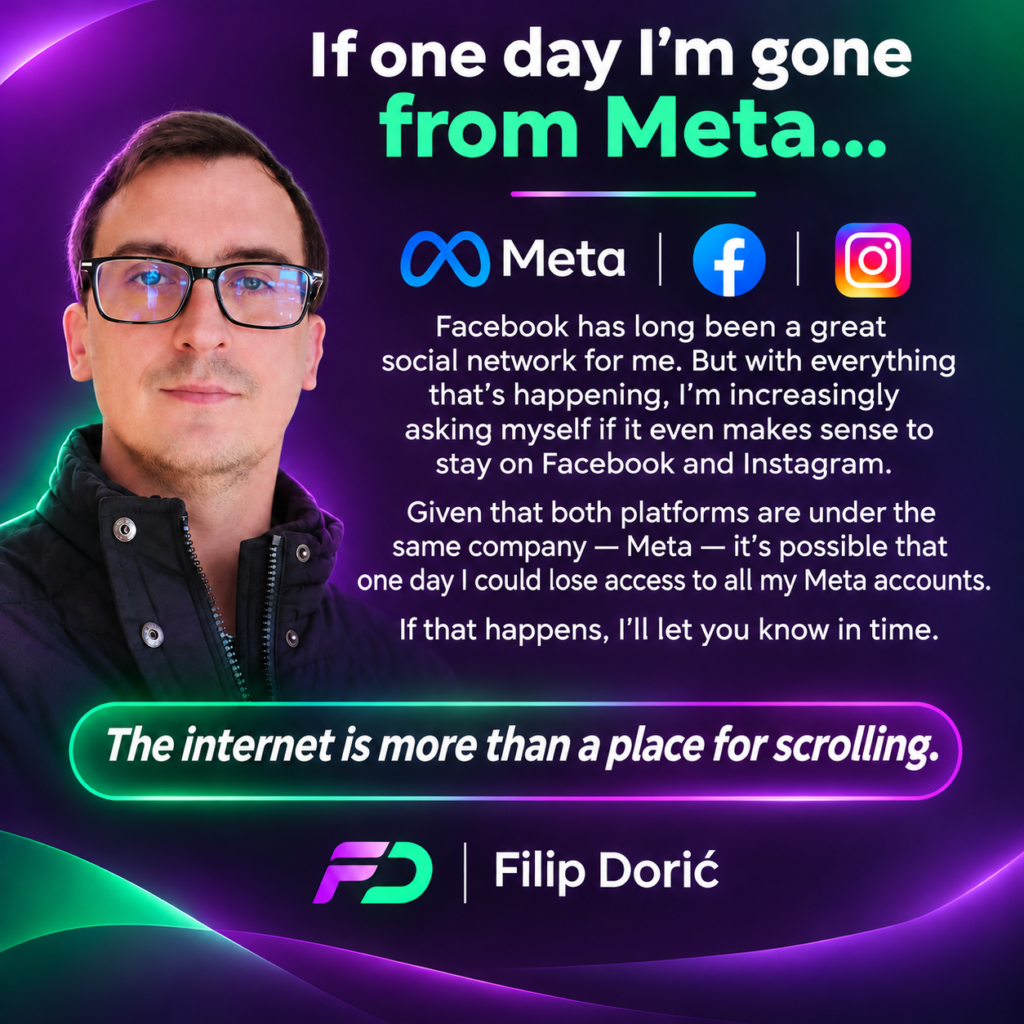
And that means part of your access always depends on rules you do not control.
The solution is not to abandon social media.
The solution is to stop making it your only digital home.
Your Profile Is Not Yours
That may sound harsh.
But it is useful to remember.
Your Facebook profile is not your website.
Your Instagram account is not your mailing list.
Your TikTok followers are not a database you control.
These platforms can be incredibly valuable.
But they remain platforms.
You are there under their terms.
That is why I want my long-term online presence to include things I can build more independently.
My websites.
My content.
My newsletter.
My own digital projects.
My relationships with readers.
Social networks remain part of that system.
Just not the entire system.
Final Thought
You may spend years building a profile.
Posting.
Networking.
Advertising.
Creating.
Growing.
And one day, one click, one scam, one security issue, one policy violation, one connected-account problem or one automated decision may suddenly remove your access.
That is the digital guillotine.
You cannot remove every risk.
But you can reduce how much one platform controls your future.
Protect your accounts.
Use strong security.
Be careful with links and suspicious messages.
Back up important content.
And most importantly:
build something outside social media too.
Because there is a major difference between:
having an audience
and
having access to that audience only while someone else’s platform allows it.
Social media is a powerful place to stay.
But you are still a tenant there.
Build your own digital home as well.
The internet is more than a place for scrolling.
📬 Want more tips like this?
Subscribe to get fresh blog posts directly to your inbox.