A digital ecosystem may sound like something reserved for the largest technology companies in the world.
Google.
Amazon.
Apple.
Meta.
They have built platforms that connect users, products, services, content, advertising, payments, devices, developers, and entire communities.
Their ecosystems are enormous.
But the basic idea behind them is not only for corporations with billions of dollars and thousands of employees.
I believe something important is changing.
Content creators, marketers, freelancers, entrepreneurs, product owners, small businesses, and community builders are also beginning to need their own connected systems.
Not systems as large as Amazon.
Not platforms designed to serve half the planet.
But smaller, focused digital ecosystems built around a specific audience, purpose, product, expertise, or community.
This is not about collecting more tools.
It is not about opening an account on every new platform.
It is not about creating another funnel and calling it an ecosystem.
It is about connecting the important parts of your online presence so they support each other.
Your content.
Your social media.
Your website.
Your email list.
Your products or services.
Your community.
Your reputation.
Your relationships.
Your business model.
When these pieces begin working together, your online business stops looking like a collection of disconnected activities.
It begins becoming an infrastructure.
And every infrastructure creates a journey.
An odyssey.
Not a short sprint toward the next launch.
A longer online business journey with different stages, challenges, discoveries, people, and destinations.
The question is no longer only:
Which tool should I use?
The bigger question is:
Which digital ecosystem am I building—or becoming part of?
Digital Ecosystems Are Not Only for Giant Companies
The largest digital ecosystems are easy to recognize because we interact with them every day.
Amazon is not only an online store.
It connects customers, merchants, reviews, payments, logistics, advertising, cloud infrastructure, subscriptions, entertainment, and many other services.
Google is not only a search engine.
Its wider ecosystem connects search, email, video, advertising, maps, mobile software, cloud tools, productivity applications, websites, and developers.
Apple does not only sell devices.
Its products, software, services, applications, payments, subscriptions, and customer accounts work together within a carefully controlled environment.
These companies show us what happens when separate products and services become parts of a larger connected experience.
A small entrepreneur will not reproduce that scale.
That is not the goal.
The important lesson is simpler:
The connected system is often more valuable than any individual component.
A social media account may attract attention.
A website may explain what you do.
A newsletter may continue the communication.
A product may solve a problem.
A community may create belonging and conversation.
Each part has value.
But the real strength appears when someone can move naturally from one part to another.
That principle can work for a global technology company.
It can also work for a consultant, author, freelancer, ecommerce brand, educator, creator, or small local producer.
The Problem With a Fragmented Online Presence
Many people already have several digital elements.
They have a Facebook profile.
An Instagram account.
Perhaps a LinkedIn page.
A simple website.
An email marketing account they rarely use.
A product hosted on another platform.
A private group that has not been active for several months.
Technically, they have many tools.
But they do not necessarily have a system.
Their social media content does not lead anywhere.
Their website does not explain the next step.
Their newsletter is disconnected from their blog.
Their customers do not know a community exists.
Their community does not know which products are available.
Their content, products, and email messages feel like separate projects.
This creates more work.
Every platform demands attention.
Every tool has its own dashboard.
Every new idea becomes another isolated task.
You post because you feel you should post.
You send an email because you have not sent one in a while.
You create another landing page because someone told you funnels are important.
You add a new tool because it looks useful.
Soon, you are managing many pieces without knowing how they support one another.
That is not a digital ecosystem.
It is digital clutter.
A real ecosystem requires connection and direction.
A Digital Ecosystem Is More Than a Sales Funnel
Sales funnels are useful.
A funnel can guide someone through a clear sequence.
For example:
A person sees a social media post.
They click a link.
They visit a landing page.
They download a free guide.
They receive several emails.
They are introduced to a product or service.
The funnel has a defined destination.
It helps move someone toward a particular action.
But online relationships are not always linear.
A person may discover your website through Google.
Then see one of your comments on LinkedIn.
Several weeks later, they join your newsletter.
They may read five articles before replying to an email.
Later, they join your Facebook group.
They may purchase something after three months.
Or they may never purchase but recommend your work to someone else.
That journey does not look like a perfect descending funnel.
It looks more like a network.
A funnel asks:
How do we guide someone toward one specific conversion?
A digital ecosystem asks:
How do all parts of our online presence continue creating value together?
Your ecosystem may contain several funnels.
But the ecosystem is larger than any individual campaign.
I explored this difference in more detail in my article about the difference between a sales funnel and a digital ecosystem.
The distinction matters because many people are trying to solve a structural problem with another temporary campaign.
They do not need only another funnel.
They need to understand the wider system around it.
Your Online Business Journey Is an Odyssey
The word odyssey describes more than a simple trip.
It suggests a long journey shaped by challenges, discoveries, changing conditions, mistakes, allies, and unexpected turns.
That is also a realistic description of online business.
You begin with one idea.
Perhaps you open a social media account.
You publish your first content.
You create a website.
You learn about search engines.
Then email marketing.
Then digital products.
Then ecommerce.
Then communities.
Then automation.
The journey rarely follows the exact plan you imagined at the beginning.
Platforms change.
Your interests evolve.
You discover that your original audience was not the right audience.
A product fails.
A post unexpectedly succeeds.
A conversation opens a new direction.
Someone joins your journey and becomes a collaborator.
The odyssey continues.
But an odyssey still needs direction.
Without a connected system, you can spend years moving from platform to platform without building anything that becomes stronger over time.
You are active.
But you are not accumulating infrastructure.
A digital ecosystem helps turn the journey into something more than constant movement.
Each article strengthens your website.
Each social post creates another point of discovery.
Each newsletter grows the relationship with your audience.
Each product teaches you more about what people need.
Each customer question can become future content.
Each community conversation creates new understanding and trust.
The individual actions begin feeding the larger system.
That is how your online business journey becomes an odyssey with purpose.
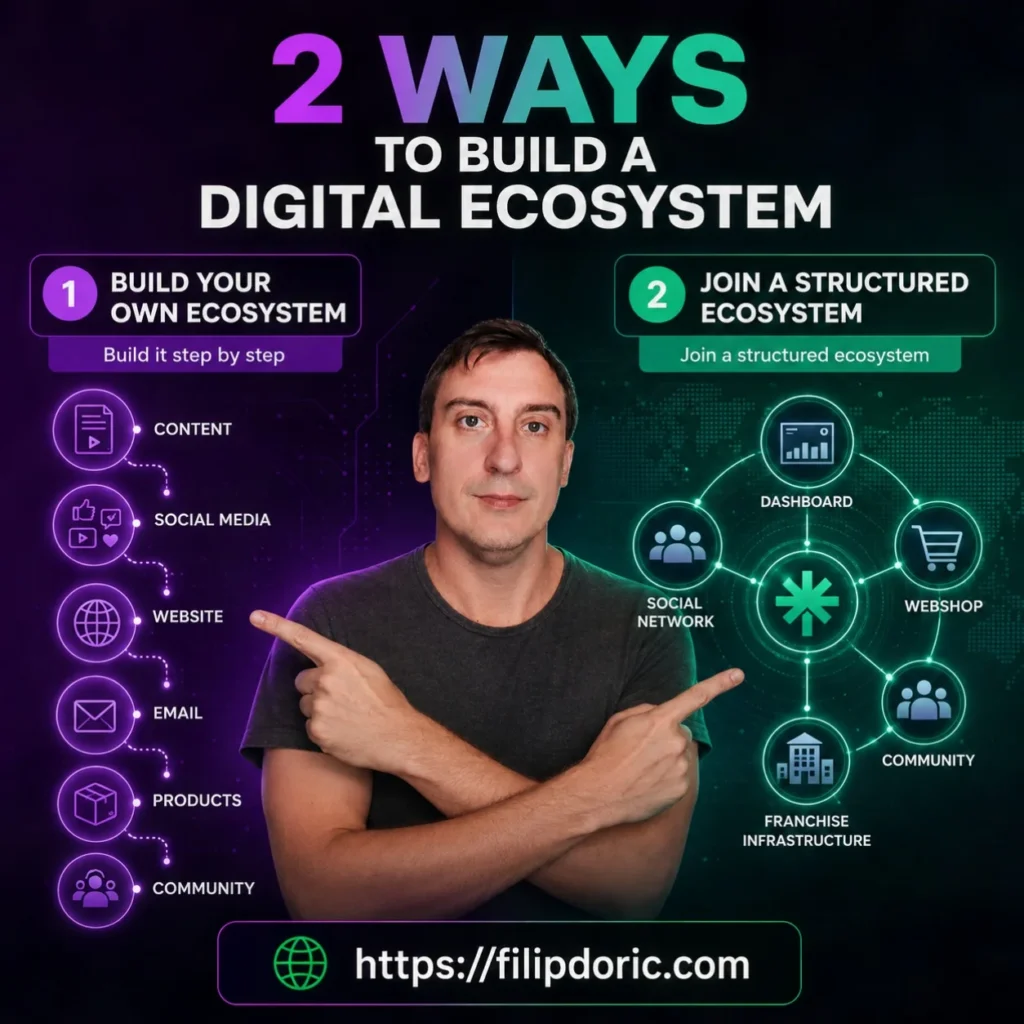
Two Paths Toward a Digital Ecosystem
I currently see two main paths.
The first is building your own digital ecosystem step by step.
The second is joining an ecosystem that is already being developed through a structured business or franchise model.
Neither path is automatically better.
They require different levels of control, responsibility, patience, investment, and trust.
Understanding those differences can help you decide which direction fits your goals.
Path One: Build Your Own Digital Ecosystem
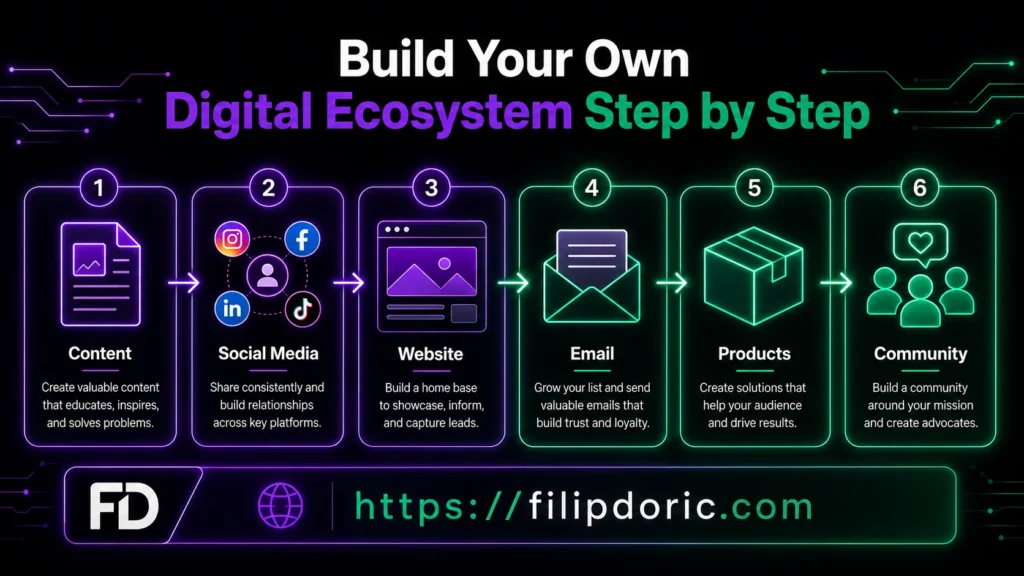
Building your own ecosystem gives you the highest level of ownership and flexibility.
You decide:
- which audience you serve
- which content you create
- which products you offer
- which platforms you use
- how your brand is positioned
- how people move between different parts
- which tools you connect
- how the system generates revenue
You do not need to build everything immediately.
In fact, trying to build every component at once is one of the fastest ways to become overwhelmed.
A practical ecosystem usually develops in layers.
Begin With Your Main Idea
Before choosing tools, define the idea around which the ecosystem will develop.
What do you help people understand or achieve?
Who is the ecosystem for?
Why should someone follow your work?
What type of value will connect the different components?
Your ecosystem might be built around:
- professional expertise
- a product category
- a local business
- education
- a personal brand
- a creative project
- a specialized community
- a particular lifestyle or interest
- a business opportunity
Without a central idea, your platforms may remain disconnected because they do not serve the same purpose.
Use Social Media for Discovery
Social networks help new people encounter your work.
You can publish ideas.
Start conversations.
Show your personality.
Connect with other people in your field.
Learn which topics create interest.
But your social account should not become your entire infrastructure.
You do not control the platform.
The algorithm decides how content is distributed.
Rules can change.
Your reach can rise or fall.
A strong social presence is useful.
A business that exists only inside one social platform is vulnerable.
Give Your Ecosystem a Home
Your website can become the central digital asset inside the system.
It can explain:
- who you are
- what you do
- who you help
- what you believe
- what you offer
- where new visitors should begin
- how people can contact you
- how they can continue following your work
Your articles can attract search traffic.
Your pages can present products and services.
Your website can connect your social channels, newsletter, store, videos, and community.
That is why I consider a website an important part of any serious online presence.
Facebook may create the first contact.
Your website gives that attention a destination.
Continue the Relationship Through Email
Most website visitors will leave.
That is normal.
They may enjoy the article but not be ready to buy or contact you.
They may intend to return and forget the website’s name.
An email list gives interested visitors a simple way to continue the relationship.
They can receive:
- new articles
- practical tips
- project updates
- recommendations
- educational sequences
- invitations
- product information
- community news
Email does not replace social media.
It connects discovery with longer-term communication.
This is also why I use tools such as Systeme.io to support the email and campaign layer of my own ecosystem.
Add Products, Services, or Offers
Content alone does not automatically create a business.
At some point, your ecosystem needs a way to exchange value.
That may be:
- a service
- consulting
- a physical product
- a digital product
- an online course
- a membership
- software
- affiliate recommendations
- sponsorship
- paid community access
- a franchise or partnership role
The offer should fit naturally with the audience and content.
A disconnected product can feel like a random promotion.
A relevant product feels like the next logical step.
Build Community and Trust
An audience listens.
A community participates.
That participation can happen inside a Facebook group, private platform, membership site, forum, messaging group, or live event.
Community creates something that content alone cannot always produce.
People begin learning from each other.
They share experiences.
They ask questions.
They see that other real people are involved.
Trust becomes less dependent on one-way communication from the creator.
But a community also requires attention.
You cannot simply open a group and expect meaningful interaction to appear automatically.
A healthy community needs direction, moderation, useful discussion, and a clear reason for existing.
The Advantages and Challenges of Building Your Own Ecosystem
The greatest advantage is control.
You shape the brand.
You select the tools.
You decide what to build.
You own more of the customer experience and data.
You can adapt the ecosystem as your business changes.
But control creates responsibility.
You must connect the tools.
Maintain the website.
Understand email.
Create content.
Develop products.
Generate traffic.
Support customers.
Moderate the community.
Analyze what works.
This path can be rewarding.
It can also take years.
You are not simply building a funnel.
You are building digital infrastructure.
Path Two: Join an Ecosystem That Is Already Being Built
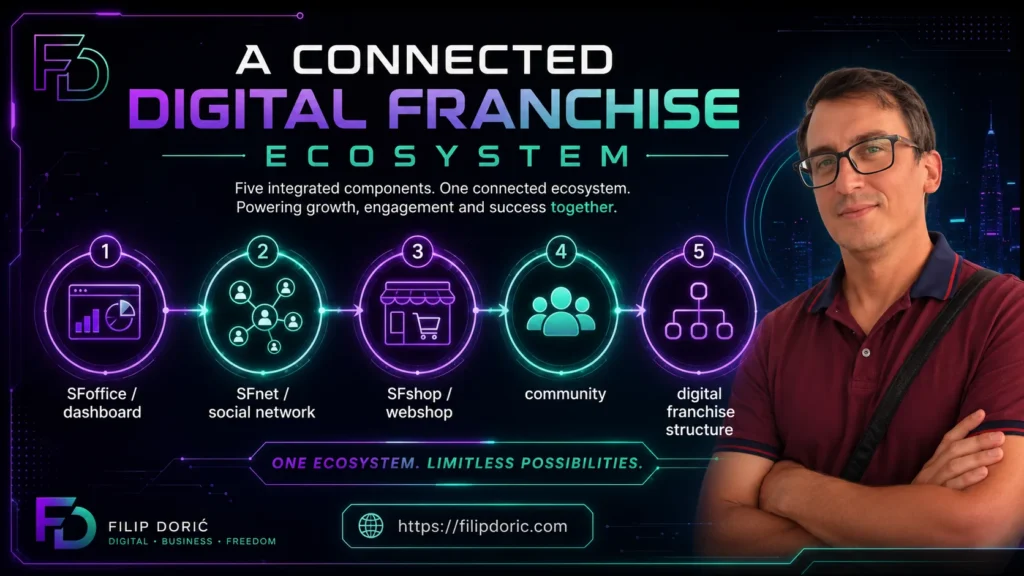
The second path is for people who do not want to create every component alone.
Instead of independently assembling a website, social network, marketplace, training system, payment structure, community, and business model, they may choose to join an ecosystem in which much of that infrastructure is already being developed.
This is where a digital franchise model becomes relevant.
A structured digital franchise may provide:
- a defined role
- tools and platforms
- products or marketplace access
- training
- mentorship
- community
- business processes
- branding or shared identity
- customer and partner pathways
- compensation structures
The participant is not inventing the entire system.
They are positioning themselves inside it.
This can lower certain barriers.
But it introduces different responsibilities and risks.
You have less control over the overall infrastructure.
You depend on the company or project team to execute its plans.
You must understand the agreement, business model, obligations, costs, and limitations.
Joining a system is not the same as owning that system.
That is why early excitement should never replace careful evaluation.
SFT21 as a Developing Digital Ecosystem
The SFT21 Business Concept is one of the reasons I continue exploring this second path.
I do not view it only as another online opportunity.
I see it as an attempt to connect several layers that are often separated:
- a business dashboard through SFoffice
- a verified social environment through SFnet
- an ecommerce layer through SFshop
- users, customers, producers, and entrepreneurs
- community participation
- mentorship and team development
- a digital franchise structure
The concept is still developing before its wider market launch.
That matters.
A developing project is not the same as a mature company with years of proven market performance.
The final outcome depends on execution.
Technology must work.
The marketplace must attract real participants.
Products need customers.
Communities need activity.
Business processes must function in practice, not only in presentations.
That is why I follow the project closely while still separating vision from completed results.
The direction is interesting.
The structure is ambitious.
The early stage gives people time to observe, learn, and ask questions.
But it should not be treated as a guarantee.
Early information is valuable when it creates more understanding.
Not when it creates pressure.
Why a Franchise-Based Ecosystem May Appeal to Some People
Building your own digital ecosystem requires many different skills.
You may need to understand:
- web design
- content
- email marketing
- ecommerce
- automation
- community management
- customer support
- branding
- business development
- analytics
Some people enjoy that process.
Others find it overwhelming.
A structured ecosystem can offer a starting framework.
Instead of asking:
Which tools should I connect?
the question becomes:
How do I use the tools and role provided within this system?
Instead of building a community entirely from zero, you join a wider community.
Instead of creating every product, you may participate in an existing marketplace.
Instead of designing a compensation model, you study and work within one that has already been defined.
The trade-off is clear.
You gain structure.
You give up some independence.
Which Path Is Right for You?
Your answer depends on what you want to build.
The first path may suit you when:
- you have a clear personal or business brand
- you want full control
- you enjoy choosing tools and systems
- you are prepared to build slowly
- you have your own products, services, or expertise
- you want the ecosystem to remain entirely yours
The second path may suit you when:
- you want a predefined structure
- you value mentorship and community
- you want to participate in something larger
- you do not want to create every component from zero
- you are comfortable operating within defined rules
- you understand that the project’s execution is outside your direct control
Some people may eventually combine the two paths.
They can build their personal brand, website, content, and audience while also holding a role inside a wider ecosystem.
Their personal infrastructure helps them communicate.
The shared ecosystem gives them additional tools, products, community, or business opportunities.
The paths are not always mutually exclusive.
Do Not Build More Tools. Build Better Connections.
The next phase of online business may not be defined by the person with the largest number of applications.
More tools often create more complexity.
The advantage will belong to people who understand how the right elements work together.
A social media audience connected to nothing remains platform-dependent.
A website with no traffic remains invisible.
A newsletter with no useful content becomes noise.
A product with no trust becomes difficult to sell.
A community with no purpose becomes inactive.
A franchise structure without execution remains only a concept.
Every component needs the others.
That is what makes ecosystem thinking so important.
You begin looking beyond individual tactics.
You stop asking only:
Should I start a newsletter?
Instead, you ask:
How will my newsletter support my website, content, community, and offers?
You stop asking only:
Should I open another social account?
You ask:
What role will this platform play inside the wider system?
You stop asking only:
Which product can I promote?
You ask:
What kind of long-term position and value am I building?
Those are better questions.
Become the Author of Your Own Online Business Odyssey
Your online business journey will probably not follow a straight line.
There will be experiments.
Failed ideas.
Unexpected opportunities.
New people.
Changing platforms.
Moments when the direction becomes clearer.
And moments when it does not.
That is part of the odyssey.
But you do not have to move without structure.
Build your own digital ecosystem.
Or carefully choose an ecosystem in which you want to participate.
Connect your platforms.
Connect your content.
Connect your audience.
Connect your products, community, and communication.
Do not become another passenger inside someone else’s algorithm.
Become the author of the odyssey that is your own online business journey.
Not just another funnel.
Not just another platform.
Not just another offer.
A connected system that can continue creating value long after today’s post disappears from the feed.
Follow the Digital Ecosystem Conversation
I will continue exploring both paths:
Building your own digital ecosystem step by step.
And understanding what it means to position yourself inside an ecosystem that is already being developed through a digital franchise model.
Through my newsletter, I share new articles, practical tools, personal observations, and updates connected to the developing SFT21 Business Concept.
No manufactured hype.
No guaranteed-income promises.
Just context, education, and a closer look at where online business may be heading.
You can also join my private Facebook community, Digital Franchise Hub, where we discuss digital ecosystems, online business, and the ideas shaping the next phase of the internet.
📬 Want more tips like this?
Subscribe to get fresh blog posts directly to your inbox.