What is ecommerce?
Most people would answer with two words:
Online shopping.
That answer is correct.
But it is also incomplete.
Ecommerce did not simply give us a new place to buy products.
It changed who can become a seller, how businesses reach customers, how trust is created, how payments move, and what people expect from a modern company.
A small producer can now reach customers outside the local area.
A creator can sell a digital product without a physical store.
A service provider can accept bookings and payments through a website.
A business can sell through a marketplace, its own online store, a mobile app, a social network, or several channels at the same time.
That is why I think the better question is not only:
What is ecommerce?
It is also:
What did ecommerce change?
And the answer is much bigger than the shopping cart on a website.
What Is Ecommerce in Simple Terms?
Ecommerce means buying or selling goods and services through computer networks using digital methods designed to receive or place an order.
In everyday language, that usually means a transaction started through the internet.
The order may happen on:
- an online store
- a marketplace
- a mobile application
- a business portal
- a social commerce platform
- a subscription platform
- a digital booking system
The product does not have to be digital.
The payment does not always have to happen online.
Even the final delivery does not have to be digital.
A customer may order a physical product online and pay when it arrives.
A company may place a wholesale order through a digital business portal and receive the goods by truck.
A person may book a service online and use that service later in a physical location.
The important part is that the order itself is placed through a system designed for digital ordering.
This is close to the official definition used by UN Trade and Development. The OECD also updated its guidance in 2025 to account more clearly for digital intermediaries, subscriptions, emerging ordering channels, and AI-assisted transactions.
So, what is ecommerce in practical terms?
It is the transaction layer of the digital economy.
It is the moment when online attention becomes an order.
Ecommerce Is More Than a Webshop
When people hear the word ecommerce, they often imagine a traditional online store.
A homepage.
Product pages.
A shopping cart.
A checkout.
That is one form of ecommerce.
But it is not the only one.
You can buy a product on Amazon.
You can purchase an item from another person on eBay.
You can order directly from a small brand through its Shopify store.
You can pay for software every month.
You can buy an ebook, a course, a membership, a ticket, a consultation, or access to a digital platform.
You can also start a purchase inside a social media application.
All these examples belong to the wider ecommerce landscape.
This distinction matters because a webshop is a tool or a sales channel.
Ecommerce is the broader system of digital trade around it.
That system includes:
- product discovery
- trust
- content
- digital ordering
- payments
- inventory
- delivery
- customer communication
- returns
- analytics
- repeat purchases
A beautiful store without traffic is not a complete ecommerce business.
A marketplace account without a strategy is not a complete ecommerce business.
A product link in a social media bio is not a complete ecommerce business.
The visible store is only one part of the structure.
The Main Types of Ecommerce
One reason ecommerce can feel confusing is that it includes several different relationships between buyers and sellers.
Business to Consumer
Business-to-consumer, or B2C, is the model most people recognize.
A business sells directly to an individual customer.
Fashion stores, electronics shops, food delivery platforms, online pharmacies, streaming services, and many software subscriptions operate in the B2C space.
Business to Business
In business-to-business ecommerce, one company sells to another company.
This may include:
- wholesale products
- manufacturing components
- business software
- professional services
- office supplies
- logistics solutions
B2B ecommerce is often less visible to the general public because many transactions happen through private portals, ordering systems, and established commercial relationships.
However, it remains a central part of digital trade.
Consumer to Consumer
The consumer-to-consumer model allows individuals to sell to other individuals.
Online marketplaces made this familiar to millions of people.
Someone can sell used furniture, collectibles, clothing, electronics, or handmade items without opening a traditional shop.
C2C commerce helped turn ordinary internet users into sellers.
It also changed how people thought about ownership.
Products no longer had to remain unused in a garage, wardrobe, or storage room.
They could be listed online and offered to someone else.
Consumer to Business
In this model, an individual provides value to a business.
Freelancers, photographers, influencers, affiliates, consultants, and creators may all participate in consumer-to-business transactions.
A creator licensing a photograph to a company is one example.
An influencer being paid to produce content is another.
A freelancer offering web design, writing, music, or consulting services to a company also participates in this part of the digital economy.
Direct to Consumer
Direct-to-consumer, or DTC, is commonly used to describe brands that sell directly to customers instead of relying entirely on traditional retailers or distributors.
The relationship is still usually B2C.
The difference is in the route to the customer.
A DTC brand may use its own online store, content, email list, community, and customer data to build a more direct relationship with its audience.
That direct relationship can become one of the company’s most valuable assets.
What Changes Did Ecommerce Bring?
Ecommerce changed much more than the location of a transaction.
It changed the logic of commerce itself.
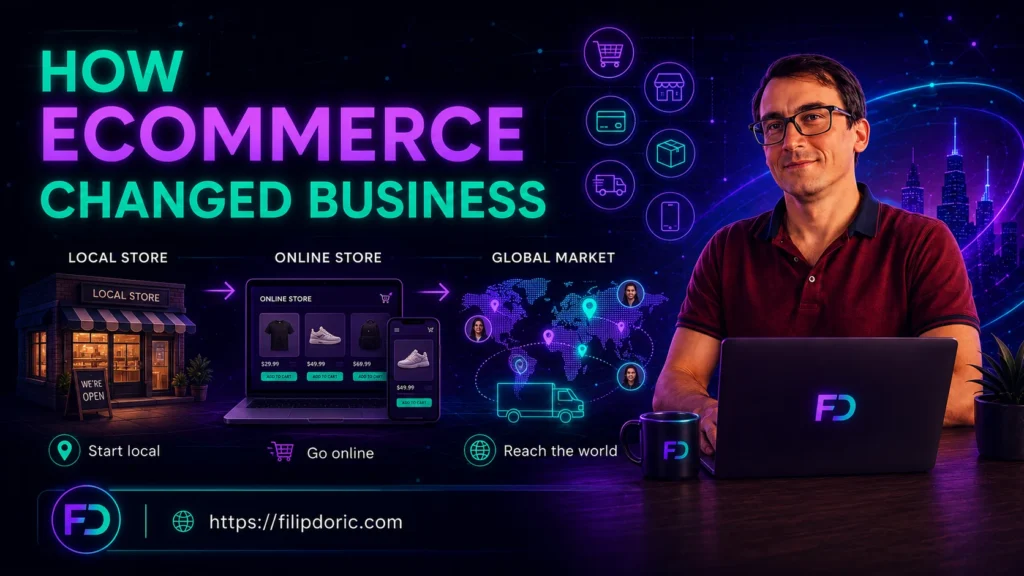
1. The Market Was No Longer Only Local
Before online trade became normal, many businesses were limited by geography.
A local store depended heavily on people who lived nearby.
A producer needed distributors, physical shelf space, catalogues, trade events, or established retail relationships to enter a larger market.
Ecommerce reduced some of those barriers.
It did not remove every challenge.
Shipping still costs money.
Regulations still matter.
Language, taxes, payment methods, customer support, and trust still matter.
But the potential market became much larger.
A small business could build a website and present its products beyond its immediate location.
A specialised producer could reach people searching for exactly that type of product.
A creator could publish something once and make it available internationally.
That was a major shift.
The internet did not guarantee customers.
It created access.
2. Commerce Became Available All Day
A physical store has opening hours.
An ecommerce system can accept orders while the owner is working, sleeping, travelling, or doing something else.
This is one of the first things that attracts people to online business.
But it is important to understand the difference between automation and passivity.
The order may be automated.
The business is not automatically passive.
Products still need to be created or sourced.
Customers need support.
Payments can fail.
Returns happen.
Websites need maintenance.
Traffic must come from somewhere.
Ecommerce made parts of the commercial process available around the clock.
It did not eliminate the need for real work.
3. Customers Gained More Choice and Control
Ecommerce allowed customers to compare prices, read reviews, search for alternatives, and buy from businesses they may never visit physically.
This changed the balance of information.
The seller was no longer the only source of product knowledge.
Customers could research before making a decision.
They could compare multiple businesses in minutes.
They could read what other buyers experienced.
They could leave a store without speaking to anyone and continue searching elsewhere.
As a result, trust became more visible.
Reviews mattered.
Clear product information mattered.
Delivery expectations mattered.
Website security mattered.
A poor digital experience could lose a customer before any human conversation began.
4. Platforms Became Powerful Marketplaces
Ecommerce created opportunities for sellers.
It also created powerful intermediaries.
Marketplaces can provide:
- existing traffic
- search tools
- payment infrastructure
- buyer protection
- reputation systems
- logistics support
- access to international demand
That can be extremely valuable.
A new seller does not necessarily have to build an audience from zero before presenting a product to potential buyers.
But there is a trade-off.
When you sell inside someone else’s marketplace, you operate inside someone else’s rules.
The platform controls the environment.
It may control visibility, fees, customer access, account policies, and how products are displayed.
The buyer may remember the marketplace more clearly than the individual seller.
This is why I do not think the future is simply a choice between a marketplace and an independent store.
Many businesses will use both.
A marketplace can help with discovery.
An owned website, newsletter, and community can help build a more direct relationship.
5. Small Businesses Received Better Tools
One of the most important changes was not only that customers moved online.
The tools available to sellers became easier to access.
In the early days, building an online store required more technical knowledge, custom development, and larger budgets.
Today, businesses can use hosted platforms, WordPress plugins, payment processors, website builders, automation tools, email systems, and third-party logistics.
That does not mean building a successful ecommerce business is easy.
It means the entry point has become more accessible.
The OECD reported in 2026 that, across the European retail and wholesale sectors it examined, the share of retail firms receiving online orders increased from 23% in 2013 to 43% in 2023.
It also found that digital adoption remains uneven, especially among smaller independent businesses.
The opportunity expanded.
So did the competition.
Being able to open a store is no longer enough.
A business must also learn how to be found, trusted, remembered, and chosen.
6. The Store Became Connected to Data
A physical store owner can observe customers.
They can notice what people pick up, what they ask, and what they ignore.
Ecommerce created a different kind of visibility.
Businesses can measure:
- where visitors come from
- which pages they view
- where they leave
- which products they buy together
- how often they return
- which emails they open
- which campaigns generate orders
Used responsibly, this information can improve the customer experience and help businesses make better decisions.
Used badly, it can become invasive, confusing, or manipulative.
The important change is that modern commerce became increasingly measurable.
Businesses no longer had to rely only on assumptions.
They could test a product page.
Compare different offers.
Measure whether an email generated sales.
See whether people abandoned the checkout process.
Data became part of everyday commercial decision-making.
7. Content Became Part of Commerce
A customer may discover a product through:
- a Google search
- a YouTube review
- a TikTok video
- an Instagram post
- a Facebook group
- a blog article
- an email
- an online community
This means ecommerce is no longer separated from media.
Content creates discovery.
Education creates trust.
Community creates conversation.
Email creates follow-up.
The store completes the transaction.
That is one reason I write so much about digital ecosystems.
The sale rarely begins at the checkout page.
It often begins much earlier.
It may begin when someone reads a useful article.
It may begin when they follow a creator.
It may begin when they join a group.
It may begin when they see a recommendation from someone they trust.
By the time the person reaches the product page, much of the decision may already have been made.
How Does Ecommerce Actually Work?
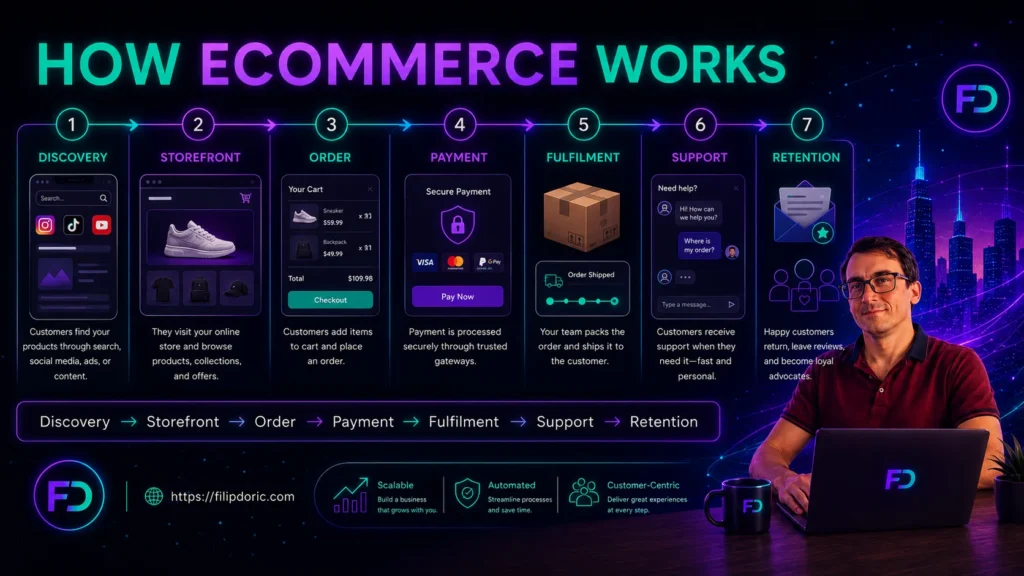
From the outside, ecommerce may look simple.
A person sees a product.
They click “buy.”
The product arrives.
Behind that simple journey, several systems may be working together.
1. Discovery
The customer first needs to find the product.
This can happen through search engines, social media, advertising, recommendations, marketplaces, affiliates, creators, or word of mouth.
Without discovery, even the best online store can remain invisible.
2. The Digital Storefront
The customer needs a place to understand the offer.
That may be a product page, marketplace listing, application screen, social commerce page, or sales page.
Good presentation helps answer basic questions:
What is this?
Who is it for?
What does it cost?
Why should I trust the seller?
What happens after I order?
3. The Ordering System
The customer selects a product or service, chooses the relevant options, provides information, and confirms the order.
For a physical product, that may include size, colour, quantity, shipping address, and delivery method.
For a digital product, it may include account creation and immediate access.
For a service, it may include selecting an appointment or submitting project information.
4. Payment
The payment layer connects the customer, seller, payment processor, and financial institutions.
Different countries and audiences prefer different methods.
Cards may be common in one market.
Bank transfers, digital wallets, cash on delivery, or local payment solutions may be important in another.
A business must understand the preferences of the market it wants to serve.
5. Fulfilment
A physical product must be packed, shipped, tracked, delivered, and sometimes returned.
A digital product may be delivered automatically through email, a download page, or a member account.
A service may activate a booking or onboarding process.
The customer sees a purchase.
The business sees a chain of operational responsibilities.
6. Communication and Support
Customers expect confirmation, updates, help, and clear policies.
Automation can handle part of this communication.
Human support is still important when something goes wrong.
Good support can turn a problem into trust.
Poor support can destroy a relationship that took months to build.
7. Retention
A strong ecommerce business does not think only about the first purchase.
It may use useful content, email marketing, loyalty systems, customer service, memberships, or community to create a longer relationship.
This is where a transaction can become part of an ecosystem.
Popular Ecommerce Models
There is no single way to build an ecommerce business.
Different models solve different problems.
Online Marketplaces
Marketplaces bring many buyers and sellers into one environment.
They can offer faster access to demand, but sellers usually have less control over the platform and the customer relationship.
A marketplace gives you access to an existing commercial space.
It does not give you ownership of that space.
Hosted Online Stores
Platforms such as Shopify make it easier to build a branded online store without managing every technical layer independently.
The seller controls the brand experience more directly but must usually generate traffic.
The platform provides infrastructure.
The business still needs customers.
Self-Hosted Stores
Systems such as WooCommerce provide more ownership and flexibility.
They may also require more responsibility for hosting, maintenance, security, performance, backups, and integrations.
More control usually means more responsibility.
Social Commerce
Social commerce reduces the distance between discovering a product and buying it.
The customer may see content, ask a question, and begin or complete the purchase without leaving the social platform.
This connects attention and transactions more directly.
It also increases the business’s dependence on the rules and algorithms of that platform.
Digital Products
Ebooks, templates, music, courses, software, memberships, and downloadable resources can be sold and delivered digitally.
They remove physical shipping.
They do not remove the need for a good offer, trust, support, positioning, and distribution.
Creating a digital product may be easy.
Creating demand for it is a different challenge.
Subscription Commerce
Subscription models turn a one-time purchase into a recurring relationship.
This can include software, memberships, media, product boxes, professional services, or access to a platform.
Recurring revenue can create more stability.
It also creates an ongoing obligation to provide value.
Omnichannel Commerce
Many businesses combine physical and digital channels.
A customer may research online, inspect a product in a store, order through an app, and collect it locally.
Another customer may discover the business in person but continue purchasing through its website.
Ecommerce did not make physical retail irrelevant.
It forced physical and digital retail to become more connected.
Is Ecommerce Only for Large Companies?
No.
But large companies often have important advantages.
They may have:
- stronger logistics
- larger advertising budgets
- established trust
- more data
- better supplier terms
- faster delivery
- dedicated technical teams
Small businesses cannot always compete on scale.
They can compete in other ways.
They can be more specific.
More personal.
More local.
More transparent.
More connected to a particular audience or community.
A small producer may not beat a global marketplace on speed.
But that producer may offer a product with a real story, local origin, personal support, and stronger meaning.
A specialised creator may understand a small audience better than a large corporation ever could.
The challenge is visibility.
A good product hidden from the market is still hidden.
That is why ecommerce must be connected with marketing, content, community, and distribution.
Ecommerce and the Rise of Digital Ecosystems
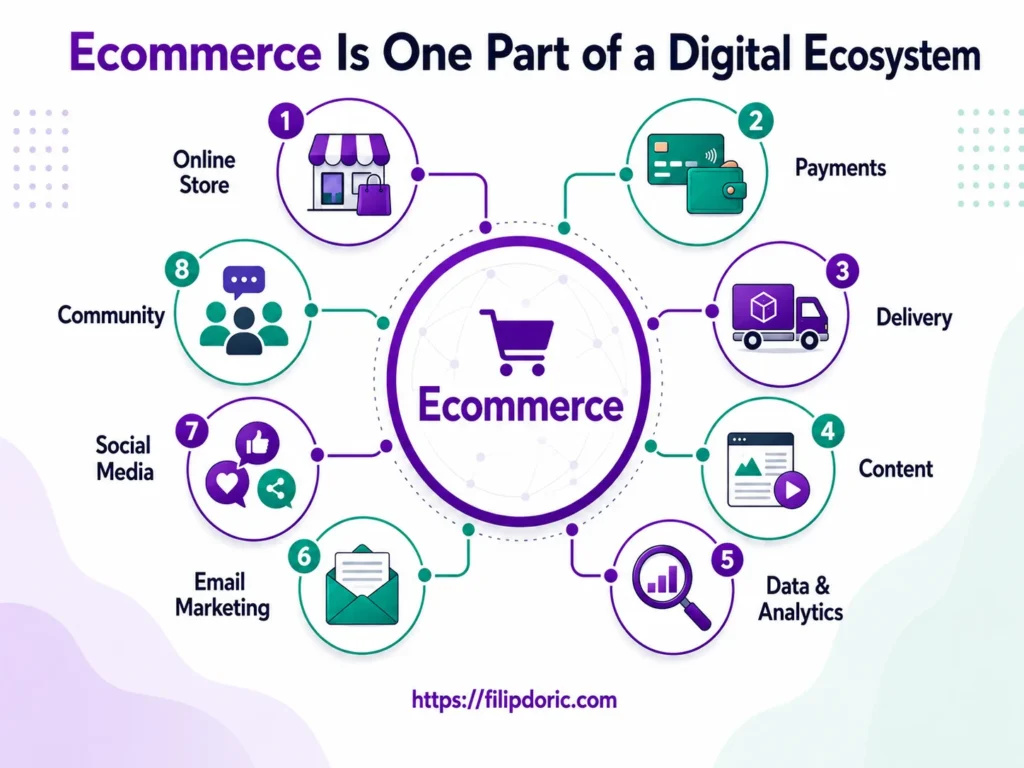
This is the part I find most interesting.
For many years, online business was built from separate pieces.
A website here.
A social network there.
A webshop somewhere else.
An email tool.
A payment processor.
A community group.
An affiliate dashboard.
A course platform.
Each tool could be useful.
But the business owner had to connect everything.
Today, more projects are trying to create integrated environments where several functions work together.
Commerce is becoming connected with:
- identity
- community
- content
- social interaction
- payments
- rewards
- business tools
- education
- distribution
In that context, ecommerce is not the entire ecosystem.
It is one important layer inside it.
The store enables transactions.
The social layer creates interaction.
The content layer creates understanding.
The community creates participation.
The business system gives people roles and structure.
This is also one reason I became interested in the SFT21 Business Concept.
The project is still in its early, pre-launch stage.
It has not yet been fully released to the market.
Its wider vision is to connect a social network, an online marketplace, a business dashboard, community participation, and a digital franchise structure inside one ecosystem.
That does not guarantee what the final result will look like.
Startup projects evolve.
Plans can change.
Execution matters more than announcements.
But the direction is worth studying.
It reflects a larger movement from isolated online tools toward connected digital environments.
Because this project is still being built, people following it today are receiving information before its wider market launch.
That early information does not mean someone should make a rushed decision.
It means there is time to observe.
Time to ask questions.
Time to understand the concept before it reaches a broader audience.
What Is Ecommerce Becoming?
The definition of ecommerce continues to evolve because the way we order continues to evolve.
A purchase may begin with a search engine.
Or a video.
Or a conversation with an AI assistant.
Or a recommendation inside a community.
Or a product shown directly inside a social feed.
The OECD’s 2025 revision specifically addressed areas such as AI-assisted transactions, digital intermediaries, subscriptions, and newer ordering channels.
This tells us something important.
Ecommerce is no longer only about visiting a website and typing card details into a checkout form.
It is becoming embedded into the wider digital experience.
The lines between content, communication, community, and commerce are becoming less clear.
For customers, that can make buying more convenient.
For businesses, it creates more opportunities—and more dependence on digital systems.
For entrepreneurs, it creates a new question:
Do you only want access to a sales channel?
Or do you want to understand the structure around that channel?
What Ecommerce Means for You
You do not need to open a large online store to benefit from understanding ecommerce.
You may be:
- a freelancer
- a creator
- a local producer
- a service provider
- an affiliate marketer
- a small business owner
- someone exploring online income
- someone interested in the future of digital business
Ecommerce affects all these paths.
A freelancer may sell packaged services.
A creator may sell a digital product.
A local producer may reach customers beyond the local market.
An affiliate may connect useful content with relevant products.
A community builder may create an environment where businesses and customers meet.
The important thing is to stop viewing ecommerce as only a technical website feature.
It is a system of exchange.
And systems work better when their parts are connected.
Final Thoughts: What Is Ecommerce Really About?
So, what is ecommerce?
At the simplest level, it is the digital buying and selling of goods and services.
But historically, its impact is much greater.
Ecommerce changed access.
It changed expectations.
It changed the power of platforms.
It gave small businesses new tools.
It connected content with transactions.
It turned websites into stores, users into sellers, and global audiences into potential markets.
Now it is entering another phase.
The next phase may not be defined by one marketplace or one webshop platform.
It may be defined by connected ecosystems where commerce works together with community, identity, communication, technology, and participation.
That is the direction I will explore in this ecommerce series.
We will look at marketplaces.
We will look at the rise of peer-to-peer selling.
We will look at owned online stores.
We will look at platforms, social commerce, and the systems behind modern digital trade.
But we will also keep asking the bigger question:
Where is online business heading next?
Follow the SFT21 Business Concept Before the Market Launch
A new team is gathering around a digital franchise concept that is still being developed before its wider market release.
I share what I learn through my newsletter, together with practical insights about digital ecosystems, ecommerce, online business, and the tools shaping this space.
Join the newsletter to receive the Free Inbox Framework and follow the SFT21 Business Concept while the story is still early.
No hype.
No pressure.
Just information, context, and a chance to understand what is being built before deciding whether it is relevant to you.
You can also join my Digital Franchise Hub Facebook group for additional updates, discussions, and early insights connected to the project.
📬 Want more tips like this?
Subscribe to get fresh blog posts directly to your inbox.