When people first hear the phrase digital ecosystem, many assume it’s simply another name for a sales funnel.
I used to think the same.
After all, both involve websites, social media, email marketing, content, and customers.
At first glance, they look very similar.
But the more I explored online business, AI, affiliate marketing, digital tools, and the evolving way people build businesses on the internet, the more I realized they are not the same thing.
In fact, a sales funnel can be part of a digital ecosystem.
But a digital ecosystem is almost never just a sales funnel.
And understanding that difference can completely change how you think about your online presence.
If you’ve already read my article about what a digital ecosystem is, you’ll know that I believe the future belongs to connected systems rather than isolated tools. In that article, I explained the concept of a digital ecosystem and why I find it so fascinating. Today, I want to go one step further and explain the difference between a sales funnel and a digital ecosystem.
Because although these two concepts often work together, they have very different purposes.
Funnel vs Sales Funnel: Are They the Same?
Before comparing the two concepts, it’s worth clearing up one common misunderstanding.
People often use the words funnel and sales funnel interchangeably.
Technically, they are not exactly the same.
A funnel is a broad term describing any structured process that guides people from one stage to another.
A sales funnel is simply one specific type of funnel designed to guide potential customers toward making a purchase.
Businesses also build:
- Recruitment funnels
- Onboarding funnels
- Lead generation funnels
- Customer success funnels
- Webinar funnels
Throughout this article, when I mention a funnel, I’m referring primarily to the sales funnel, because that’s what most online entrepreneurs mean when discussing funnels.
What Is a Digital Ecosystem?
If you’re new to the topic, here’s a simple definition.
A digital ecosystem is an interconnected network of people, technology, software, data, and digital processes that work together to create value.
Just like a natural ecosystem depends on different living organisms working together, a digital ecosystem depends on different digital components supporting one another.
Instead of operating independently, they become connected.
The Main Components of a Digital Ecosystem
A modern digital ecosystem usually includes:
- Users — customers, employees, partners, creators, and community members.
- Devices — smartphones, computers, tablets, sensors, and IoT devices.
- Software and platforms — websites, mobile apps, CRM systems, cloud services, social media platforms, and business tools.
- Data and APIs — information and connections that allow different systems to communicate with one another.
Individually, these components have value.
Together, they become something much more powerful.
If you’d like a deeper introduction to this concept, I explain it in detail in my article Digital Ecosystem Explained, where I also share why the SFT21 Business Concept attracted my attention from a digital ecosystem perspective.
Real-World Examples of Digital Ecosystems
The easiest way to understand the idea is through examples we already use every day.
Apple
The iPhone, Mac, Apple Watch, iCloud, and the App Store all work together.
They exchange information automatically.
The experience feels seamless because every component belongs to the same ecosystem.
Smart Homes
A smart lock.
Smart lights.
A thermostat.
Security cameras.
Voice assistants.
Whether powered by Google Home or Amazon Alexa, all of these devices communicate with each other to create one connected experience.
E-commerce
A customer places an order.
The online store receives it.
The warehouse prepares the shipment.
The delivery company collects the package.
The payment processor confirms the transaction.
The customer receives updates automatically.
Behind the scenes, dozens of systems work together.
That is a digital ecosystem in action.
Digital Ecosystem vs Sales Funnel
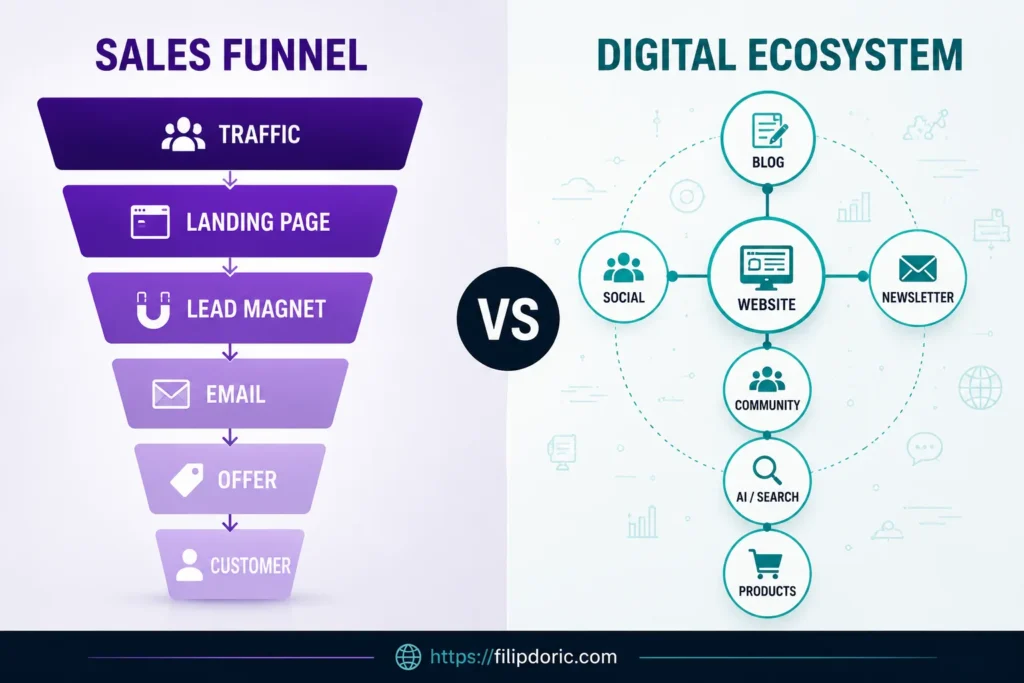
This is where many people become confused.
Both use similar tools.
Both may include:
- A website
- Landing pages
- Email marketing
- Social media
- Content
- CRM software
- Automation
So what’s the difference?
The answer is surprisingly simple.
A sales funnel focuses on guiding someone toward one specific outcome.
A digital ecosystem focuses on building an environment where people continue creating value long after that first interaction.
I like to explain it using one simple metaphor.
The City and the Store
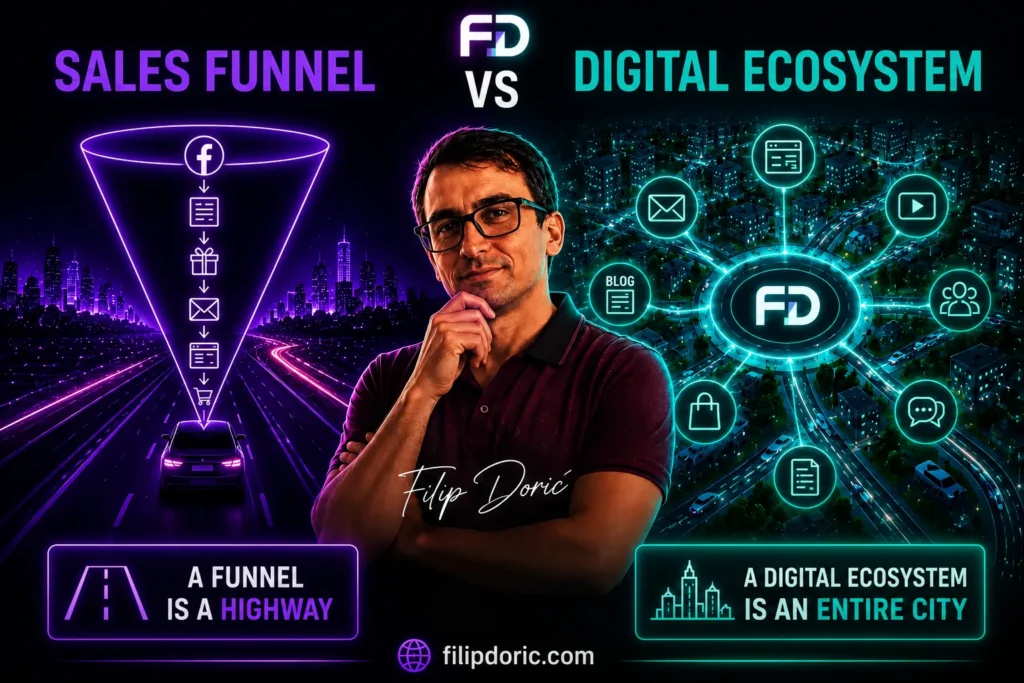
Imagine an entire city.
It has roads.
Public transport.
Shops.
Restaurants.
Schools.
Parks.
Offices.
Hospitals.
Homes.
Everything works together.
Now imagine a single store inside that city.
The store has signs pointing people toward the entrance.
It has shelves.
Products.
A checkout.
Its purpose is clear.
Help visitors become customers.
That store is your sales funnel.
The city is your digital ecosystem.
The funnel exists inside the ecosystem.
Not the other way around.
Five Important Differences Between a Digital Ecosystem and a Sales Funnel
1. A Sales Funnel Is Linear. A Digital Ecosystem Is Continuous.
A sales funnel has a clear beginning.
Someone discovers your business.
They learn more.
They trust you.
They buy.
Mission accomplished.
A digital ecosystem doesn’t end with the purchase.
Customers can continue reading your blog.
Following your social media.
Watching your videos.
Opening your newsletters.
Joining your community.
Referring other people.
Returning months later.
The relationship continues.
2. A Sales Funnel Focuses on Transactions. A Digital Ecosystem Focuses on Long-Term Value.
Funnels are excellent at converting visitors into customers.
That’s exactly what they’re designed to do.
A digital ecosystem asks a much bigger question.
How can we continue helping people after the purchase?
Trust.
Education.
Community.
Support.
Content.
Partnerships.
These all become part of the experience.
3. One Digital Ecosystem Can Contain Many Sales Funnels
This is another important difference.
A company rarely has just one funnel.
It may have:
- A product sales funnel.
- A lead generation funnel.
- A recruitment funnel.
- A partner funnel.
- A webinar funnel.
They all use the same website.
The same CRM.
The same analytics.
The same content.
The same infrastructure.
The same ecosystem.
4. A Sales Funnel Belongs to Marketing. A Digital Ecosystem Belongs to the Entire Business.
A sales funnel mainly supports marketing and sales.
A digital ecosystem includes everything.
Customer support.
Internal communication.
Data management.
Automation.
Payments.
Business operations.
Community.
Technology.
It connects departments that customers may never even see.
5. Campaigns End. Ecosystems Continue Growing.
Marketing campaigns come and go.
Funnels can change.
Landing pages can be redesigned.
Ads can stop running.
A digital ecosystem keeps evolving.
Every new article strengthens your website.
Every newsletter builds trust.
Every social media conversation creates another connection.
Every satisfied customer adds to your reputation.
That value compounds over time.
Why This Difference Matters More Than Ever
The internet has changed.
Years ago, simply creating a Facebook page felt enough.
Later, everyone talked about websites.
Then funnels became the solution.
Today, I believe something even bigger is happening.
Everything is becoming connected.
Your website.
Your blog.
Your newsletter.
Your YouTube channel.
Your social media profiles.
Your community.
Your AI tools.
Your CRM.
Your automation.
Your search visibility.
Instead of treating these as separate projects, more creators and businesses are beginning to see them as parts of one connected system.
That system is a digital ecosystem.
Your Digital Ecosystem Is Like Your Goalkeeper
One phrase has become increasingly popular lately.
Goalkeeper.
Think about your business the same way.
A great goalkeeper doesn’t score every goal.
Instead, they protect the team when unexpected situations happen.
Your digital ecosystem works in a similar way.
Algorithms change.
Social platforms lose popularity.
Advertising costs increase.
AI changes how people search.
But if you’ve built your own website, your own newsletter, your own content library, and your own community, you still have something that belongs to you.
Your digital ecosystem becomes your goalkeeper.
It protects your long-term online presence.
It gives your business stability while the internet continues evolving.
How My Thinking Changed
A few years ago, I mainly thought about individual tools.
How do I get more visitors?
How do I increase conversions?
How do I grow my email list?
Today, I ask different questions.
How do these tools work together?
How does my website support my newsletter?
How does my blog strengthen my SEO?
How do social media platforms introduce people to my content?
How can AI help people discover my articles?
How do all these elements create one connected experience?
That shift completely changed how I approach online business.
I no longer think about isolated platforms.
I think about connected systems.
Where the SFT21 Business Concept Fits In
One of the reasons I became interested in the SFT21 Business Concept is precisely because it approaches online business from the perspective of a digital ecosystem.
Rather than focusing on a single tool or one isolated opportunity, the long-term vision is to connect multiple digital components into one integrated environment.
That’s one of the ideas I explored in my earlier article about the SFT21 Digital Ecosystem.
Whether you’re interested in SFT21 or simply exploring how modern online businesses evolve, understanding the broader concept of a digital ecosystem makes everything easier to understand.
Sales Funnels Still Matter
After reading this article, you might think I’m against sales funnels.
Not at all.
A well-designed sales funnel is still one of the most effective ways to guide potential customers toward a product or service.
Funnels work.
They solve real problems.
They increase conversions.
But they should not become your entire business strategy.
Think of them as one important part of something much bigger.
Final Thoughts
If I had to summarize everything in one sentence, it would be this:
A sales funnel helps strangers become customers. A digital ecosystem helps customers become long-term members of your story.
I believe this way of thinking will become increasingly important over the next few years.
Search engines are changing.
Artificial intelligence is changing how people discover information.
Social media platforms continue evolving.
Communities matter more than ever.
Trust takes longer to build.
That’s why I believe the businesses that succeed in the future won’t simply build better campaigns.
They’ll build better digital ecosystems.
Not because it’s the latest buzzword.
But because connected systems create more value than disconnected tools ever could.
And perhaps that’s the biggest lesson I’ve learned on my own digital journey.
Build more than a funnel.
Build an ecosystem.
Your future self—and your future business—will thank you.
Want to Learn More About Digital Ecosystems?
If you’re interested in digital ecosystems, online business, AI, affiliate marketing, digital tools, organic marketing, and the ideas shaping the future of the internet, I invite you to join my newsletter.
I regularly share new articles, practical insights, and observations from my own journey exploring connected digital systems and emerging business concepts.
Because the future of online business isn’t just about selling.
It’s about building something people genuinely want to come back to.
📬 Want more tips like this?
Subscribe to get fresh blog posts directly to your inbox.