

Maybe you want to earn some additional income online.
But you don’t have a product.
You don’t have thousands of dollars to invest in a new project.
You don’t want to build an ecommerce store, deal with inventory, or spend months creating something before you can make your first sale.
Or maybe you have already explored a few different ways to make money online and nothing really clicked.
There is another option.
You can recommend products and services created by other companies – and earn a commission when your recommendation leads to a sale.
That is affiliate marketing.
And if this is the first time you are hearing about it, this affiliate marketing for beginners guide will show you how the model actually works, why companies use it, why customers buy through affiliates, and how you can start without creating your own product.
No magic.
No guaranteed income.
Just a surprisingly simple business model that has grown into a multi-billion-dollar industry.
What Is Affiliate Marketing?
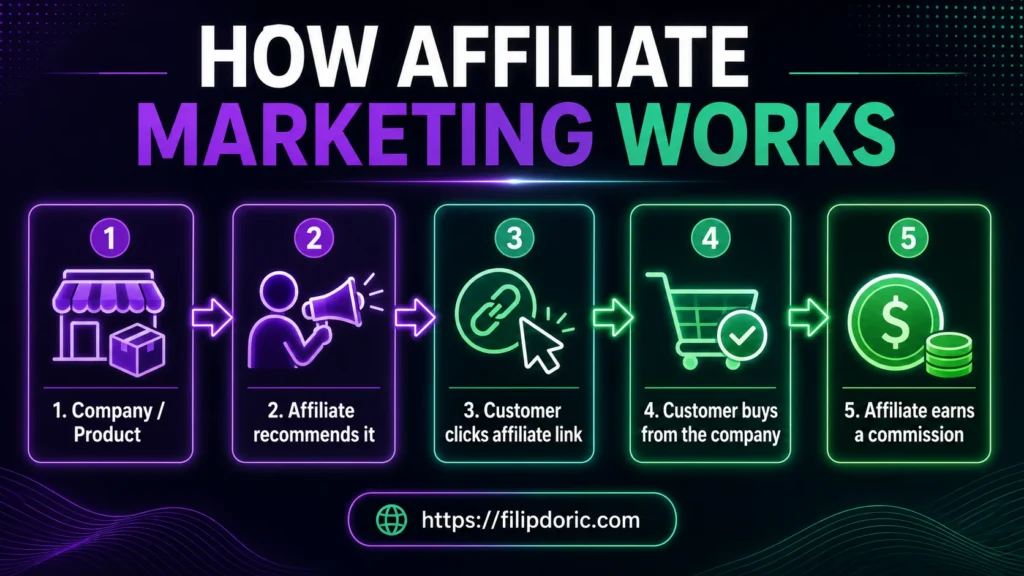
Affiliate marketing is a performance-based partnership between a company and a person, publisher, creator, website owner, or other partner who recommends that company’s products.
You join an affiliate program.
The company gives you a unique tracking link.
You recommend its product or service.
Someone clicks your link and makes a qualifying purchase.
You receive a commission.
That is the basic cycle:
Recommend → Customer buys → You earn a commission
You are essentially helping a company find a customer.
The company rewards you when that introduction creates a result.
And that last part is important.
In most affiliate programs, the company does not pay you simply because you posted something.
It pays when your referral creates a specific action, usually a purchase.
That is one of the reasons the model is attractive to companies as well.
Affiliate marketing has become a major global industry; current estimates place its value in the tens of billions of dollars, while major ecommerce companies continue to operate large affiliate programs.
This isn’t some obscure internet trick.
It is a real marketing channel.
You Probably Already Recommend Products for Free
Think about the last few weeks.
Maybe you told a friend about a great Netflix series.
Someone asked you where you bought your shoes.
You recommended a restaurant.
A friend asked which laptop you use.
Someone wanted to know which hosting company you use for your website.
You discovered a useful app and sent the link to someone.
We do this constantly.
And usually, we do it for free.
Why?
Because recommendations are a normal part of human behaviour.
When we find something useful, we talk about it.
Affiliate marketing simply adds a commercial relationship to that process.
Imagine telling your friend:
“I watched this film last weekend. You should watch it.”
Your friend already had Netflix.
The movie was already there.
But they only watched it because you brought it to their attention.
That is the part many people miss when they first discover affiliate marketing.
You don’t always create demand from nothing.
Sometimes you simply help someone discover the right product at the right moment.
Why Would Someone Buy Through Me Instead of Going Directly to the Company?
This is probably one of the best questions a beginner can ask.
If a company already has its own website, why does it need you?
Why wouldn’t the customer simply go there directly?
Because companies have products.
But customers have questions.
Imagine you are looking for a new pair of running shoes.
The company can tell you:
the materials,
the price,
the specifications,
the sizes,
the technology,
and everything else about the product.
But you may still search:
“Are these shoes good for everyday walking?”
“Are they comfortable after six months?”
“Are they worth the price?”
“How do they compare with another model?”
That is where creators, bloggers, reviewers and other affiliates can provide something the product page cannot always provide:
context.
A good affiliate does not simply say:
BUY THIS.
A good affiliate helps someone decide.
That may be through a review.
A comparison.
A tutorial.
A video.
A blog post.
A personal experience.
Or simply a useful recommendation.
The customer still purchases from the company.
You simply helped them get there.
Why Do Major Companies Want Affiliate Partners?
Turn the question around.
Instead of asking why someone would buy through you, ask:
Why do so many successful companies offer affiliate partnerships in the first place?
They do it because referrals can bring them additional customers.
Imagine a company trying to reach one million potential customers entirely through its own advertising.
That can become expensive.
Now imagine thousands of bloggers, creators, publishers and niche websites talking about its products.
The company gains distribution.
The affiliate gains an opportunity to earn.
And the customer may discover something useful.
That is why affiliate marketing can work for all three sides.
Company → gets a customer
Affiliate → earns a commission
Customer → discovers a product that solves a problem
Of course, it only works well when the recommendation is genuine.
And we’ll come back to that.
You Don’t Need Your Own Product
This is one of the biggest advantages of affiliate marketing for beginners.
Creating a product takes work.
If you create a physical product, you may need manufacturing, inventory, logistics, packaging, payments and customer support.
If you create a digital product, you still need to create it, host it, sell it, update it and support customers.
With affiliate marketing, someone else has already done that work.
You focus primarily on:
finding the right audience and making useful recommendations.
The merchant usually takes care of:
- the product
- the checkout
- payment processing
- shipping or digital delivery
- refunds
- customer support
- inventory
You send the customer to the merchant through your affiliate link.
If the sale qualifies under the program’s rules, you receive your commission.
Affiliate Marketing vs. Dropshipping
People sometimes confuse affiliate marketing with dropshipping.
They are not the same.
With dropshipping, you normally operate your own online store.
The customer buys from your store, while another supplier may handle the physical fulfilment.
You are much closer to being the retailer.
With affiliate marketing, the customer normally leaves your content and completes the purchase directly with the merchant.
You don’t need to create your own shop.
You don’t set the product price.
You don’t process the payment.
You don’t ship the product.
That makes affiliate marketing simpler to enter.
The trade-off is that you also have less control and usually receive only part of the sale as commission.
Neither model is automatically better.
They are simply different.
How Do Affiliate Links Actually Work?
Once a company approves you as an affiliate, it normally gives you a special link.
That link contains an identifier connected to your affiliate account.
For example, instead of sending someone to:
company.com/product
your link might contain additional tracking information.
When someone clicks it, the affiliate system records that referral.
If that person makes a qualifying purchase according to the program’s rules, the commission can be credited to you.
Different programs have different rules.
Some track referrals for a short period.
Others use longer attribution windows.
Commission percentages can vary dramatically.
Some pay a percentage of the sale.
Some pay a fixed amount.
Some products may not qualify at all.
This is why you should always read the terms of the affiliate program you join.
Is It Expensive to Become an Affiliate?
Often, no.
Many affiliate programs are free to apply for.
Amazon Associates, for example, currently allows eligible creators, publishers and bloggers to apply to its program and earn commissions from qualifying purchases.
But I would not tell you that every company will automatically approve everyone.
Some programs have requirements.
They may want you to have:
a website,
an established social profile,
relevant content,
a particular audience,
or a minimum level of activity.
Some programs are available only in certain countries.
Others may review your application manually.
So the correct expectation is:
Many affiliate programs are relatively easy and inexpensive to apply for, but acceptance depends on the individual program.
And you certainly don’t need to spend thousands of dollars just to understand how affiliate marketing works.
You Don’t Need to Promote “Make Money Online” Programs
This is another important point.
When people first encounter affiliate marketing online, they sometimes get a distorted picture of the industry.
They see someone selling a course about affiliate marketing.
That person teaches others to promote the same course.
Those people then teach more people how to promote the course.
And suddenly it looks like affiliate marketing is just people selling affiliate marketing to other affiliate marketers.
It isn’t.
That is only one tiny corner of a much larger industry.
Real affiliate marketing can involve:
software,
hosting,
WordPress themes,
clothing,
electronics,
books,
travel,
business tools,
beauty products,
sports equipment,
home products,
online services,
digital products,
and thousands of other categories.
You don’t have to teach people how to make money online.
You can simply help people choose products.
In fact, that is the affiliate marketing I find most natural.
My Own Approach: Recommend What You Actually Know

I have always made recommendations.
I still do.
Even while much of my current attention is focused on a completely different startup project, affiliate marketing still makes sense to me.
Why wouldn’t it?
Imagine I have tested five different hosting providers over the years.
Eventually, I find one that gives me the combination I want:
good performance,
reasonable pricing,
useful features,
and an experience I am comfortable recommending.
If someone asks me which hosting provider I use, why wouldn’t I recommend it?
And if that company happens to offer an affiliate partnership, why wouldn’t I use my affiliate link?
The same applies to WordPress themes.
I’ve worked with websites.
I’ve created websites for friends and worked with clients through freelance platforms.
That means I’ve actually used different tools.
If I find a WordPress theme that solves a problem particularly well, I can explain why I use it.
That is much stronger than randomly finding a product with a high commission and pretending to love it.
Your Commission Should Not Decide Your Opinion
This principle is worth remembering:
First decide whether you would recommend the product. Then check whether it has an affiliate program.
Not the other way around.
There will always be products offering attractive commissions.
That doesn’t mean you should promote them.
If you recommend something poor because the commission looks good, you may earn once.
But you lose something much more valuable:
trust.
And trust compounds.
If someone reads one of my recommendations and has a good experience, they are more likely to trust the next article.
If I repeatedly recommend things I don’t know, eventually people notice.
Affiliate marketing works much better when the recommendation comes first and the commission comes second.
Choose a Niche You Can Actually Understand
You don’t need to become an expert in everything.
In fact, you shouldn’t.
Pick an area where you can realistically create useful content.
If you love fitness, you may talk about equipment, apps or products you actually use.
If you’re interested in technology, perhaps software or gadgets.
If you build websites, hosting, themes, plugins and online tools make sense.
If you travel frequently, travel-related products may make sense.
If you love books, start there.
The best niche is not always the niche with the biggest theoretical commission.
It is often the niche where you can continue creating useful content without pretending to be someone you’re not.
Where Can You Promote Affiliate Products?
Almost anywhere people discover information.
A blog is one obvious example.
You can publish:
product reviews,
tutorials,
comparisons,
“best of” guides,
case studies,
and personal recommendations.
But a website is not the only option.
You can also use:
social media,
YouTube,
email,
newsletters,
communities,
and other content platforms.
The important part is not simply placing links everywhere.
The important part is creating a reason for someone to click.
Content first. Affiliate link second.
Do You Need Thousands of Followers?
No.
A large audience can help.
But audience size alone doesn’t determine whether someone buys.
Imagine two people.
One has 100,000 followers and posts:
“Best hosting! Buy here!”
The other has a small website but publishes a detailed article:
“I tested five hosting providers. Here is what happened, what I liked, what annoyed me, and which one I still use.”
Which recommendation would you trust more?
Affiliate marketing is not only about reach.
It is about relevance and intent.
One person actively searching for the right solution can be more valuable than thousands of people casually scrolling past your post.
Can Affiliate Marketing Become Additional Online Income?
Yes.
That is one reason I think affiliate marketing for beginners deserves more attention.
You don’t necessarily need to quit your job.
You don’t need to immediately create a company with employees.
You don’t need to invest large amounts of money into inventory.
You can start small.
One useful article.
One product you know.
One recommendation.
Then another.
Over time, you may create a library of useful content that continues bringing visitors to your recommendations.
That does not mean affiliate marketing is effortless passive income.
Content has to be created.
Traffic has to come from somewhere.
Products change.
Programs change.
Links break.
Competition exists.
And nobody can guarantee that someone will buy.
But the entry barrier can be relatively low compared with many other business models.
That makes it interesting for someone who wants to begin exploring online income without making a large upfront investment.
A Simple Affiliate Marketing for Beginners Plan
If I were starting today, I would keep it very simple.
1. Choose one area you already understand.
Don’t start with ten niches.
2. Write down five products or services you genuinely use.
Forget commissions for a moment.
What would you recommend anyway?
3. Check whether those companies offer affiliate programs.
Look for terms such as Affiliate Program, Partners, Associates or Referral Program on their websites.
4. Read the conditions before joining.
Understand commissions, attribution, allowed promotion methods and payout requirements.
5. Create useful content.
Answer real questions people have about the product.
6. Include your affiliate link naturally.
Do not turn every paragraph into a sales pitch.
7. Clearly disclose the affiliate relationship.
People should know that you may receive a commission.
8. Keep learning from real results.
Which content attracts readers?
What questions do they ask?
What actually gets clicks?
Then improve.
That is how experience develops.
Don’t Start by Asking “How Much Can I Earn?”
I understand why people ask.
But there is a better first question:
Can I become useful enough that people trust my recommendations?
Because affiliate income can vary enormously.
Someone may earn nothing.
Someone may make occasional commissions.
Someone else may eventually build a substantial affiliate business.
There are too many variables to promise an outcome.
Audience.
Traffic.
Niche.
Content quality.
Commission structure.
Product price.
Conversion rate.
Trust.
Competition.
Consistency.
Affiliate marketing gives you a mechanism to earn.
It does not guarantee that people will buy.
Start With One Good Recommendation
Affiliate marketing can become complicated.
Funnels.
Analytics.
SEO.
Conversion rates.
Email automation.
Tracking.
Content strategy.
Paid advertising.
All of that can come later.
For now, remember what the model actually is.
You know something.
Someone else needs that information.
You recommend a product that may help them.
The company makes the sale.
You receive a commission if the referral qualifies.
That’s affiliate marketing.
And perhaps the most interesting part is that you may already have the first product to recommend.
You just haven’t thought about your recommendations that way before.
Want to Keep Learning?
I write about affiliate marketing, online business, digital tools, websites, ecommerce and the wider changes happening across the digital world.
Not every model is right for everyone.
And you don’t need to jump from one opportunity to another every week.
Sometimes the best thing you can do is simply understand your options first.
If you want more practical ideas like this, join my newsletter.
I’ll send you new articles, tools and observations that can help you understand online business one step at a time.
Learn first. Build second.
The internet will still be here tomorrow.
📬 Want more tips like this?
Subscribe to get fresh blog posts directly to your inbox.



can you help me?”